
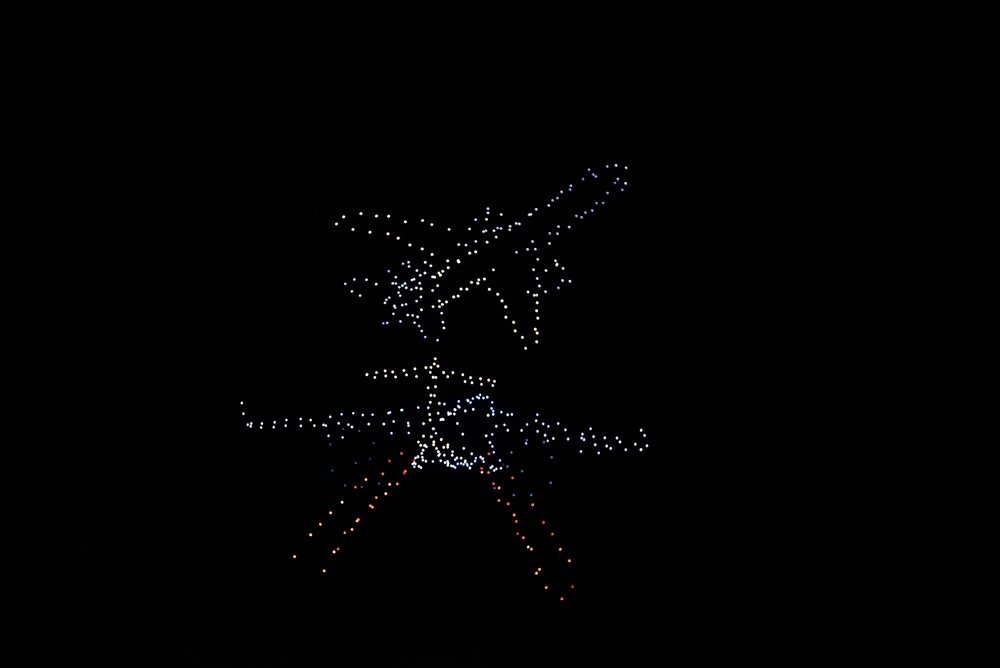
Howard County, Maryland spent months planning a 12-minute drone light show as the centerpiece of HoCo250, its Independence Day celebration marking the nation's 250th anniversary. The show, produced by Sky Elements, never left the ground. Days before the Fourth of July, a Federal Aviation Administration temporary flight restriction tied to a National Special Security Event in Washington, D.C. expanded to swallow Howard County's airspace entirely, forcing organizers to scrap the display while the celebration's traditional fireworks show went on as planned.
The cancellation is a small, local story with a much larger implication: as drone light shows increasingly substitute for fireworks at civic celebrations nationwide, the commercial operators running them are exposed to a regulatory risk that fireworks companies simply do not face — a VIP-movement security perimeter that can appear on days' notice, cover dozens of miles, and carry FAA fines for anyone who flies inside it anyway.
What Grounded the Show
The restriction came from the Salute to America 250 National Special Security Event in Washington, D.C., which triggered additional flight restrictions layered on top of the region's already-restricted Special Flight Rules Area and Flight Restricted Zone around Reagan National Airport. According to the FAA Safety Team's official notice, the restrictions were in effect July 4, 2026 through the advisory's July 5, 2026 expiration, and they explicitly prohibited model aircraft, unmanned aircraft (UAS), aerobatic maneuvers, glider operations, and parachute operations anywhere within the SFRA/FRZ. The notice also suspended all previously granted flight waivers to operate within that zone, except for specific designated categories.
That blanket suspension of waivers is the detail that mattered most for Sky Elements. Commercial drone light shows typically fly under FAA waivers that authorize otherwise-restricted operations, such as flying at night or operating multiple aircraft as a swarm beyond the normal limits of Part 107. When the agency temporarily voided those waivers across a 30-nautical-mile radius around Reagan National, tied to VIP movement and military flyovers associated with the Salute to America event, it removed the legal basis for the show to fly at all, regardless of how far Columbia sits from the National Mall.
Jon Schiner, owner of BQ Drone Guy, described the calculus bluntly to WMAR-2 News: if a show falls within those restriction rings, it's a no-go, full stop — and the FAA can impose fines on operators who fly anyway. There was no gray area to negotiate and no local exception to request. Howard County Recreation and Parks confirmed the show would be rescheduled later this summer.
Fireworks Flew, Drones Didn't
The starkest illustration of the regulatory gap came from what still happened that night. Columbia's traditional fireworks display, scheduled for 9:15 to 9:30 p.m., proceeded as planned even as the drone show was scrubbed. Pyrotechnics fall outside drone-specific FAA restrictions and are regulated instead through separate state and local fire-safety and airspace notice processes that were unaffected by the TFR expansion. The Baltimore Chronicle's coverage confirmed the same 30-nautical-mile perimeter that grounded the drones left the fireworks show untouched.
For a celebration built around two competing forms of aerial spectacle, the result was a real-time comparison of regulatory exposure: one technology proceeded under decades-old, well-understood fire-code frameworks, while the other was subject to a federal no-fly order that can materialize with a security calendar entry in Washington, more than 30 miles away.
Why It Matters
Drone light shows have become one of the fastest-growing segments of the commercial UAS industry, marketed to municipalities, festivals, and corporate clients as a quieter, wildfire-safer, and increasingly cost-competitive alternative to fireworks. That growth has been built partly on the assumption that once an operator secures the necessary FAA waivers, a show is a show — a scheduling and choreography problem, not a legal one.
The HoCo250 cancellation shows that assumption doesn't hold when a show's airspace overlaps, even at a great distance, with a National Special Security Event. Unlike a standard TFR tied to a single fixed event, the Salute to America 250 restriction was explicitly built around VIP movement and military flyover activity, meaning its footprint and duration were tied to security operations the public and even nearby event organizers had limited visibility into. The FAA notice's blanket suspension of existing waivers — rather than a case-by-case review — meant there was no appeal path available to a local operator once the restriction was published.
That leaves drone-show operators and the municipalities that hire them carrying a form of regulatory risk that fireworks vendors don't: a federally imposed grounding, arriving on short notice, that can cancel a fully paid-for, fully permitted show outright, with fines awaiting anyone who tests the boundary. As drone shows scale up around high-profile national dates — Independence Day chief among them, especially in a year built around 250th-anniversary programming across the country — that risk is likely to recur wherever local celebrations sit inside the blast radius of federal security operations elsewhere. Howard County's experience is a preview of a friction point the commercial drone-show industry will need to build into its planning, insurance, and client contracts going forward.
