
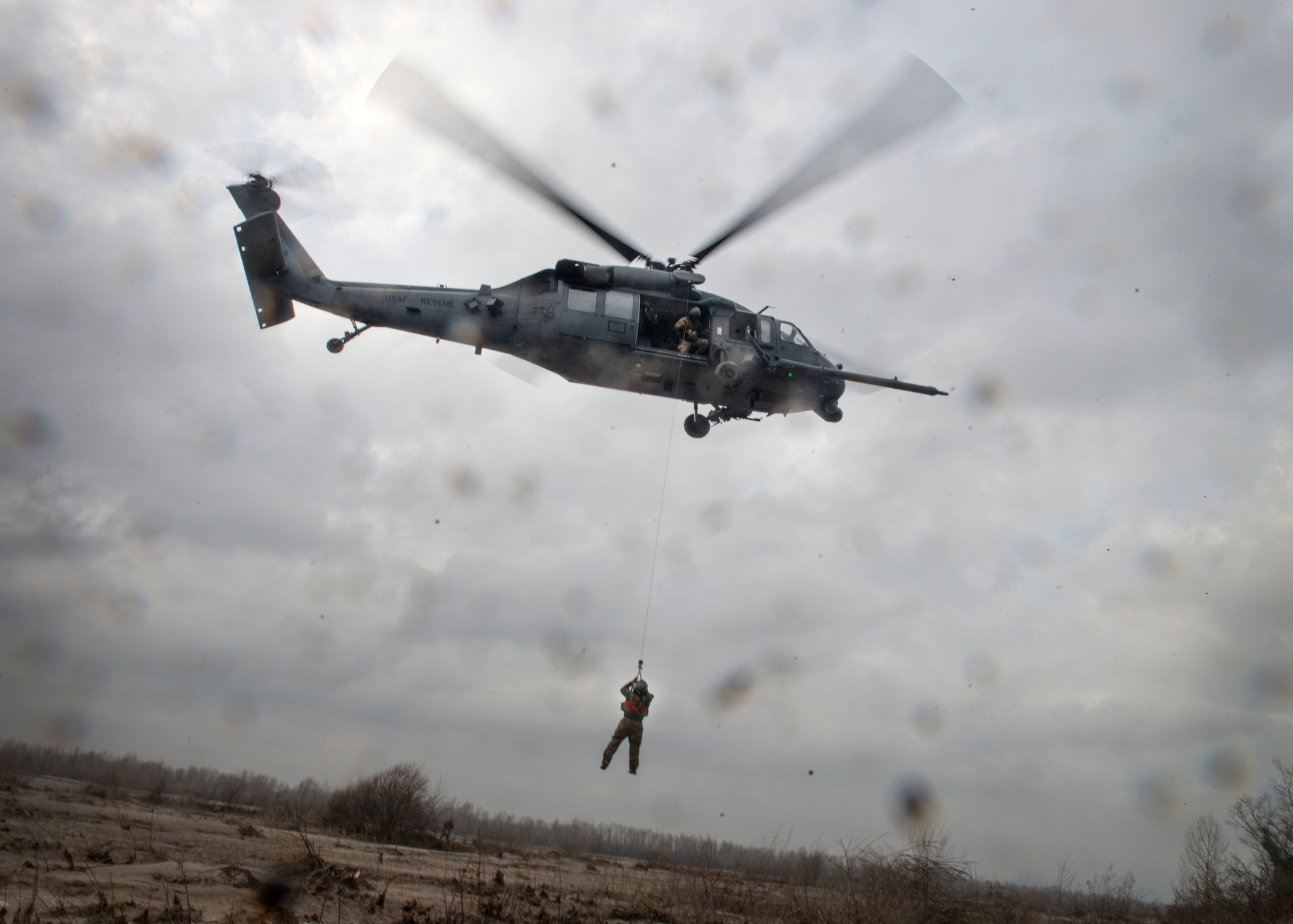
The 31st Contracting Squadron at Aviano Air Base, Italy, published a solicitation on September 4, 2026, seeking four Echodyne EchoShield counter-drone radars, a Rapid Deployment Kit capable of networking up to four of the units together, and three years of sustainment support. The customer is the 57th Rescue Squadron, which flies the HH-60W Jolly Green II combat search-and-rescue helicopter. Vendors have until September 11 to submit quotes.
Buried in the solicitation is a line that contracting officers don't usually volunteer this bluntly: "Funds are not presently available for this effort. No award will be made under this solicitation until funds are available." The Air Force wants the radars. It has priced them, specified them by name, and set a bid deadline. It just hasn't secured the money to pay for them.
What's Actually Being Bought
EchoShield is Echodyne's counter-UAS radar line, built to the Sensor Open Systems Architecture (SOSA) standard — a Department of Defense hardware/software framework meant to let sensors from different vendors plug into a common base-defense architecture rather than each requiring bespoke integration. The radar is not a new or unproven product for the Air Force: it's the same sensor line at the center of Trust Automation's $490 million Air Force indefinite-delivery/indefinite-quantity (IDIQ) contract, awarded December 17, 2025, for Trust Automation's RD-SUADS counter-drone system.
Under that IDIQ, EchoShield serves as the primary detection radar for RD-SUADS, which is built to detect, classify, and track small UAVs at ranges of roughly 3 to 4.5 kilometers, using recursive neural network machine-learning models for drone classification. The same underlying radar has already been built out into two additional platform configurations under that program — the fixed-site FS-SUADS and the expeditionary EX-SUADS — suggesting the Air Force is treating EchoShield less as a one-off purchase and more as a standard building block it intends to keep buying.
The Aviano solicitation fits that pattern, but with a twist: it isn't a task order flowing down from the Trust Automation IDIQ vehicle. It's a separate, base-level solicitation, initiated by the wing's own contracting squadron on behalf of one flying unit. That distinction matters, because it says something about how fast demand for this specific radar is spreading through the Air Force's installation-level buying process — ahead of, or parallel to, the enterprise contract vehicle built to supply it.
Why a Rescue Squadron, and Why Now
The 57th Rescue Squadron's HH-60W helicopters exist to recover downed aircrew, often flying low, slow, and into contested or unpredictable airspace — exactly the flight profile most vulnerable to a cheap quadcopter loitering near a base perimeter or a helicopter pad. Small drones have become a standard nuisance and, increasingly, a standard threat at U.S. installations in Europe and the Middle East, whether flown by hobbyists, criminal surveillance operators, or hostile actors probing base security. A helicopter unit whose mission depends on predictable, secure takeoff and landing windows has an obvious institutional interest in knowing what's flying nearby before it takes off.
The Rapid Deployment Kit specified in the solicitation — hardware that links up to four EchoShield units into a single networked picture — points to a base-perimeter or multi-node detection layout rather than a single fixed radar covering one approach. That's consistent with how counter-UAS systems are typically arrayed around an airfield: overlapping coverage rather than a single sensor with a blind spot.
The Money Problem
The explicit funding disclaimer in the solicitation isn't necessarily unusual as a contracting mechanism — services sometimes issue solicitations ahead of appropriated funds arriving, so a vendor is already lined up and priced when money does show up, shortening the timeline to award. But it does mean nothing here is guaranteed. The September 11 quote deadline establishes who could deliver at what price; it does not establish that anyone will be paid to do so, or when.
That gap between demand and appropriated funding lines up with commentary from Echodyne's own leadership. In a July 2026 interview, Echodyne CEO Eben Frankenberg described the global counter-drone market as "red hot," saying demand for affordable short-range radar could grow tenfold by 2030 and that "the only way to counter mass is with mass." The Aviano solicitation reads as a small-scale instance of that same demand curve: a single squadron at a single overseas base, working through its own contracting shop, trying to get counter-drone radar fielded on its own timeline — even before the funding to do so is confirmed.
Why It Matters
The Aviano solicitation is a small dollar-value action, but it's a useful signal of how counter-UAS procurement is actually happening across the Air Force right now: not primarily through one large program methodically fielding a single system base by base, but through parallel, overlapping paths — an enterprise IDIQ like Trust Automation's $490 million vehicle running alongside individual installations independently soliciting the same underlying radar for their own units. Echodyne's EchoShield ends up showing up in both channels because it's already validated to the SOSA standard the Air Force wants and already carries a service track record from the RD-SUADS program.
The funding caveat is the more interesting detail for anyone tracking how urgently the Air Force actually views small-drone threats at installations like Aviano. A combat search-and-rescue squadron whose helicopters routinely fly into and out of a fixed base is precisely the kind of unit that benefits most from early warning against a nuisance drone or a more deliberate probe near the flight line. That the wing is pushing this solicitation out before funding is secured suggests the requirement is considered real and near-term — the bureaucracy just hasn't caught up with the money yet. Whether it does, and how quickly, will say something about how the Air Force is prioritizing base-level counter-drone defense against everything else competing for the same appropriated dollars.
Sources
- U.S. Air Force to buy Echodyne radars for Italy rescue squadron — Defence Blog
- Echodyne announced as primary radar system for Trust Automation's RD-SUADS — Janes
- Echodyne Radar Selected for $490M US Air Force Counter-UAS Contract — DPRTE
- In 'red hot' counter-drone market, Echodyne CEO sees radar demand boom — Defense News
