
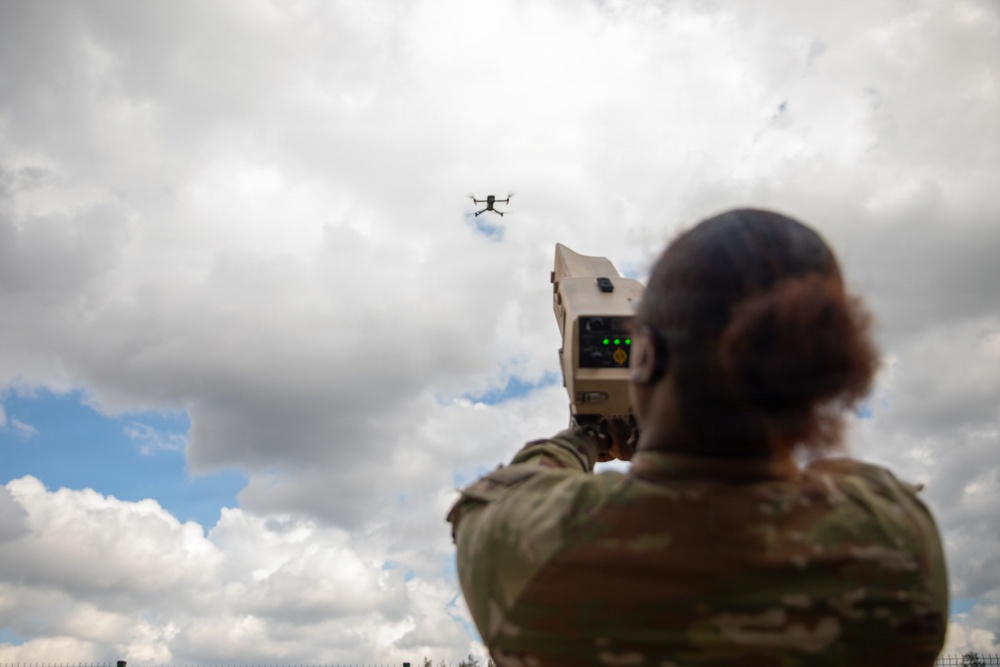
At Eurosatory 2026 in Paris, the Australian counter-drone specialist DroneShield announced something that, on paper, sounds like a logistics footnote: it has finished building a counter-UAS system in Europe instead of shipping one in from Australia. In practice, it is a deliberate move to plant a manufacturing flag on a continent that is increasingly unwilling to buy critical defense hardware made anywhere else.
In a newsroom statement dated June 15, 2026, DroneShield said its first European-produced counter-UAS system had rolled off the line through a contract-manufacturing arrangement backed by a "primarily European supply chain." The company is careful to stress that the European-built unit is not a watered-down regional variant: it claims identical performance to the systems produced in Australia. The announcement landed on the show floor at Eurosatory 2026, where DroneShield is exhibiting in Hall 6 at stand B120 and showing its RfPatrol Mk2, the AI-powered drone-detection unit pitched at both military and civilian users.
What DroneShield Actually Announced
Strip away the trade-show framing and there are three concrete claims worth isolating.
First, production location. The system was manufactured in Europe via contract manufacturing, not at DroneShield's Australian facilities. That is the headline and the genuinely new part.
Second, the supply chain. DroneShield describes it as "primarily European," language that matters enormously to government buyers writing procurement rules around domestic content. It is a qualified phrase — "primarily," not "entirely" — and the company has not, in the materials at hand, broken down which components or subassemblies remain sourced from outside the region.
Third, performance parity. The company states the European-built system delivers identical performance to the Australian-built product. For a buyer, that is the reassurance that localizing production does not mean accepting a second-tier capability.
"This milestone reflects our commitment to supporting allied nations with locally produced, highly capable counter-UAS systems," said Chief Commercial Officer Louis Gamarra in the company's announcement. In a separate comment reported by Defence Connect, Gamarra framed the customer pitch more directly: "Customers in Europe can now access the same trusted DroneShield technology, built with a supply chain aligned to regional industrial priorities."
Why "Sovereign" Is the Operative Word
The phrase doing the heavy lifting here is sovereign capability — the idea that a nation should be able to produce, sustain, and control the defense systems it depends on without relying on a foreign supply chain that a crisis, an export restriction, or a shipping bottleneck could sever.
DroneShield ties this milestone explicitly to the European Union's Readiness 2030 framework, the bloc's push to scale up defense-industrial capacity and reduce dependence on suppliers outside the region. Defence Connect, reporting on June 16, 2026, noted that the European production effort follows a manufacturing contract the company signed earlier in 2026 and aligns with that Readiness 2030 agenda. In other words, this was not an opportunistic one-off build; it is the first visible output of a contract structured around European production from the start.
The company has been laying the groundwork on the corporate side as well. DroneShield established its European headquarters in Amsterdam, giving it a regional base from which to coordinate sales, support, and now manufacturing partnerships. The combination — a European HQ plus European-built hardware plus a regionally aligned supply chain — is precisely the profile that European defense ministries increasingly demand when they write counter-drone requirements.
The Backdrop: Counter-Drone Demand Is Not Theoretical
Counter-UAS is no longer a niche line item, and DroneShield's own deployments illustrate why the localization push has urgency. According to Defence Connect, DroneShield systems are currently deployed supporting police in Kansas City during the FIFA World Cup — a reminder that the threat model now spans far beyond the battlefield to stadiums, public events, and dense urban environments where a cheap quadcopter can become a security incident.
That dual-use reality runs straight through DroneShield's product framing. The RfPatrol Mk2 it is showing at Eurosatory uses AI-powered detection and is explicitly marketed for both military and civilian sectors. Police forces protecting a World Cup venue and an allied military unit guarding a forward position are, increasingly, shopping from the same catalog — and increasingly, on the European side of that catalog, they want the gear stamped as locally made.
What We Don't Yet Know
The announcement is a milestone, and it should be read as one rather than as a finished industrial transformation. Several questions remain open from the available material.
The company has not disclosed the contract manufacturer it is working with, the specific European country where the unit was built, or production volumes and timelines for scaling beyond this first system. "Primarily European" supply chain is a meaningful claim, but without a content breakdown it is difficult to assess how it would measure against any given national procurement rule on domestic or EU-origin content. And "identical performance" is the company's own assertion; it has not been independently verified in the materials reviewed here.
None of that diminishes the significance of the step. It does mean the harder questions — can DroneShield scale European output, and will "primarily European" satisfy the strictest sovereignty clauses — are still ahead.
Why It Matters
European nations are rewriting their defense procurement around local production, and counter-drone systems sit near the top of the priority list because the threat is immediate, cheap to mount, and relevant to civilian as well as military security. A foreign vendor that can only ship finished units from outside the region risks being locked out of contracts that carry sovereignty or domestic-content requirements — exactly the kind of rules the EU's Readiness 2030 framework encourages.
By building its first system in Europe, DroneShield is trying to convert itself from an importer into a regional producer before competitors do the same. If it succeeds in scaling that European line, it can compete for procurements that would otherwise be closed to it. The broader signal is that the counter-UAS market is no longer just a contest over who has the best detection algorithm or jammer — it is increasingly a contest over who can prove they built the box on the right continent. For European buyers, that is a feature. For every C-UAS vendor watching from outside the bloc, it is a warning shot.
Sources
- DroneShield Expands European Sovereign Manufacturing Capability with First EU-Produced Counter-UAS Units — DroneShield Newsroom (June 15, 2026)
- DroneShield announces first European-made counter-drone technology — Defence Connect (June 16, 2026)
- European-made counter-UAS system from DroneShield set to support sovereign missions — Military Embedded Systems (June 17, 2026)
- DroneShield signs MoU with Terma focusing on C-UAS — Janes (May 6, 2026), reporting DroneShield's 11 March 2026 establishment of a C-UAS manufacturing operation in an EU country
