DroneShield exists in a market that was barely acknowledged five years ago and now commands multi-billion-dollar defense budgets. The Sydney-headquartered, ASX-listed counter-UAS specialist has spent a decade building a product line that spans from a wearable detection system clipped to a soldier’s kit to an enterprise command-and-control network linking military installations across continents. As of September 2025, the company had surpassed 4,000 total systems sold to customers across 70+ nations—a milestone that, more than any revenue figure, captures how normalized the counter-drone requirement has become.
DroneShield was founded in 2014 in Virginia and listed on the Australian Securities Exchange (ASX: DRO) in 2016. For its early years, growth was modest: the company was building a technology stack around RF sensing, artificial intelligence, sensor fusion, and electronic warfare before the strategic environment caught up with its product roadmap. The inflection point came around 2022–2023. Russia’s full-scale invasion of Ukraine turned commercial drones into standard military hardware, generating immediate and visible demand for anything that could counter them. DroneShield’s DroneGun systems were deployed by Ukrainian forces from the early days of the conflict, and the global procurement conversation shifted from “why do we need this?” to “how many do we need?”
Detect, Defeat, Connect: A Three-Tier Architecture
DroneShield’s portfolio is organized across three operational tiers, with a software layer running above all of them.
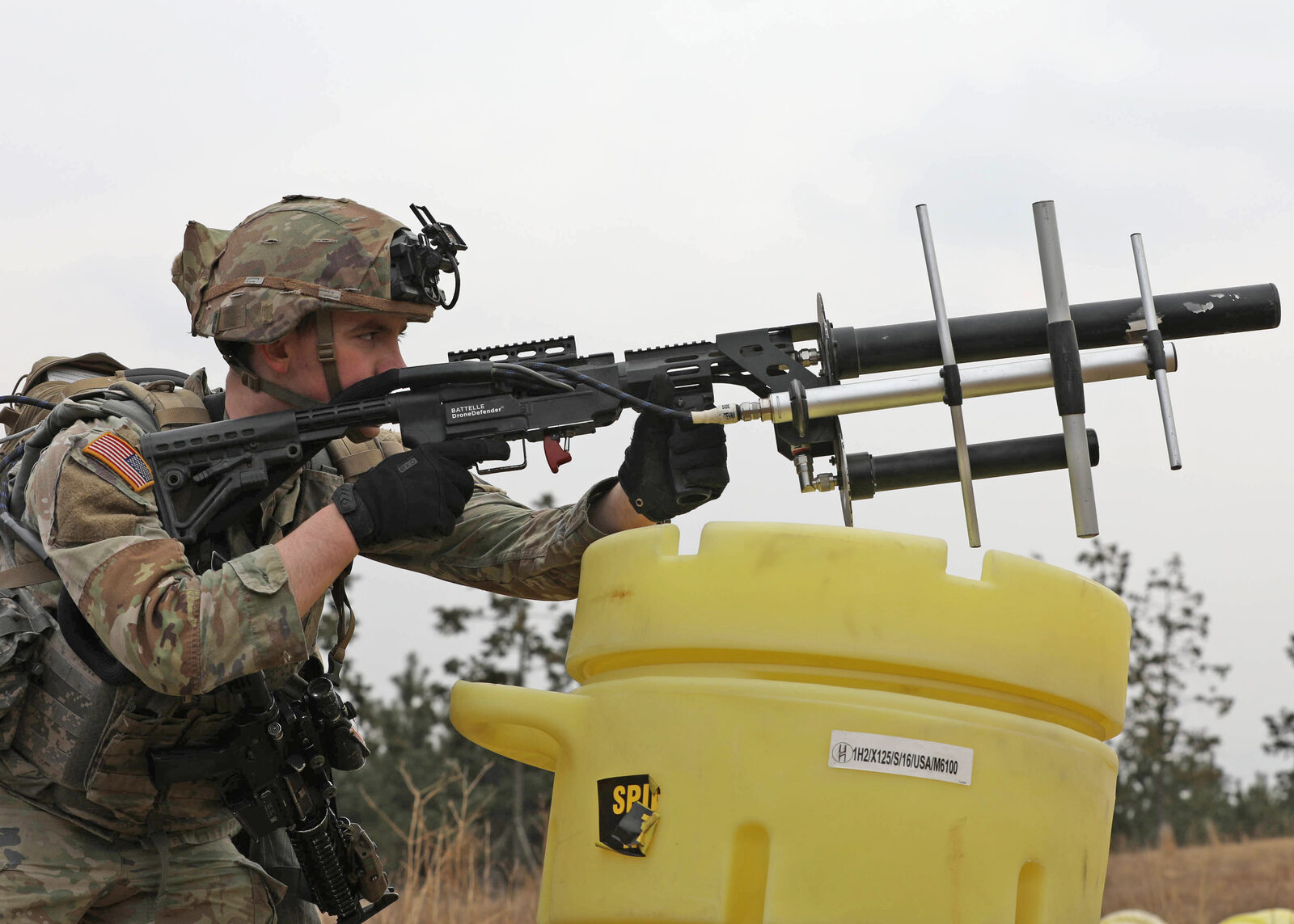
At the dismounted level, the DroneGun Mk4—an ultra-portable handheld RF countermeasure launched in April 2023—pairs with the RfPatrol Mk2, a wearable detection system. Then-CEO Oleg Vornik described the pairing directly: “The RfPatrol is a natural companion device to the DroneGun Mk4. The former detects and the latter defeats.” The design philosophy on the defeat side emphasizes operator accessibility: the ultra-portable form factor is built to be deployable by any soldier at a moment’s notice, without specialist training. An Immediate Response Kit rounds out the portable tier as a complete, rapidly deployable package.
The mobile tier centers on the DroneSentry-X Mk2, a vehicle-mounted on-the-move C-UAS system for tactical operations. The fixed-site tier is anchored by DroneSentry, a modular detection suite incorporating RADA’s RFP-82 long-range radars and FLIR Ranger cameras alongside RF and optical sensors. For commercial and infrastructure applications, SentryCiv provides 360-degree RF situational awareness. DroneOptID—an AI-enabled optical detection and classification system using both thermal and electro-optical cameras, updated quarterly—spans across tiers.
The software layer is where DroneShield is placing its long-term bets. DroneSentry-C2 (command-and-control software) evolved into DroneSentry-C2 Enterprise (C2E), which connects multiple sites—military installations, airports, energy infrastructure, data centers—into a unified network with centralized UAS alert management, remote video verification, and toggleable control granularity. By late 2025, C2E had secured its first named customer on NATO’s eastern flank, with deployment scheduled for early 2026. The UAS Incident Platform, launched at the Avalon Airshow in early 2025, aggregates open-source data to provide real-time intelligence on UAV activities and emerging threats—offered at no additional cost to customers with existing device subscriptions.
A deliberate design principle runs through all of it: drone agnosticism. “C-UAS solutions need to be drone agnostic, meaning that they can detect, and when authorized, defeat more than just DJI drones,” said Matt McCrann, US CEO. All systems are TAK (Team Awareness Kit) compliant, enabling integration with US military situational awareness infrastructure—a requirement that simplifies procurement conversations with US DoD customers significantly.
From Hardware Vendor to Software Platform
The most consequential strategic move in DroneShield’s history is its documented repositioning as a software-defined company. Around 2022–2023, the company formalized a shift in emphasis from hardware-centric to software-defined C-UAS. Vornik framed it plainly:
“If you asked me five years ago what kind of company DroneShield is, I would say we’re a hardware business with a bit of software sprinkled on top. Now we are fundamentally a software business, underpinned by a hardware platform.”
The financial evidence is early but directional. In Q1 2025, SaaS revenue reached A$1.67 million—up 198% from A$561,000 in Q1 2024. DroneOptID receives quarterly AI model updates; the C2E architecture targets enterprise customers managing multisite deployments at the installation or national-infrastructure scale. Vornik cited observed demand: “There is a shift in focus among C-UAS users towards software on an embedded level, site level, and enterprise level, which covers multisite threat awareness.”
The Epirus partnership, announced June 2023, illustrates the software-led integration strategy in practice. DroneShield combined its DroneSentry platform with Epirus’s Leonidas high-power microwave directed-energy system. Epirus invested approximately USD 2.5 million into DroneShield as part of the arrangement. The combination, in Vornik’s framing, delivered “significantly expanded options for Department of Defense customers” without requiring DroneShield to develop directed-energy capabilities internally. The C2 software manages the integration; the hardware partners beneath it are interchangeable by design.
Ukraine, Contracts, and the Revenue Surge
Ukraine’s war made DroneShield’s product line visible to every serious military buyer on the planet. DroneGun systems deployed by Ukrainian forces generated the kind of real-world validation that no press release can manufacture, and the resulting awareness drove a step-change in inquiry volume that translated into contracts starting in 2023.
The contract cadence traces the arc: USD 2.2 million combined in early 2023 for DroneGun Mk4 and RfPatrol deliveries to US DoD; USD 9.9 million from an unnamed Five Eyes customer in July 2023; AUD 11 million from a Western government agency; and then the landmark USD 33 million US government order—tied to detection and defeat capabilities and described as the largest single order in the company’s history at the time. A May 2024 repeat order worth A$5.7 million covered multiple C-UAS product lines.
The revenue trajectory that followed is striking. Q1 2025 revenue came in at A$33.5 million, up 102% from A$16.6 million in Q1 2024. By Q1 2025, committed full-year revenue plus payments received totaled A$94.4 million. DroneShield held A$196.6 million in cash with no debt as of April 2025. The sales pipeline reached A$1.6 billion in April 2025—Europe accounting for A$503 million across 57 projects, Asia A$534 million across 21 projects, the US A$428 million across 102 projects. The company was added to the S&P/ASX200 Index in September 2025.
June 2026 brought the most operationally significant contract award to date. A JIATF-401 IDIQ task order worth A$24.9 million—including A$5.6 million in options over five years—covers mobile counter-drone solutions, hardware, subscriptions, and services across 2026–2027. On the same day, a Joint Task Force-Southern Border contract placed DroneShield in the lead systems integrator role for C-UAS detection and mitigation along the southern border, in support of DHS and US Customs and Border Protection. “This contract demonstrates the growing requirement for counter-drone capabilities across complex operational environments,” said CEO Angus Bean.
Behind the contracts, DroneShield’s manufacturing infrastructure has been scaling to match. The company crossed 100 employees for the first time in January 2024; by Q1 2025 headcount stood at 306, including 217 engineers, with a target of 330 by mid-2025. A European headquarters and manufacturing facility were established in 2026, adding to existing locations in Sydney and Warrenton, Virginia. Manufacturing capacity is built to support up to A$500 million in annual revenue. Enterprise value as of Q1 2025 was A$874 million, fully diluted.
Why It Matters
DroneShield’s trajectory matters for reasons that extend beyond a single company’s growth story. Counter-UAS is no longer an edge capability bolted onto existing air defense systems—it’s a baseline operational requirement being procured at scale, from the squad level up to enterprise network infrastructure. The speed at which that transition has occurred, from niche procurement in 2019 to S&P/ASX200 inclusion in 2025, reflects a structural shift in threat calculus that is unlikely to reverse.
The software-subscription pivot, if it continues to scale, changes the financial architecture of the C-UAS market. Recurring SaaS revenue in an industry historically defined by lumpy hardware contracts alters both the stability of C-UAS company financials and the procurement incentives of their customers—who gain ongoing capability updates rather than point-in-time hardware purchases. The growth of the UAS Incident Platform as a bundled subscriber benefit is a direct expression of that logic: lock customers into the data layer, and the hardware refresh cycle follows.
The Southern Border contract is also a leading indicator worth watching. Deploying C-UAS infrastructure under DHS and CBP operational control—with a commercial defense integrator in the lead role—moves counter-drone technology into civilian law enforcement at meaningful scale. That’s a market expansion well beyond the military installations and conflict-zone use cases that defined the category’s first decade, and it signals that the addressable market for C-UAS is substantially larger than early defense procurement alone suggested.
Sources
- Janes — DroneShield shifts C-UAS development focus to software, AI (2023-07-24)
- Janes — DroneShield to deliver portable C-UAS equipment to the US DoD
- Janes — DroneShield’s new C-UAS C2 system finds customer on NATO’s eastern flank (2025-10-15)
- Janes — Avalon 2025: DroneShield launches UAS Incident Platform (2025-03-27)
- C4ISRNET — Agnostic drone guns can secure US infrastructure, manufacturer says (2023-04-18)
- C4ISRNET — Epirus, DroneShield combine on UAS-roasting air defense (2023-06-15)
- DroneShield — DroneShield Awarded $5.7 Million US Government Contract (2024-05-22)
- DroneShield — About DroneShield (company overview)
- Inside Unmanned Systems — DroneShield Wins $33 Million in JIATF-401 Counter-Drone Awards (2026-06-02)
- Investing.com — DroneShield Q1 2025 slides: revenue surges 102% amid global C-UAS demand (2025-04)