
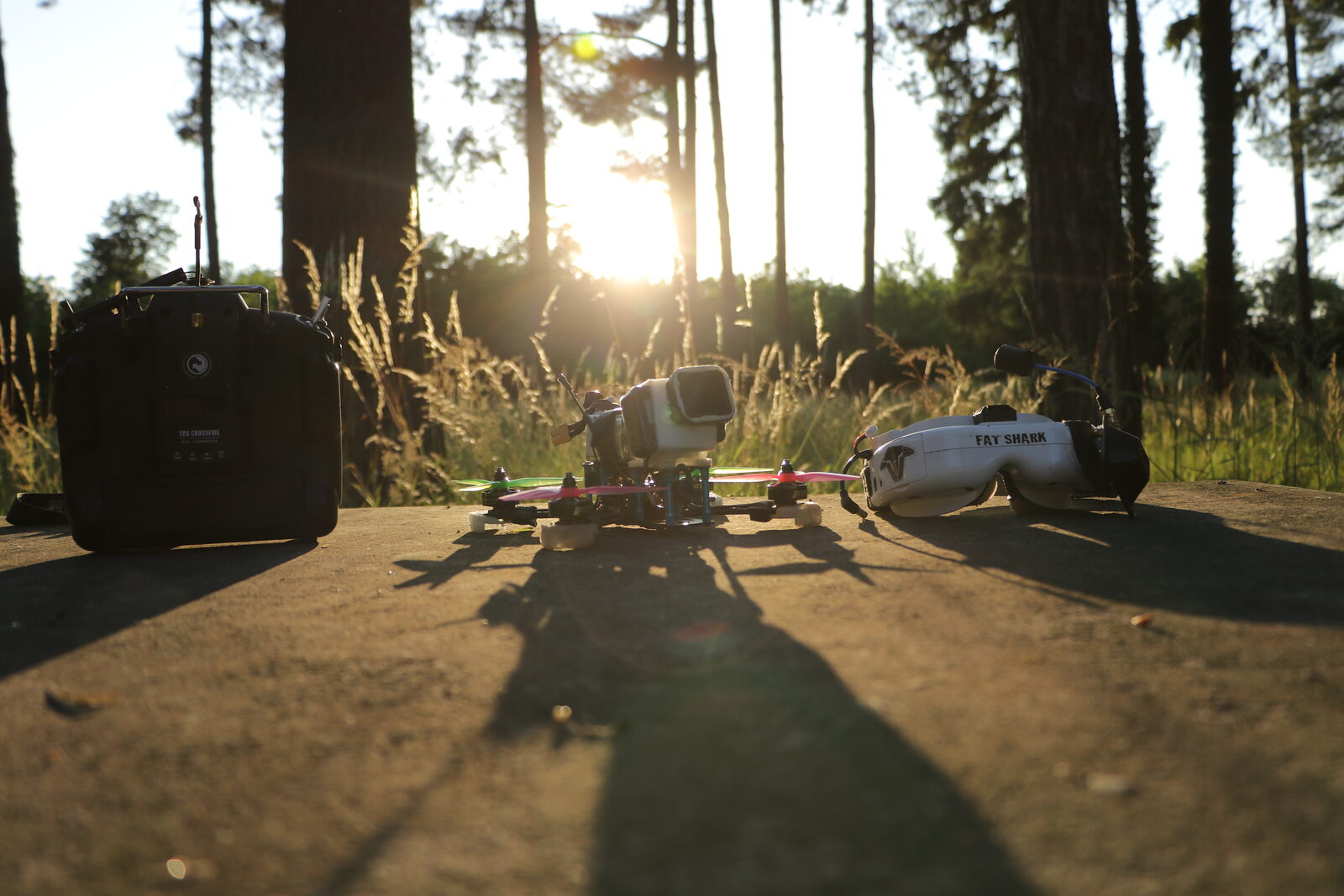
Fly a consumer drone in a dense neighborhood and you are contesting the electromagnetic equivalent of a traffic jam. Your aircraft's command-and-control link operates in the 2.4 GHz or 5.8 GHz ISM band — the same unlicensed spectrum occupied by every Wi-Fi router, Bluetooth speaker, and baby monitor in range. The drone's firmware deploys frequency-hopping spread spectrum to dodge the worst congestion, but in a saturated environment it is running on engineering resilience and something close to luck. That structural arrangement — aviation-safety-critical communications sharing spectrum with consumer electronics — explains why the transition from line-of-sight hobby flight to scalable commercial BVLOS operations has been so protracted, and why three federal agencies have spent the better part of a decade arguing over a 61-megahertz sliver of C-band that the U.S. itself proposed at the United Nations back in 2012.
What ISM Bands Actually Provide — and Don't
The Industrial, Scientific, and Medical bands at 2.4 GHz and 5.8 GHz are unlicensed spectrum. No entity holds a license; no entity has interference protection. That design made consumer wireless ubiquitous — it eliminated spectrum licensing friction for billions of devices — and it imposes real costs on any user who requires reliability rather than convenience.
The physics of the two primary drone bands illustrate the tradeoff precisely. At 2.4 GHz, signals penetrate obstacles reasonably well and reach up to 10 kilometers under FCC rules, making it the default for range-critical operations; maximum bit rate is approximately 12 Mbps, adequate for telemetry and control but constraining for high-resolution video downlink. At 5.8 GHz, the band is less congested and modern high-end systems (e.g., Autel SkyLink) achieve 1080p/60fps real-time video with ranges up to 15 km in open environments, but building penetration is poor and the band is entirely restricted in some countries. Neither specification survives contact with a dense urban environment: where buildings and competing RF sources multiply, reliable control range collapses to roughly half a mile regardless of what the spec sheet advertises.
Security compounds the congestion problem. ISM spectrum is inherently susceptible to signal interception, jamming, protocol spoofing, and GNSS spoofing — an adversary with appropriate hardware can transmit counterfeit GPS signals to force an aircraft off course or cause it to miscalculate its position. Drone manufacturers have layered proprietary encrypted links on top of ISM allocations: DJI's Lightbridge and OcuSync systems partially address the vulnerability without resolving it, since the underlying spectrum remains shared and carries no interference protection. Industrial manufacturers offer quad-frequency systems that cycle automatically across 900 MHz, 2.4 GHz, 5.2 GHz, and 5.8 GHz to optimize links opportunistically. These are engineering workarounds for the absence of dedicated, interference-protected aviation spectrum, not a substitute for one. As of the FCC's February 2023 Notice of Proposed Rulemaking, no U.S. spectrum had been licensed exclusively for UAS communications; operators relied on unlicensed low-power operations or experimental licenses.
Three Agencies, One Band, and the Eleven-Year Gap
U.S. spectrum governance divides authority in a way that makes drone communications uniquely complicated. The FCC holds primary authority over civilian spectrum allocation and equipment certification. The FAA governs airspace safety and drone operational rules. The NTIA coordinates federal government spectrum use. A drone's radio link sits at the intersection of all three: it requires FCC approval as a radio device, FAA approval as an airborne system component, and NTIA coordination when operating near federal users. No single agency can resolve the problem alone, and getting all three to move in concert has proven consistently difficult.
Section 374 of the FAA Reauthorization Act of 2018 forced coordination by directing the FAA, NTIA, and FCC to jointly evaluate two candidate bands for UAS use: the 960-1164 MHz L-band and the 5030-5091 MHz C-band. The L-band was rejected for significant interference concerns with GPS and aeronautical navigation systems occupying adjacent frequencies. The C-band was endorsed.
The 5030-5091 MHz band has an aviation pedigree that predates the modern commercial drone industry. At the 2012 World Radiocommunication Conference, the United States proposed — and the ITU adopted — allocating the band to the Aeronautical Mobile (Route) Service on a primary basis, explicitly to accommodate terrestrial command-and-control links for unmanned aircraft. The ITU defines AM(R)S as an aeronautical mobile service reserved for communications relating to safety and regularity of flight along national and international civil air routes — a designation that carries interference protection unavailable in any unlicensed band and that places drone command links in the same regulatory category as manned aviation communications. The U.S. had secured the international framework it needed by 2012.
After the 2012 WRC allocation, the FCC deferred all technical and operational rulemaking to an unspecified future proceeding. The NPRM was published in the Federal Register on February 7, 2023 — eleven years after the international allocation. It proposed dividing the 61 MHz into two service tiers: Non-Network Access for radio line-of-sight operations drawing on the 5030-5035 MHz and 5086-5091 MHz sub-bands, and Network-Supported Service for beyond-line-of-sight operations requiring network infrastructure. NNA would operate under licensed-by-rule authorization with no individual spectrum license required; NSS would receive exclusive geographic-area licenses assigned through competitive bidding with 15-year initial terms and 10-year renewal options. Frequency coordination in both tiers would run through Dynamic Frequency Management Systems — private third-party administrators modeled on the Citizens Broadband Radio Service Spectrum Access System governing the 3.55-3.7 GHz band.
Cellular networks raise an obvious alternative. LTE and 5G are technically capable of supporting BVLOS command links, and cellular coverage increasingly overlaps with drone operational areas. The regulatory answer is unambiguous: existing FCC rules preclude aeronautical mobile use in most major flexible-use bands, including 1670-1675 MHz, the 1.4 GHz band, the 2.3 GHz band, and the 3.7 GHz band. Cellular is the path of least technical resistance and the path of most regulatory resistance.
What Part 88 Established — and Left Open
On August 21, 2024, the FCC adopted a Report and Order creating Part 88 rules — the first dedicated licensed spectrum framework for drone command-and-control in U.S. history. Equipment must be FCC-certified against RTCA DO-362A, the consensus minimum operational performance standard for UAS radio communications. Permitted transmissions are restricted to air-to-ground and ground-to-air links; aircraft-to-aircraft communications and payload operations are explicitly excluded. Ground stations may be fixed or mobile but must not be in motion during operation; the Order expressly permits limited ad hoc networks of multiple ground stations, enabling relay-based BVLOS coverage within the NNA framework.
The interim access mechanism provides immediate practical access before the full DFMS infrastructure is operational. Operators secure a 20 MHz block — specifically 5040-5060 MHz — by obtaining FAA deconfliction approval and completing FCC registration; operations can begin immediately upon confirmation. Under the longer-term DFMS framework, a contiguous 10 MHz block (5040-5050 MHz) will be managed by competing private DFMS providers generating flight-plan-specific temporary frequency assignments.
“Through an automated process, these dynamic frequency management systems will assign a requesting operator the temporary use of certain frequencies for a particular geographic area and time period tailored to the operator’s submitted UAS flight plan.” — FCC Commissioner Geoffrey Starks
Assignments are capped at 24 hours; requests cannot be submitted more than seven calendar days in advance. DFMS providers must obtain FAA authorization before granting spectrum access, communicate with the FAA regarding flight status, and coordinate with Microwave Landing System users and adjacent-band operators. Operations within 25 miles of radio astronomy sites require National Science Foundation notification.
What the Order deferred is as significant as what it established. The Network-Supported Service tier — the rules that would govern scaled, networked BVLOS operations — was explicitly pushed to future rulemaking. A comprehensive final band plan for the full 61 MHz block remains open. Part 88 built the foundation; the structure above it is still being drawn.
The Unfinished Architecture
The residual gaps resurfaced in April 2026, when the FCC opened GN Docket No. 26-74, titled “Unleashing American Drone Dominance.” The proceeding was rooted in executive orders directing agencies to prioritize spectrum access and streamline UAS certification. Under renewed examination: ISM band viability at operational scale, the 450 MHz band (subject of a pending AURA Networks petition for long-range command links), 24 GHz spectrum for radar and detect-and-avoid systems, millimeter-wave bands for short-range high-bandwidth payload links, CBRS, and the 960-1164 MHz L-band — listed as “presently unavailable” rather than permanently excluded, suggesting the GPS interference issue may be revisited rather than treated as a final ruling.
On the operational side, the FAA Reauthorization Act of 2024 directed the FAA to issue a final rule for a performance-based BVLOS regulatory pathway under a proposed Part 108 framework by the end of 2024 — a deadline the agency missed. The March 2022 BVLOS Aviation Rulemaking Committee report, whose 70 recommendations across 381 pages provided the blueprint for Part 108, was direct about the spectrum dependency: recommendation GP 2.12 called on the FAA to work with the FCC and NTIA “to support enabling all available communications technology for the industry in a timely way.”
International compatibility adds a further constraint. U.S. equipment certified to RTCA DO-362A may not interoperate with European UAS operating under the proposed draft ED-265 standard for satellite-based control links — a divergence that could fragment equipment markets and limit cross-border operations in ways that would penalize the commercial sector on both sides.
FCC Chairwoman Jessica Rosenworcel framed the scale of what remains on the table directly: “In 2021 there were 2 million drones in operation in the United States. By 2030, we expect that number to more than triple to 6.5 million.” Part 88 provides 20 MHz of interim licensed C-band access and a DFMS coordination framework in active development. What it does not yet provide is the protected-spectrum architecture those numbers imply: NSS rules for networked BVLOS, a finalized comprehensive band plan, resolved cellular access authority, and international equipment standard harmonization. The U.S. proposed the foundational ITU allocation in 2012. More than a decade later, the implementation remains an ongoing rulemaking.
Sources
- Morgan Lewis — FCC Considers Technical and Operational Rules for Drones in 5030-5091 MHz Band
- Wiley Law — FCC Adopts Long-Awaited Order Enabling Limited Access to Dedicated Spectrum for Uncrewed Aircraft Systems
- Inside Unmanned Systems — The FCC’s New Role at the Center of the U.S. Drone Market
- Inside Unmanned Systems — FCC Steps Up Spectrum Rulemaking for UAS
- Military Aerospace — FCC Announces New Rules for Dedicated RF Frequencies for UAS Operators
- DroneLife — FCC Drone Spectrum Policy Could Shape U.S. Operations
- Autelpilot — Understand the Frequency Bands of Drones
- Airsight — How Drones Operate and What’s Their Security Implications
- Pilot Institute — What Causes Signal Dropouts When Flying Drones?
- FCC — FCC Report Supports Use of 5030-5091 MHz Band for UAS Operations
- FCC — FCC Starts Rulemaking on Licensed Spectrum for Unmanned Aircraft Use
- FCC — DOC-366460A1: Report on Section 374 of the FAA Reauthorization Act of 2018
- Drone Pilot Ground School — Part 108: What We Know So Far about the FAA’s BVLOS Rule
