
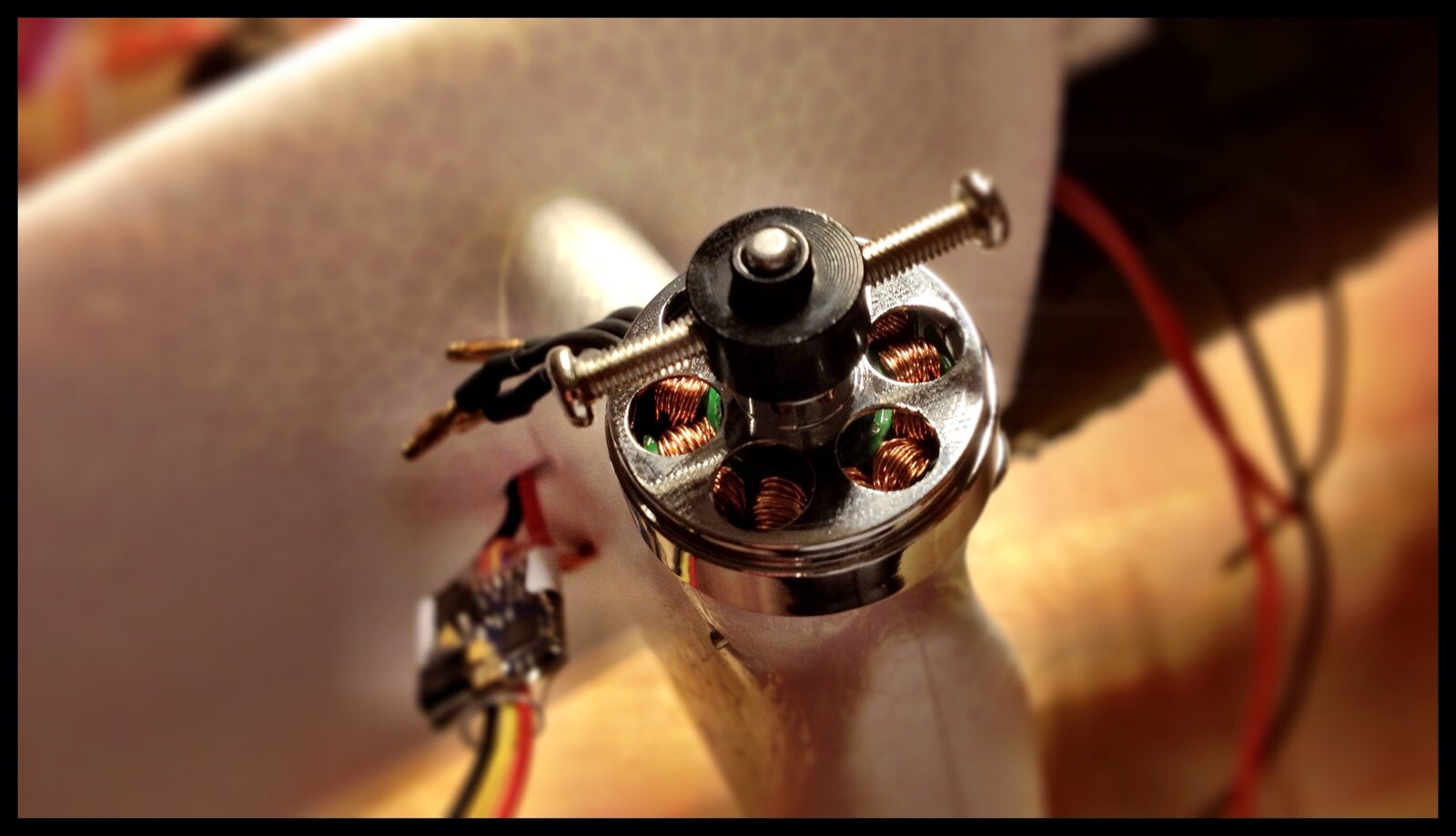
Strip a multirotor down to its engineering fundamentals and you find a power chain with three nodes: a brushless DC motor that converts electrical energy into torque, an electronic speed controller that choreographs the current flow making that possible, and a propeller that turns shaft rotation into thrust. Each node imposes constraints on the others. Optimize one in isolation and you break something downstream. Getting it right requires understanding all three as a single system — and then understanding where the system runs out of runway against larger propulsion architectures.
Brushless Motors: Geometry, Magnets, and the End of Brush Wear
The shift from brushed to brushless motors is not incremental — it is architectural. Brushed motors use physical brushes and a commutator to mechanically switch current through rotor windings. The friction that generates is not a nuisance; it is a structural loss mechanism that caps efficiency and imposes a finite lifespan on every motor in service. BLDC motors replace that mechanical commutation entirely, handing the job to an ESC and eliminating brush contact. The result: energy conversion efficiencies above 90% and lifespan extended to tens of thousands of continuous operating hours, against the chronic heat generation and mechanical degradation of brushed designs. BLDC motors deliver 30–50% longer flight times than brushed designs running identical battery packs, according to T-Motor's technical documentation.
The geometry that makes this work at drone scale is the outrunner configuration. Unlike an inrunner — where the rotor spins inside a fixed stator — an outrunner puts the rotor shell on the outside, spinning around the stator. JOUAV's engineering documentation describes why this matters: “The rotor rotates outside the stator, as opposed to within it. This design choice increases the torque generated by extending the application diameter.” More diameter means more magnetic pole pairs before the motor becomes physically unwieldy, and more pole pairs means smoother rotation and higher torque density.
The magnets enabling this are neodymium iron boron (NdFeB) sintered magnets, which achieve a maximum energy product (BH)MAX of 336 kJ/m³ — the highest of any permanent magnet material commercially available. Nidec's motor engineering documentation frames the torque relationship as an approximation: “derived an expression that gives a rough estimate of the maximum torque, expressed as the product of the number of magnet pole pairs, magnet volume, and maximum energy product (BH)MAX.” Multi-pole rotors — 8, 16, or 32 poles — are standard. High-end designs use N52SH grade curved neodymium magnets, rated to 150°C versus the 80°C ceiling of N35 grade, which matters during sustained high-load flight where thermal headroom determines whether efficiency holds or degrades.
The stator uses silicon steel laminations for high magnetic permeability and low eddy current losses, wound with single-stranded wire (high current capacity) or multi-stranded wire (stronger electromagnetic field). Physical dimensions follow a four-digit code: first two digits give diameter in millimeters, last two give height. A 2207 motor measures 22mm × 7mm; a 3510 suits long-endurance platforms; a 1103 goes into micro drones. Diameter drives torque; height drives load capacity. Heavy-lift motors span 30–3,000 watts.
KV Rating, Stator Sizing, and Thermal Reality
KV is the most misread specification in drone propulsion. It is not a performance rating — it is a physical constant describing how many RPM an unloaded motor produces per volt applied. A 2300KV motor at 10V theoretically spins at 23,000 RPM. In actual flight, with a propeller converting shaft energy into thrust, air resistance cuts that figure to 60–85% of the theoretical no-load value. What KV determines is the pairing between motor and propeller, and between motor and battery voltage.
The logic runs in one direction: high KV motors spin fast, which means they need small-diameter propellers to avoid overloading the motor and exceeding safe current limits. Low KV motors spin slowly and pair with large-diameter props that generate high thrust per revolution. UAVModel Insights' 2026 motor sizing guide specifies the current FPV meta: 4S (14.8V) systems run best at 2,400–2,750KV; 6S (22.2V) systems drop to 1,700–1,950KV for 5-inch props, or 1,300–1,600KV for 7-inch long-range builds. As UAVModel Insights notes, “The 6S 1700–1950KV range for 5-inch is the current meta. 1750KV runs cooler, 1950KV is snappier.” Tiny whoops on 1S or 2S push to 7,500–10,000KV to match their 2–3 inch props. Agricultural and heavy-lift platforms move entirely below 400KV to drive 15–30 inch propellers efficiently.
Motor internal resistance — typically 40–90 milliohms for racing designs, 60–300 milliohms for camera platforms — governs thermal losses through the I²R relationship: power dissipated as heat equals current squared times resistance. Lower resistance means less waste heat per amp, which translates directly to sustained efficiency at high throttle. Motor weight also carries a constraint that is easy to overlook: the optimal motor package represents 20–25% of total all-up weight. Exceed 35% and handling becomes unstable regardless of whether the thrust-to-weight ratio looks adequate on paper.
Electronic Speed Controllers: The Commutation Engine
An ESC does one fundamental job: take DC power from the battery and convert it into three-phase AC current timed precisely to drive BLDC commutation. Each motor requires its own dedicated ESC. The flight controller sends speed commands — historically as PWM (Pulse Width Modulation) analog signals, increasingly via D-Shot digital protocol that eliminates signal interpretation latency and radio-frequency interference susceptibility. The ESC adjusts output frequency and voltage to deliver the commanded RPM.
Beyond commutation, ESCs carry protective functions: a Battery Elimination Circuit (BEC) lets the flight controller draw power from the main battery; low-voltage cutoff prevents deep discharge damage; thermal protection trips at a configurable ceiling; active braking enables precision deceleration. A general guideline is to maintain a safety margin above the motor's measured full-throttle draw. Undersizing the ESC is among the most common causes of in-flight failures that present as motor faults.
Propeller Physics: The Fourth-Power Reality
Propeller sizing is where the physics become unforgiving. The thrust equation is T = CT × ρ × n² × D⁴, where CT is the thrust coefficient (a function of blade geometry and pitch), ρ is air density (1.225 kg/m³ at sea level, decreasing with altitude), n is revolutions per second, and D is diameter in meters. The D⁴ term is the number that matters: a 10% increase in propeller diameter produces approximately a 46% increase in thrust at constant RPM. Diameter is by far the most powerful lever in propulsion design, which is why heavy-lift applications push diameter as far as physical constraints allow.
Pitch — the theoretical forward distance traveled per revolution — trades differently. Higher pitch increases top-end speed and efficiency at high velocity but increases current draw and reduces static thrust efficiency. Agricultural drones use 15–30 inch props with 4–6 inch pitch. Photography and mapping platforms run 8–14 inch props with 4.5–7 inch pitch. Racing drones use 4–7 inch props with 5–7 inch pitch to prioritize RPM response over thrust per watt.
Thrust scales with RPM squared — double the RPM, quadruple the thrust — but current draw rises steeply with RPM, so actual operating points cluster well below maximum rated speed. Bench test specs will consistently overstate real-world performance: battery voltage sag and airflow interference from the airframe typically cut measured thrust by 15–20%. Propulsion systems should be sized to deliver target thrust with a 20% overhead already built in.
Thrust-to-weight ratio (TWR) targets by application: racing drones need 5:1 minimum, often 7:1+; freestyle and long-range platforms 4:1–5:1; industrial heavy-lift 3–5:1; camera platforms 2.5–3:1. The functional floor is combined motor thrust equal to at least twice the drone's all-up weight.
Where Electric Propulsion Hits Its Structural Ceiling
The multirotor power chain described above scales remarkably well up to roughly 25–50kg all-up weight and endurance requirements measured in tens of minutes to low single-digit hours. Above that threshold, a physics problem the electrical system cannot solve begins to dominate: energy density.
Jet-A fuel carries approximately 12,000 Wh/kg. Rechargeable lithium-ion aviation cells currently deliver around 100–150 Wh/kg; the most advanced aviation batteries, including lithium metal chemistries, reach approximately 500 Wh/kg, with near-future projections of 300–400 Wh/kg. Even accounting for the roughly two-thirds thermal loss in a gas turbine combustion cycle, Aerospace America notes the gap remains stark: “Jet fuel still is six to eight times more energy dense than the most advanced batteries currently available.”
This is why the MQ-9A Reaper runs a Honeywell TPE331-10 turboprop, not a battery pack. The performance profile that results — over 27 hours endurance (34 hours for the extended-range variant), 240 KTAS cruise, 50,000 feet operating ceiling, 3,850-pound payload — is simply not achievable in electric configurations with current battery technology at any reasonable airframe weight fraction.
Electric motors hold genuine advantages the turbine cannot match: instantaneous throttle response (the ESC can adjust motor current in milliseconds, while a turbine is limited by fuel flow rate), near-zero acoustic signature at low power settings, and zero local emissions. Those properties make electric multirotors the right choice for FPV sport through short-range commercial delivery. Southwest Research Institute's hybrid approach — a gas turbine core spinning at 118,000 RPM combined with electric drive — attempts to capture both: “Including a gas turbine greatly extends the operating range compared to a traditional electrically powered UAS,” SwRI notes. For the near-to-medium term, the propulsion divide between small electric multirotors and large fuel-powered fixed-wing UAS is not a preference or a policy choice. It is determined by a number: watts per kilogram, and how far solid-state chemistry can push it.
Sources
- T-Motor — Brushless vs. Brushed BLDC Drone Motors
- JOUAV — Heavy Lift Drone Motors
- T-Motor — Drone Motor & Propeller Matching Guide
- LigPower — Drone Motor Specifications and Parameters
- Mechtex — Role of Electronic Speed Controllers (ESCs) in Drone Motors
- UAVModel Insights — FPV Drone Motor Sizing Guide: Stator Volume, KV Selection, and Thrust-to-Weight Ratio (2026)
- Evolution Flight — Calculate Propeller Thrust
- Nidec Corporation — Motor Academic: Maximum Torque and Permanent Magnets
- General Atomics Aeronautical Systems — MQ-9A Reaper
- Aerospace America / AIAA — The Buzz Over Batteries
- Grepow — How to Choose the Right Motors and Propeller for Different Drone Applications
- Southwest Research Institute — Hybrid Can Really Fly
