
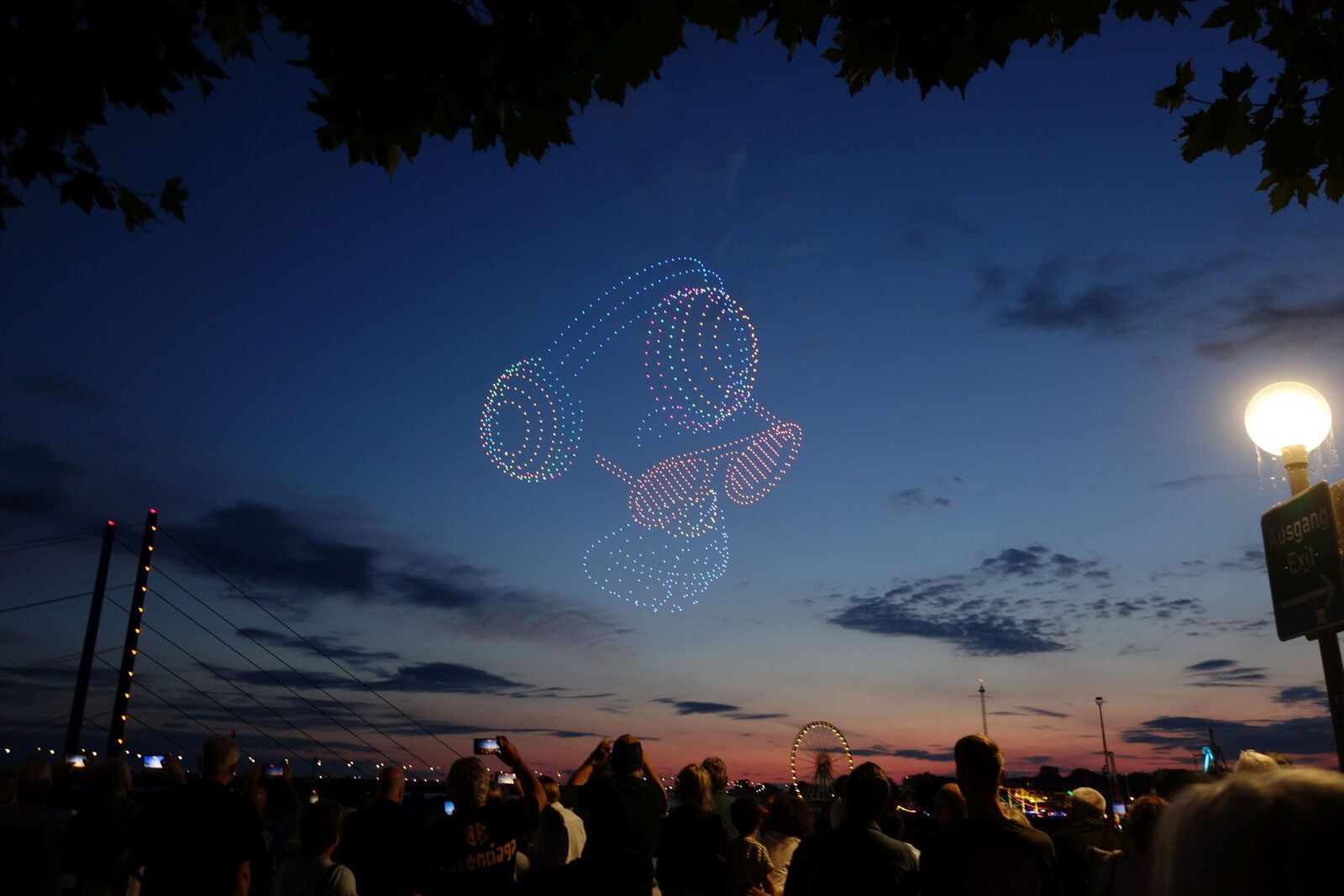
On December 21, 2024, Sky Elements launched 500 drones over Lake Eola Park in downtown Orlando. The formation collapsed mid-show — aircraft plunged into the lake, veered off course, and one struck a seven-year-old in the crowd. Alezander Edgerton required open-heart surgery. NTSB investigators found not one catastrophic failure but five critical failures: the launch parameter file had never been sent to the aircraft, the geofence safety buffer was set at 1 meter instead of the required 5, the formation had shifted 7 degrees off-axis, five drones failed to accept launch data during pre-launch checks, and the shutdown procedure was complicated enough that the pilot did not intervene mid-show.
Drone light shows look like magic. They are precision aerospace operations running on GPS correction data, encrypted multi-band radio networks, automated collision solvers, and a regulatory framework that takes 90 days and 145 pages of documentation to navigate. Orlando is what the gap between those two descriptions looks like.
Positioning, Choreography, and Ground Control
Consumer GPS delivers meter-level accuracy — catastrophically insufficient when 500 aircraft are flying within meters of each other. Shows solve this with RTK (Real-Time Kinematic) positioning: a fixed ground base station broadcasts correction data the aircraft fuse with their own GNSS signals to achieve centimeter-level precision. Backup correction channels maintain accuracy if the primary signal degrades. Verge Aero runs multiple radios on different frequency bands over a local, encrypted network, and each drone carries an autopilot processor and a separate mission control processor — two independent computational systems per aircraft.
Choreography follows a fixed workflow: storyboarding, 3D animation design, automated anti-collision validation, simulation, export to mission control software, pre-flight checklist, one-click launch. Verge Aero's platform mathematically guarantees flight paths will not intersect. Time code integration synchronizes aircraft with music, lighting, and pyrotechnics. Typical lead time from concept to performance is six to eight weeks; two Verge Aero operators can set up and fly a 100-drone show in approximately 45 minutes.
On show night, a Red Button commands emergency stop or fleet-wide landing in a single input. Geofencing runs as a two-layer system: a warning fence alerts the operator when aircraft approach the outer boundary; the hardfence commands stop regardless of operator input — both layers are required for FAA waiver compliance. If GPS or RTK signal cannot be reestablished within 60 seconds of loss, the remote pilot must land the fleet by the safest available means.
Purpose-built show drones differ substantially from commercial platforms. Intel's Shooting Star used foam and flexible plastic with caged propellers — deliberately frangible to reduce impact injury — with LEDs capable of more than 4 billion color combinations. The UVify IFO now commands roughly 90% market share among purpose-built show drones at approximately $1,300–$1,400 per unit. At the hardware edge, PABLO Air's PabloX F40 can physically attach pyrotechnic charges to the aircraft — a hybrid format that received FAA approval in August 2024 and set a Guinness record with 1,068 pyro-drones in April 2024.
Intel's Exit and the U.S. Market
The industry traces to Intel's Shooting Star division, which set the first Guinness record for simultaneously airborne UAVs — 500 drones — in Germany in 2016, then broke it at PyeongChang 2018 with 1,218 aircraft controlled by a single pilot. Intel has since exited; Germany-based Nova Sky Stories acquired its full fleet and now operates more than 9,000 drones. Christopher Franzwa, cofounder of Verge Aero, watched the 2018 record and steered his company toward selling the hardware-and-software stack to operators rather than running shows:
We were like, ‘Hey, let’s make it so that anybody can do this.’
Sky Elements (Coppell, Texas) holds 22.2% domestic market share and 17 Guinness World Record titles, running 100-plus shows per peak holiday weekend for clients including Disney Studios, Marvel, and MLB franchises — 40 shows over the 2023 Fourth of July weekend. Pixis Drones (Alexandria, Virginia) holds 10.9% market share. Globally, China's HighGreat has executed over 5,000 shows across 300 cities; BotLab Dynamics flew 1,200 drones at the 2023 Cricket World Cup Final and separately set an Indian national record with 3,500 drones over Rashtrapati Bhavan. North America accounts for 34% of global shows; the average domestic show uses 218 aircraft at $233 per drone.
The FAA Waiver Stack
Commercial shows require three simultaneous Part 107 waivers. Part 107.29 permits nighttime operations past civil twilight. Part 107.35 waives the one-pilot-one-drone rule, allowing one remote pilot to control hundreds of aircraft. Part 107.39 addresses flight over people. Since 2024, Remote ID compliance is bundled within the package. Technical mandates include dual flight control systems, dual transmission systems, real-time telemetry per drone, the two-layer geofence, and written training manuals with examinations. Staffing: one visual observer per 50 drones plus perimeter control staff. Waiver documentation runs 145 to 165 pages and costs $3,500 to $5,000 to prepare; processing takes approximately 90 calendar days; approval lasts four years. A NOTAM must be filed 72 hours before each show; the local Flight Standards District Office notified 24 hours out.
Fireworks Trade-Offs and Failure Lessons
A 12-minute drone show costs approximately $20,000 — comparable to a 20-minute fireworks display — but the fleet is reusable across thousands of shows. Fireworks raise fine particulate pollutant levels an average of 42% over 24 hours and leave heavy metals in soil and waterways. Boulder, Colorado, ended a fireworks tradition dating to 1941 citing climate-driven fire danger. Salt Lake City Mayor Erin Mendenhall stated it plainly:
As temperatures rise and fire danger increases, we must be conscientious of both our air quality and the potential for wildfires.Burn bans in California, Colorado, Arizona, and New Mexico have pushed other jurisdictions the same direction.
Orlando was not the industry's first cascade failure. The NTSB's Orlando finding — that the launch parameter file was simply never transmitted to the aircraft — points to a pre-flight verification failure that software checklists exist to prevent. The FAA suspended Sky Elements' Part 107 waiver pending investigation. The harder lesson is procedural: when shutdown procedures are complex enough to discourage pilot intervention mid-show, safety margins exist only on paper.
Sources
- Pixis Drones — How Drone Light Shows Work
- Verge Aero — Everything About Drone Light Shows
- Drone Show Software — Drone Show Regulations and Requirements
- Drone Show Software — Drone Light Show Choreography
- Intel Corporation — Intel Drone Light Show Breaks Guinness World Records Title (2018)
- Drone DJ / NTSB — Orlando Drone Show NTSB Report
- The Drone Girl — Biggest Drone Show Companies (2025)
- The Drone Girl — American Drone Show Companies (2024)
- The Drone Girl — Light Show Drones (2023)
- Technical.ly — Verge Aero Drone Startup Software Platform
- Verge Aero — Drones Replacing Fireworks
- Newsweek — Fireworks Replaced by Drone Shows Over Environmental and Fire Concerns
- Sky Elements — About Us
- National Transportation Safety Board — Advisory to Operators of Civil Uncrewed Aircraft Systems
