
Electronic warfare is currently the single largest killer of drones over Ukraine — roughly 10,000 Ukrainian UAS per month destroyed or lost to jamming, by mid-2024 estimates. And yet the newest drones being fielded there cannot be jammed at all. Understanding that paradox starts with the physics of what jamming actually attacks.
Two Attack Surfaces: C2 and GNSS
Every conventional drone depends on two independent RF links, and a jammer can sever either or both. The first is the command-and-control (C2) link between the pilot's controller and the aircraft. Consumer and commercial platforms operate primarily at 2.4 GHz (2.400–2.484 GHz) for control and 5.8 GHz (5.725–5.875 GHz) for video downlink — both unlicensed ISM bands chosen for their global availability, not their resilience. Longer-range telemetry commonly runs at 900 MHz. Ukraine's FPV combat fleet spans all four bands: 900 MHz, 1.3 GHz, 2.4 GHz, and 5.8 GHz. Specific Russian platforms concentrate narrower slices: the Orlan-10 uses 850–930 MHz; the Lancet sits at 868–870 MHz plus 902–928 MHz.
The second attack surface is GNSS navigation. GPS L1 at 1575.42 MHz is by far the most targeted frequency; L2 (1227.60 MHz) and L5 (1176.45 MHz) are secondary. The vulnerability is fundamental to the physics: GPS L1 arrives at Earth's surface at roughly −130 dBm — an extraordinarily weak signal, already near the noise floor of ordinary receivers. Overpowering it requires almost nothing. Vehicle-mounted jammers typically transmit 100–500 watts against controller outputs of 1–5 watts, a 13–20 dB advantage that makes reliable lock impossible across a wide area. Russia's Pole-21 system denies all GNSS constellations at ranges exceeding 50 km. Commercial GPS jammers capable of disrupting consumer drones are available for $40–80.
The attack mechanic is simple: flood the target frequency band until the jam-to-signal ratio goes positive. The legitimate signal is buried in noise; the receiver cannot lock. What happens next depends on what you jammed and what the aircraft's firmware is programmed to do.
Jamming, Spoofing, and Meaconing — Not the Same Thing
Denial through noise is only one of three electronic attack modes against drone navigation, and conflating them leads to bad defensive choices. Pure jamming raises the noise floor until the receiver loses lock entirely; the drone knows it has lost signal and responds with whatever failsafe it was programmed with. Spoofing is more insidious: a transmitter broadcasts counterfeit GNSS signals that are syntactically valid but geometrically false, redefining the drone's apparent position. Done well, spoofing can steer a drone to a capture site while the operator's ground-station telemetry continues to display a normal flight. The aircraft never trips a loss-of-signal failsafe because, from its perspective, it never lost signal. Meaconing is a third variant — delayed rebroadcast of authentic navigation signals — which produces predictable but hard-to-diagnose positional errors.
Spire Global's satellite-derived interference data for the Baltic and Kaliningrad region (October 2024) documented more than 300 aircraft showing positional-integrity metrics at zero, with errors exceeding 30 meters across 84 hours of interference during a six-month window. The interference was traced to vessel-based mobile jammers — a reminder that GNSS denial is a problem well outside active combat zones.
When a commercially built drone loses its C2 link alone, typical failsafe logic triggers a return-to-home sequence. GPS-only jamming without C2 denial typically causes drift — the aircraft can still receive commands but navigates poorly. Simultaneous jamming of both links usually causes an uncontrolled descent or loss of aircraft. Modern commercial systems push back harder than they used to: DJI's OcuSync protocol uses spread-spectrum transmission, AES-256 encryption, dynamic channel hopping, and adaptive power output, forcing any effective jammer toward broadband barrage techniques that are harder to make portable and harder to keep below regulatory thresholds.
The US and Allied Toolkit
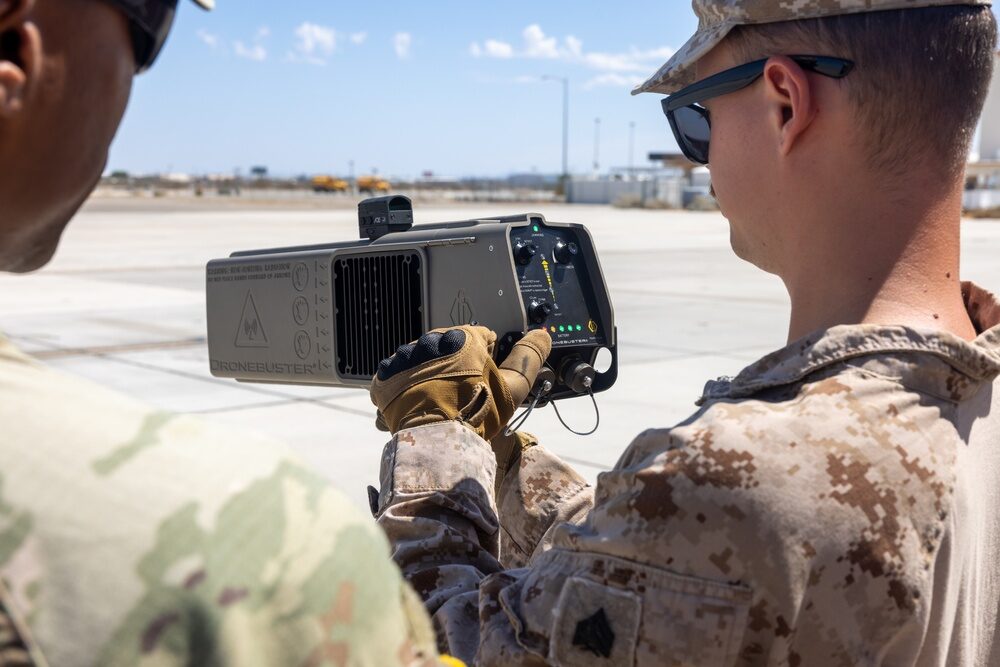
The US military operates a layered portfolio of dedicated jamming systems. At the low end of the size-weight-power spectrum is the Dronebuster (Flex Force): the Block 3 weighs 4.1 pounds, sustains more than three hours of jamming, and the Block 3B adds a dedicated GNSS-jamming mode. The 1,000th unit was delivered in February 2022. The USAF's NINJA system handles RF detect-and-defeat at Air Force installations. The Navy's DRAKE (Northrop Grumman) is a backpack-class jammer now aboard surface combatants including USS Kansas City, with CO approval required for use in CONUS waters. The USMC's LMADIS is a vehicle-mounted counter-drone system fielded aboard amphibious ships. Sierra Nevada's Modi II, procured at $73.2 million for 581 systems in 2016, is fielded in man-packable, vehicle-mounted, fixed, and airborne configurations; the Department of Defense described it as the most modern and highly-capable dismounted ECM system in the DoD inventory.
A qualitatively different category has emerged in the form of high-power microwave (HPM) effectors. Epirus's Leonidas system uses gallium nitride solid-state amplifiers to project directed microwave energy. The DoD awarded Epirus $66.1 million in January 2023 and a $43.5 million Gen II contract in July 2025. Projected cost per engagement: roughly $0.05 in electricity. The strategic importance of HPM is that it defeats fiber-optic and fully autonomous drones by inducing disabling currents directly in onboard electronics — it attacks the hardware, not the RF link. That makes it the only current cross-cutting defeat mechanism against the new generation.
The Two Hard Exceptions
Jamming's tactical dominance in Ukraine has an expiration date measured in procurement cycles. Two categories of drone have already broken the RF-kill model.
Fiber-optic FPVs carry their entire control link over a hair-thin fiber spool that unspools behind them in flight — no RF command link exists to jam. Russia pioneered their battlefield use, and fiber-optic FPVs reached mass-level fielding in Ukraine by summer 2025, per IEEE Spectrum's reporting. Typical range runs 20 kilometers or more, with larger airframes reaching further. The fiber spool is a real cost: the cable alone can run upwards of $500 — in many cases more than the drone itself. The operational verdict was delivered bluntly by Vadym Burukin, CEO of Huless:
"Right now, there is no protection against fiber-optic drones."
The second exception is visual-inertial and AI-guided navigation. KrattWorks' Ghost Dragon compares a live camera feed against stored satellite imagery onboard, maintaining accurate navigation with every GNSS constellation fully jammed. Ukraine's TFL-1 terminal guidance system uses a neural net for the final 500 meters of flight. Low-cost AI guidance modules are spreading fast across the FPV fleet for exactly this reason. As KrattWorks COO Martin Karmin put it, "It's like a cat-and-mouse game."
The cat currently has momentum: fielded EW solutions in Ukraine are typically countered within weeks, and drone operators reflash firmware on similar cycles to evade updated jamming signatures. FPV hit rates fell sharply in heavily jammed sectors through 2024 — and that collapse came before fiber-optic adoption scaled.
Who Can Legally Jam in the United States
This section is not a gray area. In the United States, operating, marketing, importing, or selling a jamming device — regardless of the threat you believe you face — is a federal crime under the Communications Act of 1934. The relevant statutes are 47 U.S.C. §§ 301, 302a, and 333. There is no exemption for businesses, property owners, critical-infrastructure operators, or private security firms. FCC enforcement actions carry civil fines up to $112,500 per violation, and willful violations carry criminal exposure. Jamming a drone — even one you believe is surveilling your property — also implicates 18 U.S.C. § 32 (the Aircraft Sabotage Act), because drones are legally aircraft, and disabling one is a federal crime on that basis as well. Intercepting the command-and-control signal raises additional exposure under the Wiretap Act.
The Preventing Emerging Threats Act of 2018 created an explicit C-UAS mitigation authority — but extended it only to DHS and DOJ. The Department of Defense operates under 10 U.S.C. § 130i; the Department of Energy and US Coast Guard have separate statutory grants. The FY2026 NDAA's SAFER SKIES Act represents the first extension of mitigation authority to state, local, tribal, and territorial agencies — but only after certification by the FBI's National Counter-UAS Training Center in Huntsville. Private companies and critical-infrastructure operators are still explicitly outside that authority. Federal counter-UAS funding flows entirely to government entities operating under these authorities.
The practical consequence: if you are not a federal agency operating under a specific statutory grant, or a newly certified state/local agency under SAFER SKIES, you have no legal pathway to jam a drone over or near your facility. Legal C-UAS options for private operators currently stop at detection and acoustic/optical deterrence.
A Bifurcated Threat Landscape
Electronic warfare has sorted the drone world into two populations: jammable RF-dependent aircraft and unjammable platforms that have routed around the RF stack entirely. Against the first population, the existing toolkit — from handheld Dronebusters to vehicle-mounted LMADIS to software-defined NINJA — remains effective when properly employed and rapidly updated. Against the second, the only current hardware answer is HPM effectors like Leonidas, which defeat the electronics rather than the link. The Ukraine data makes the adaptation timeline clear: 21 days from deployment to countermeasure. Any layered C-UAS architecture built today needs to account not just for the drones that are in the air, but for the drones that will be in the air by the time the procurement clears.
Sources
- Cornell LII — 47 U.S.C. § 333 (Communications Act, prohibition on jamming)
- IEEE Spectrum — Ukraine killer drones (June 2025)
- Spire Global — GNSS Interference Report: Russia / Baltic region (2024–25)
- U.S. Army — Army selects countermeasures against drones (June 2020)
- Airforce Technology — Dronebuster handheld C-UAS
- Unmanned Airspace — US Navy equips surface fleet with Northrop Grumman counter-drone system
- Sierra Nevada Corp — $73.2M USMC Modi II contract (2016)
- Airsight — Drone jammer legal guide (2026)
- drone-warfare.com — Counter-UAS electronic warfare
- VGI-9 — Drones vs. electronic warfare: who's winning the battle for the skies in Ukraine (June 2025)