
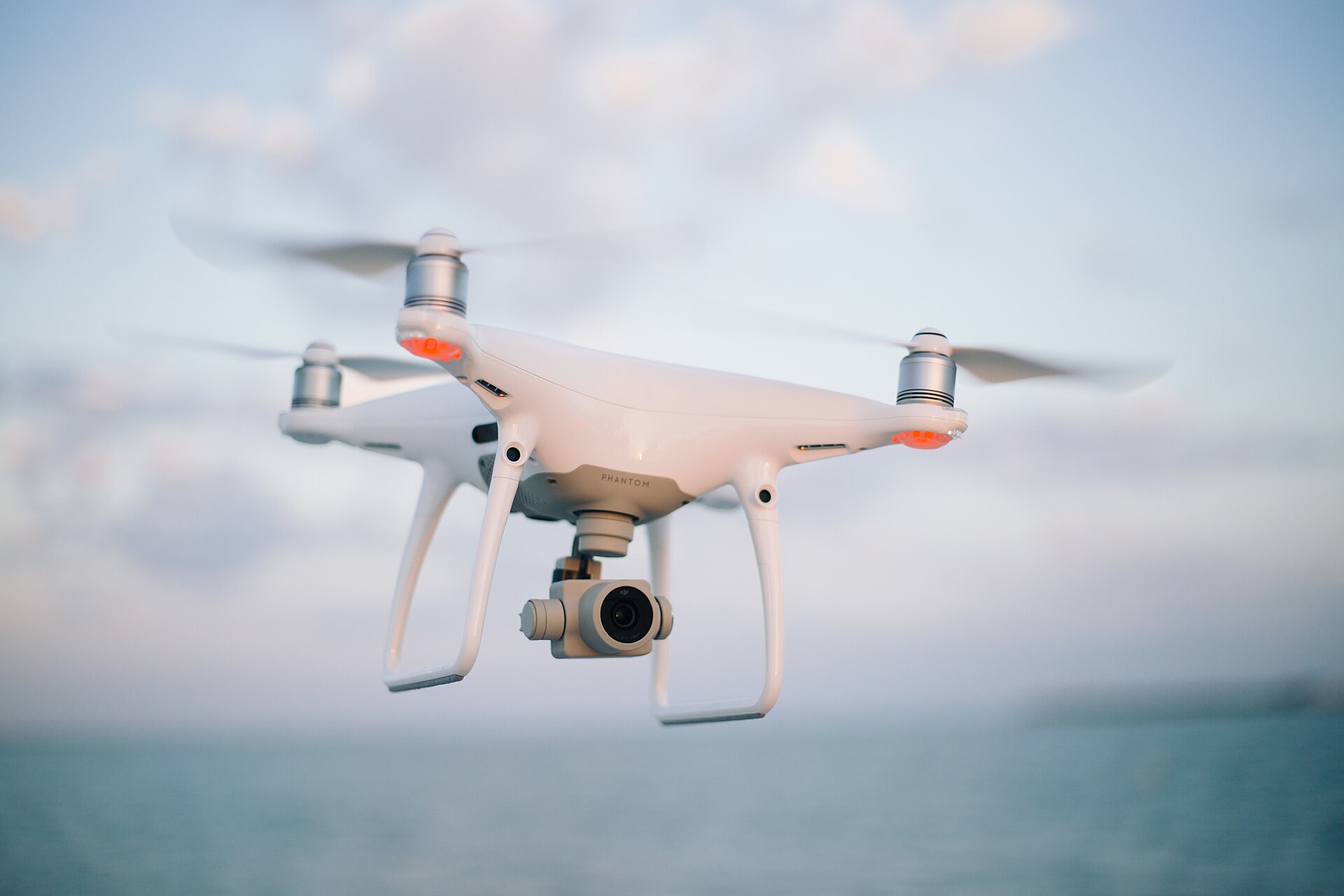
In the spring of 2021, a film crew gathered at Bryant Lake Bowl in Minneapolis for a shot that would have been technically impossible a few years earlier. Director Anthony Jaska and pilot Jay Christensen of Rally Studios aimed to fly a small FPV drone through the entire bowling alley in a single uncut take — threading between lanes, skimming over pinsetters, weaving through a live crowd. The finished cut ran 87 seconds. The video went viral, eventually accumulating 1.6 million YouTube views, and Guardians of the Galaxy director James Gunn reacted on Twitter:
"Oh my God this drone shot is stupendous."
The shot was not an isolated stunt. It was a data point marking the moment a class of unmanned aircraft moved from regulatory novelty to cinematic vocabulary.
A Century of Aerial Photography, Then a Gate Opened
Wings (1927), the first Best Picture winner, used fixed-wing aircraft for its aerial combat sequences — one pilot died during production, another was hospitalized. The first civilian helicopters capable of aerial photography arrived in 1946; The Bandit of Sherwood Forest was the first film to attempt helicopter aerial photography, though that footage was ultimately cut. Roger Monteran designed the first spring-based camera stabilizer for helicopter shots on The Longest Day; Nelson Tyler later created the Tyler Camera Mount, which appeared in Batman (1966) and Funny Girl (1968). Even so, helicopter aerial cinematography remained a specialized rarity, constrained by cost and FAA airspace coordination.
The regulatory foundation for commercial drone use in film arrived in stages. The FAA Modernization and Reform Act of 2012, signed February 14, 2012, directed the FAA to establish exemption pathways for commercial UAS while permanent rules were developed — producing Section 333. In September 2014, the FAA granted its first commercial UAS exemptions to aerial photo and video production companies.
The operational requirements under those exemptions were exacting. Under the MPAA/FAA framework, aircraft had to weigh less than 55 pounds including camera payload, fly at 50 knots or less, stay below 400 feet AGL, operate in daytime, and remain within Visual Line of Sight of the Pilot in Command at all times. A dedicated Visual Observer was required alongside every pilot. A Notice to Airmen had to be filed 48–72 hours before each operation. An FAA-approved Motion Picture and Television Operations Manual was mandatory. Non-consenting persons were barred within 500 feet of the operation area. Pilots needed a manned-aircraft certificate — airline transport, commercial, or private — and a current medical certificate.
Part 107, effective August 2016, replaced that structure entirely. The Remote Pilot Certificate it introduced dropped the manned-aircraft license requirement and eliminated the medical certificate. By end of 2015 the FAA had issued 1,000 commercial UAS permits; by end of 2016, 20,000. In November 2016, the FAA retroactively updated over 5,000 existing Section 333 exemptions to standardized restrictions. The Section 333 pathway was largely supplanted but survives as 49 USC Section 44807, now rarely used.
Carrying Cinema Glass: The Hardware Problem
A remote pilot certificate enables legal flight. Whether a drone can carry a cinema-grade camera is a separate engineering problem.
Early production drones were built around GoPros and consumer action cameras. Skyfall (2012) — one of the first major features to use drones, for aerial shots of the Scottish Highlands — and Martin Scorsese's drone-sourced wide shots in The Wolf of Wall Street (2013) relied on comparatively rudimentary rigs. The Russo brothers pushed lightweight platforms further in the airport battle sequence of Captain America: Civil War (2016), and 1917 (2019) used drones to enable the seamless transitions that maintained its continuous-take illusion — but the constraint remained: cinema-grade cameras require cinema-grade lift.
Freefly Systems addressed this directly with the Alta X, introduced in September 2019 at approximately $16,000 for the chassis and $25,000 with the MōVI Pro gimbal. The Alta X carries up to 35 pounds of payload — sufficient for an ARRI Alexa Mini, a RED Komodo, or a Sony Venice on a stabilized gimbal — at a maximum gross takeoff weight of 76.9 pounds at sea level. Flight time with a 22-pound load is 22 minutes; ActiveBlade propeller technology cuts vibration to one-fifth normal levels. The DJI ecosystem — Inspire series, Matrice 600 Pro with Zenmuse gimbals, the Inspire 3 with Waypoint Pro — covers mid-range production work. The Sony Airpeak S1 rounds out the high-end platform field.
FPV: The Camera Enters the Action
Heavy-lift drones put cinema cameras in the air. FPV drones do something different: they collapse the distance between the camera and the action to near zero.
First Person View drones transmit live video directly to pilot goggles, creating a cockpit-immersion experience. Unlike conventional production platforms they carry no automated fail-safes, require hand-assembly, can reach 80 miles per hour, sustain high-G maneuvers, and fly as low as two feet from the ground. The cinewhoop subcategory — small FPV craft with ducted propellers protecting the blades — enables interior flight sequences that a conventional stabilized drone could never safely attempt. On cinewhoop rigs the pilot sees the FPV camera feed; a separate GoPro Hero series captures the actual production image.
DJI's consumer FPV drone, released in March 2021, dramatically lowered the entry barrier to the format. That same spring, Christensen and Jaska's bowling alley film demonstrated what hand-built hardware and enough attempts could produce. The video spawned a sequel at Mall of America — "The Quack Attack is Back" — and effectively codified the scripted single-shot FPV fly-through as a recognized cinematic form.
The industry formalized quickly. Lightcraft, a Hollywood-focused FPV and cinema-drone production company, maintains a pilot roster built around competitive racing talent, including Alex Vanover, the 2019 Drone Racing League World Champion, and Jordan Temkin. Michael Bay's Ambulance (2022) is the benchmark deployment, with FPV drones woven through car chase sequences. Top Gun: Maverick and Mission: Impossible – Dead Reckoning (2023–24) followed with FPV work on motorcycle chase sequences. Avatar: The Way of Water (2022–23) extended the principle underwater, deploying submersible drones for oceanic photography.
FAA Part 107 compliance remains the baseline on any professional production today: Remote Pilot Certificate, aviation liability insurance, and MPAA-derived safety protocols that continue to govern major studio work even after the Section 333 frameworks that created them were retired. The New York City Drone Film Festival has emerged as the annual benchmark event for the field.
Between Wings (1927) and Ambulance (2022), the technology changed completely — and so did the regulatory architecture that made commercial aerial cinematography viable at the scale where it could evolve into something indistinguishable from standard production vocabulary.
Sources
- Safety on the Set (MPAA) — UAS Exemption Summary
- Rupprecht Law — Section 333 Exemption vs. Part 107
- No Film School — Planes, Helis, and Drones: How the View Above Changed Cinema
- Assemble — Guide to FPV Drones
- CineD — Right Up Our Alley: FPV Drone Flying at Its Finest
- PetaPixel — Drone Pilot Who Shot FPV Bowling Alley Viral Video Continues to Impress
- Y.M.Cinema Magazine — Freefly Introduces the Alta X
- Freefly Systems — Alta X (manufacturer page)
- CineDrones — The Evolution of CineDrones in Hollywood
- InsideFPV — Drones in Film Production: Behind the Scenes of Hollywood's Tech
- Federal Aviation Administration — Commercial Operators (Part 107)
