
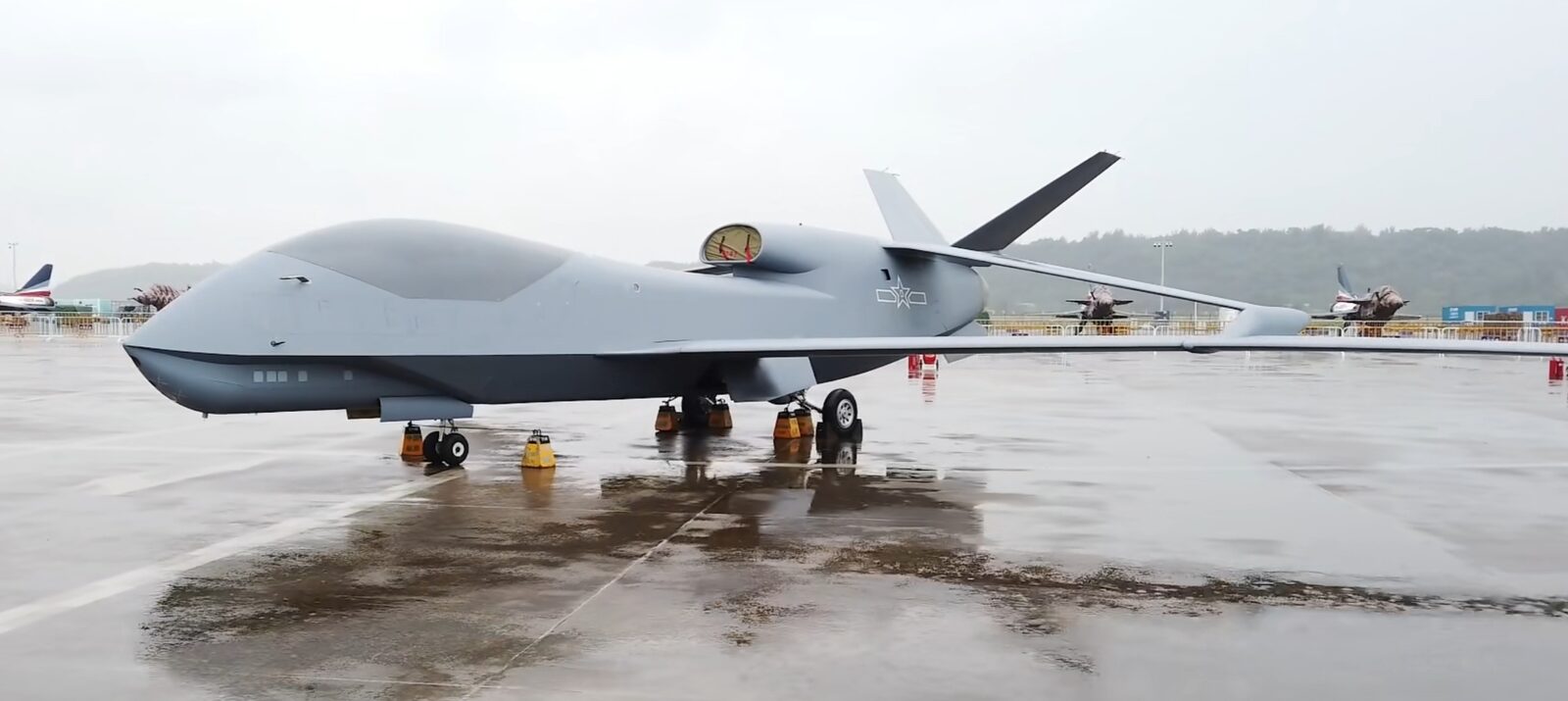
On the morning of March 26, 2024, Japan’s Air Self-Defense Force scrambled fighters after tracking an unidentified contact executing a counterclockwise loop over the Sea of Japan at roughly 60,000 feet — above most surface-to-air missile engagement envelopes and beyond the service ceiling of any interceptor on quick-reaction alert. Tokyo’s Ministry of Defense, in translated statements, described the aircraft as having “come from the continent, circled over the Sea of Japan, and then headed northwest toward the continent.” The intruder was a People’s Liberation Army WZ-7 Xianglong, or Soaring Dragon — and it was the first documented WZ-7 overflight of that body of water. Japan’s Chūbu Air Defense Force ceased tracking after the drone exited the country’s air-defense identification zone. Three weeks later, on April 18, another WZ-7 appeared northwest of the Philippine archipelago, its flight coinciding with the U.S. Army’s inaugural deployment of the Typhon ground-launched missile system to Luzon.
Neither sortie was a test flight. By early 2024 the WZ-7 had logged documented missions spanning Tibet, the Miyako Strait, the Sea of Japan, and the West Philippine Sea. It is a mature, operational ISR asset. Understanding its design, limits, and strategic role — and why the Pentagon singled it out by name in its 2024 China Military Power Report — matters for anyone tracking how China intends to surveil and potentially strike adversary forces across the Indo-Pacific.
A Joined-Wing Solution to High-Altitude Loiter
The WZ-7 is designed and manufactured by the Guizhou Aircraft Industry Corporation (GAIC). Its most visually distinctive feature is a tandem joined-wing — or box-wing — configuration: two swept wings mounted at different heights and connected at their tips, forming a rigid aerodynamic diamond. The geometry increases torsional rigidity without proportionally heavier spars, yielding a higher lift-to-drag ratio suited to sustained high-altitude loiter. Conventional HALE designs like the RQ-4 Global Hawk achieve similar efficiency with a high-aspect-ratio straight wing; the box-wing trades raw span for structural compactness at a given payload capacity. The configuration also simplifies manufacturing of a large-span aircraft by distributing structural loads across two connected wing assemblies rather than a single cantilevered beam.
The airframe spans 25 meters with a 14.3-meter fuselage, stands 5.4 meters tall, and has a maximum takeoff weight of 7,500 kilograms carrying 650 kilograms of mission payload. A gondola-like fairing under the forward fuselage houses radar and electro-optical/infrared sensor packages. The type has been in low-rate production since at least the mid-2010s, with publicly reported airframe totals unconfirmed.
Performance Against the Global Hawk: An Honest Accounting
At cruise, the WZ-7 operates at approximately 18,000 meters (60,000 feet) and 750 kilometers per hour (405 knots). Against the RQ-4B Global Hawk, the ceiling comparison is nearly a wash — the RQ-4B operates at roughly 18,300 meters. The divergence comes on range and endurance. The WZ-7’s stated range is 7,000 kilometers (~4,350 miles); the RQ-4B exceeds 26,000 kilometers. The WZ-7’s endurance is not officially disclosed but is estimated at a minimum of 10 hours, against the Global Hawk’s 30-plus. The War Zone’s analysis concluded that the WZ-7’s specifications “may come up short of a true HALE drone like the U.S. RQ-4 Global Hawk.”
That characterization is accurate but requires context. The Global Hawk was engineered for theater-agnostic, continent-spanning persistent ISR — a legacy of Cold War requirement sets. China’s actual surveillance priorities are geographically bounded: Taiwan, the East and South China Seas, the Korean Peninsula, the Tibetan border with India. A 7,000-kilometer radius from bases in Jilin Province, Tibet, or Hainan covers all of it with margin. The WZ-7 is not attempting to replicate the Global Hawk’s intercontinental legs; it is purpose-built for the theaters where China’s security competition is actively contested. Where the range gap does matter is in sustained persistence over open ocean — a genuine constraint for any WZ-7 mission beyond the first island chain.
The Kill Chain: Sensors, SIGINT, and the Naval Variant
The naval WZ-7 variant — reported by Naval News in 2023 — diverges materially from the baseline PLAAF airframe. Radar-transparent (wave-transmitting) material integrated into the nose, wing roots, and forward fuselage enables satellite communications for beyond-line-of-sight data relay without requiring the aircraft to maneuver. Electronic support measures (ESM) antennas embedded in the wing roots allow passive collection of radar emissions and communications signatures for signals and electronic intelligence missions (SIGINT/ELINT).
Naval analysts have compared the maritime WZ-7 directly to the U.S. Navy’s MQ-4C Triton in mission role. The analogy is apt: the WZ-7 provides long-range maritime domain awareness and targeting-quality data to anti-ship units. In PLA operational architecture, that means cueing the DF-21D and DF-26 anti-ship ballistic missile families — China’s principal carrier-denial weapons — with over-the-horizon targeting coordinates. The critical challenge for any anti-ship ballistic missile is mid-course and terminal guidance at ranges of 1,500 kilometers or more; a persistent HALE ISR platform capable of tracking a carrier strike group and relaying coordinates over encrypted satellite links directly addresses that problem. Some analysts have additionally assessed a potential stand-off jamming role, degrading surface combatants’ radar and communications in advance of a strike. The WZ-7’s AI-enabled sensor fusion and jamming-resistant data links are built for near-real-time ISR relay to forward units. Both the PLAAF and the People’s Liberation Army Naval Air Force (PLANAF) operate the WZ-7, a dual-service adoption that reflects its flexibility across land-border and maritime missions.
Why It Matters
The WZ-7’s basing network maps directly onto China’s declared threat axes. Janes identified Yishuntun Air Base near Shuangliao in Jilin Province — close to the North Korean border — as the probable launch point for the March 2024 Sea of Japan sortie. To reach the Sea of Japan from Jilin, the aircraft would have had to transit Russian or North Korean airspace; China holds no direct coastline on that body of water. Satellite imagery has placed WZ-7 airframes at Shigatse Air Base in the Tibet Autonomous Region, where they were observed two days after Indian and PLA troops clashed at Tawang, Arunachal Pradesh in December 2022. Hainan-based coverage extends across the South China Sea and the West Philippine Sea.
The documented sortie timeline now forms a coherent operational picture: Tibet post-Tawang in December 2022; the Miyako Strait on January 1–2, 2023; the Sea of Japan in March 2024; the West Philippine Sea — timed precisely to the Typhon deployment — in April 2024. The pattern describes deliberate ISR characterization of U.S. and allied force disposition across the first island chain. The Typhon timing in particular signals that the WZ-7 is being tasked to track the exact kinds of ground-based strike assets that complicate PLA operational planning.
“[China] is modernizing and indigenizing its aircraft and unmanned aerial systems, rapidly matching U.S. standards.” — DoD 2024 China Military Power Report
The Pentagon’s 2024 China Military Power Report named the WZ-7 Soaring Dragon alongside the WZ-8 high-speed reconnaissance drone and the GJ-11 stealth combat UAV as a centerpiece of PLA unmanned modernization. Operational across two services, with confirmed coverage from the Indian subcontinent to Japan’s home waters and a naval variant engineered to close anti-ship kill chains, the WZ-7 is the persistent high-altitude sensor layer that gives the rest of China’s A2/AD architecture — the missiles, the jammers, the submarines — the targeting data they need to function. Its limitations are real; its operational footprint is not.
Sources
- Janes — PLA WZ-7 HALE seen over East Sea for the first time (March 2024)
- The War Zone — First known Chinese WZ-7 high-altitude drone flight over Sea of Japan (March 2024)
- The War Zone — China’s high-altitude WZ-7 drone has appeared near the Philippines (April 2024)
- Naval News — China unveils naval variant of WZ-7 recon drone (March 2023)
- Eurasian Times — China’s AI-enabled WZ-7 Soaring Dragon appears near Indian border (December 2022)
- DefenseScoop — China’s drone modernization efforts close to matching US standards, Pentagon report says (December 2024)
- UDS Aviation — WZ-7 Soaring Dragon (October 2025)