
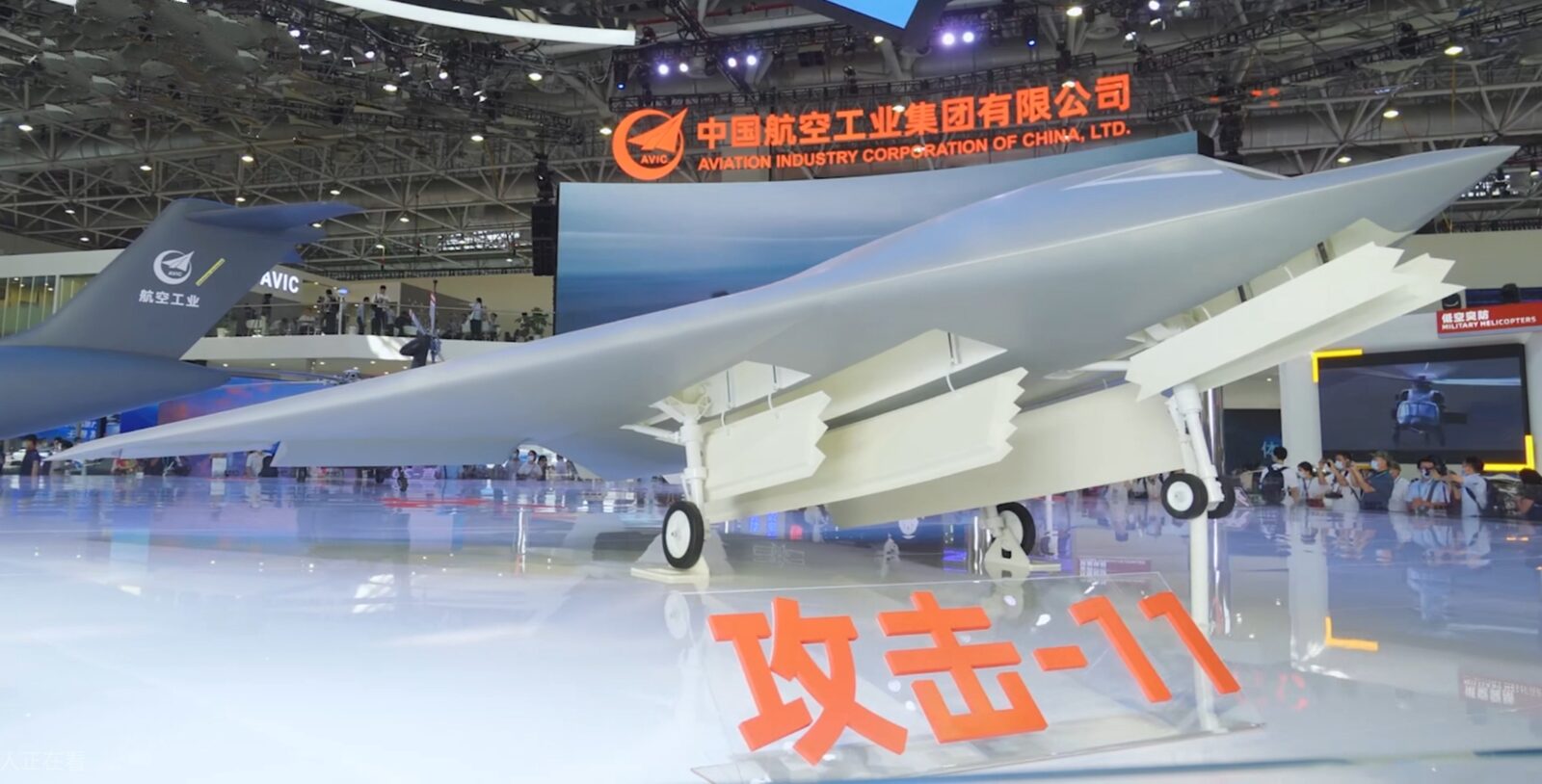
On November 11, 2025, the People's Liberation Army Air Force released a short commemorative film to mark its 76th founding anniversary. Titled “Far-Reaching Dreams,” it contained something defense analysts had spent years waiting to see: the GJ-11 in official, unambiguous aerial footage, flying in tight formation with a J-20 stealth fighter and a J-16D electronic warfare aircraft. The PLAAF formally christened the aircraft Xuanlong — Dark Dragon — and military affairs expert Song Zhongping told state media that the drone “has already reached a certain level of operational capability in terms of operating with manned aircraft.”
Eleven weeks earlier, at Beijing’s September 3 Victory Day parade, a GJ-11 had rolled past cameras with something new and unmistakable: folding-wing hinges, the structural signature of a carrier-optimized aircraft. China’s most capable unmanned combat aerial vehicle — formally designated Gongji-11 (攻击-11), or “Attack-11,” known by its Chinese name Lijian (利剑, “Sharp Sword”) — has been evolving rapidly and, increasingly, in plain view. The pace of that evolution is what demands serious attention now.
Origin and Architecture of the Sharp Sword
The GJ-11 traces to the AVIC 601-S initiative, a program formally launched in 2009 under China’s state aerospace conglomerate. Design responsibility fell to the Shenyang Aircraft Design Institute (601st Institute); manufacturing to Hongdu Aviation Industry Group — both AVIC subsidiaries. The collaboration moved briskly: the first completed airframe was assembled on December 13, 2012, and lifted off on November 21, 2013, at a test flight center in southwest China.
That first flight made China, by GlobalSecurity.org’s account citing Chinese aerospace reporting, the “fourth country after the United States, France, and the United Kingdom” to successfully fly a stealth flying-wing UCAV. The Defense Systems Information Analysis Center — a DoD and DTIC resource — goes further, characterizing the GJ-11 as “the first non-NATO stealthy unmanned combat aerial vehicle.” The aircraft subsequently won second place in China’s National Science and Technology Advancement Prizes, a formal acknowledgment of its strategic significance within the defense establishment.
The airframe is a tailless flying wing with a blended body and trailing-edge control surfaces. The defining structural choice is a dorsal serpentine S-duct intake that shields the engine compressor face from frontal radar illumination — a design constraint that shapes everything from the fuselage cross-section to the flight control architecture. The 2013 configuration showed clear design influence from the Northrop Grumman X-47B and France’s Dassault nEUROn, though subsequent refinements have differentiated the Chinese aircraft in operationally significant ways.
The 2019 Refinement: Nozzle, Stealth, and Operational Status
The 2013 prototype flew with a conventional, non-stealthy exhaust nozzle — an accepted concession on a technology demonstrator, where validating flight dynamics takes precedence over rear-aspect signature management. DSIAC confirms this directly: the first prototype “lacks stealthy nozzle due to its technology demonstrator status.” By the time the GJ-11 appeared at China’s 70th National Day parade on October 1, 2019, that nozzle was gone.
In its place: a buried, flattened exhaust architecture closely resembling the approach used on the X-47B, designed to disperse the thermal plume and reduce both infrared and radar cross-section from the rear aspect. The 2019 aircraft also featured reshaped serrated weapon-bay doors, a refined leading-edge planform, and an overall gray paint scheme matching China’s J-20 fifth-generation fighter. A Chinese military official confirmed at the parade that “all weapons showcased during the parade are in active service” — a direct declaration that the GJ-11 had crossed from demonstrator to operational weapon.
Reuters correspondent Gary Doyle observed that actuator protrusions remained visible on the control surfaces at the 2019 stage — a trade-off between stealth optimization and the flight control authority demanded of an aircraft that relies entirely on differential thrust, elevons, and split-drag rudders, with no vertical tail. Frontal RCS is estimated at less than 0.05 to 0.1 square meters in X-band. Analysis notes that tailless flying wings experience degraded RCS reduction at VHF and UHF frequencies due to Rayleigh and Mie scattering — the same physical constraint that limits the B-2’s advantage against long-wavelength early-warning radars.
The specifications that emerge from open-source assessment place the aircraft at approximately 10 to 12.2 meters in length and 14 to 14.4 meters in wingspan, with an empty weight around 6,350 kilograms and a maximum takeoff weight of 20,215 kilograms. Two internal weapons bays carry approximately 2,000 kilograms total — open-source analysis, including Grey Dynamics, assesses approximately four precision-guided munitions per bay. A single non-afterburning WS-13 turbofan (specific thrust figures remain unconfirmed in primary sources) powers the aircraft, with published performance figures citing a range of approximately 4,000 kilometers, a combat radius exceeding 1,500 kilometers, a service ceiling of 12,500 meters, and approximately six hours of endurance.
Deployment Trajectory: Malan, Shigatse, and the Naval Variant
Through most of 2023, the GJ-11 remained largely invisible outside designated test ranges. That changed sharply in 2024. Planet Labs satellite imagery documented two GJ-11 airframes simultaneously active at Malan Air Base in Xinjiang — a secretive test facility — with separate observations on July 12 and July 18, 2024. Operating multiple airframes concurrently enables what a single-platform program cannot: testing of cooperative autonomous behaviors and manned-unmanned teaming with crewed aircraft across coordinated scenarios. That distinction matters for what comes next: the U.S. Navy’s X-47B was cancelled in 2015 before reaching the multi-airframe cooperative testing phase. In August 2024, independent video of the GJ-11 in flight began circulating on Chinese social media; military analyst Andreas Rupprecht noted this was “not the first” such citizen-captured footage, pointing to earlier sightings in December 2020 and late 2023.
The forward-basing signal arrived in 2025. Between August 6 and September 5, three GJ-11 airframes were confirmed via satellite imagery at Shigatse Air Base in the Tibet Autonomous Region — the first publicly documented forward-basing of a Chinese stealth UCAV at a contested high-altitude border location. Shigatse sits at approximately 12,410 feet elevation, roughly 90 miles northeast of the India-Sikkim border and near the Siliguri Corridor, the 22-kilometer “Chicken’s Neck” bottleneck that connects northeast India to the rest of the country. At least two aircraft bore overall gray paint schemes; one carried a red/brown protective covering. The War Zone, which first reported the deployment, assessed the basing as “in line with an operational test” that “might point to the GJ-11 having reached a semi-operational state.”
The November 2025 formation footage from “Far-Reaching Dreams” made explicit what Chinese state media had been depicting in CGI since at least 2022: the GJ-11 flying as a loyal wingman alongside the J-20. The doctrinal triad that emerges from open-source analysis assigns distinct roles to each platform: the J-16D jams enemy air defense radar; the J-20 provides the command and data-link node while penetrating defended airspace; the GJ-11 executes high-risk strikes in zones too lethal for crewed aircraft.
“The GJ-11 drone has already reached a certain level of operational capability in terms of operating with manned aircraft.” — Song Zhongping, military affairs expert, Global Times, November 11, 2025
Claims that a single J-20 could manage sixteen GJ-11s simultaneously are assessed as aspiration rather than near-term capability; realistic controller-to-drone ratios for the foreseeable future are estimated at two to four GJ-11s per J-20. The gap between that aspiration and demonstrated reality matters because the United States is developing Collaborative Combat Aircraft under comparable doctrinal pressure, and both sides are codifying the rules of manned-unmanned teaming before the hardware fully matures.
The folding-wing hinges visible at the September 2025 parade point toward an active naval variant reportedly incorporating a catapult launch bar, arresting tail hook, folding wing panels, strengthened landing gear, and maritime corrosion-resistant coatings. Mockups consistent with the GJ-11 planform have been photographed near Chinese carrier test catapult facilities and Type 076 amphibious assault ship construction sites; the Type 076’s official emblem reportedly features imagery resembling the aircraft’s distinctive wing planform. If a ship-based variant reaches initial operational capability, it would represent what Army Recognition described as potentially “China’s first shipborne stealth combat drone” — a threshold no other nation, including the United States, has yet crossed.
Why It Matters
The GJ-11’s trajectory represents the convergence of three capabilities that have historically demanded separate platforms: stealth penetration, long-range precision strike, and cooperative operation under manned-aircraft command in actively contested airspace. Its arc from 2013 technology demonstrator to 2025 forward-deployed operational asset — with a carrier variant apparently in development — compresses a timeline that American naval aviation programs never completed. The X-47B demonstrated carrier compatibility and autonomous aerial refueling before the Navy cancelled it in 2015. China did not cancel the equivalent program; it refined it, paused public disclosure, and then accelerated.
The Shigatse deployment illustrates the strategic register at which this program now operates. Positioning a stealth UCAV at a high-altitude base above a friction zone near the Siliguri Corridor is as much a signaling act as an operational one. The GJ-11 expands PLA strike options without pilot exposure; it complicates adversary integrated air defense planning by introducing a low-observable penetrator capable of absorbing the first, most lethal wave of a contested-airspace strike package; and a naval variant aboard the Type 076 or Type 003 Fujian would give Chinese carrier strike groups standoff strike reach no peer competitor currently holds.
The program’s accelerating public exposure — multiple airframes simultaneously at Malan, citizen-captured overflights across populated areas, Shigatse basing in a known friction zone, parade appearances with folding wings already attached — suggests China has moved past the phase where concealment was the dominant priority. The Sharp Sword is no longer a secret. It is a statement of where PLA airpower intends to go, and a measure of how far it has already traveled.
Sources
- DSIAC (DoD/DTIC) — China’s Sharp Sword: A Stealth Drone That Can Likely Carry 2 Tons of Bombs
- GlobalSecurity.org — Lijian (Sharp Sword) GJ-11 UCAV
- The Aviationist — China Exhibits New Sharp Sword UCAV During Military Parade for PRC’s 70th Anniversary
- The War Zone — China’s Stealth Sharp Sword UCAVs Deployed to Operational Airbase
- The War Zone — Chinese Flying-Wing UCAV Testing Accelerating Based on Satellite Imagery, Videos
- Grey Dynamics — GJ-11: China Integrating Manned and UCAV Systems
- Army Recognition — New GJ-11 Variant May Signal China’s First Shipborne Stealth Combat Drone
- The Defense Post — China GJ-11 UCAV
- Defense One — New Drones, Weapons Get Spotlight in China’s Military Parade
- Drone Warfare — GJ-11 Sharp Sword Open-Source Analysis
- The Aviationist — China’s GJ-11 Sharp Sword UCAV Captured Flying (August 2024)
- GlobalSecurity (Global Times reprint) — GJ-11 Xuanlong Debut, November 2025
