
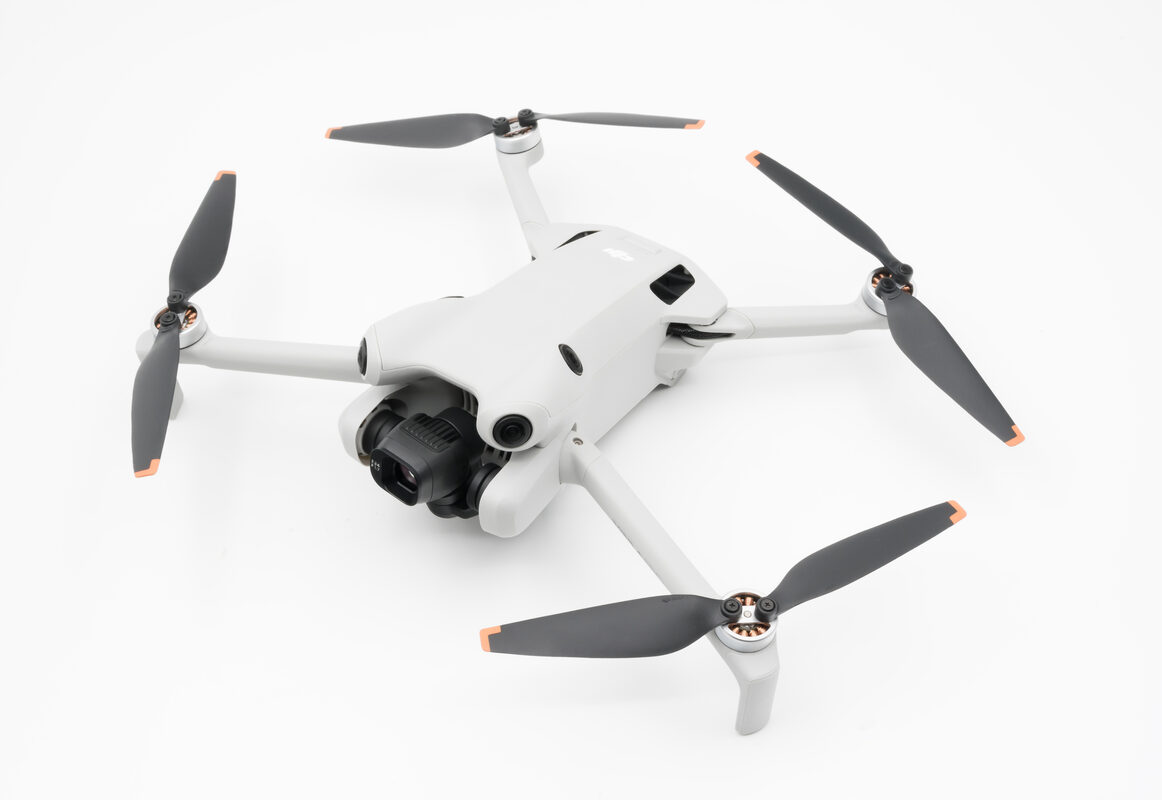
On Oct. 19, three Chinese government bodies jointly issued Announcement No. 49 of 2026: the Ministry of Commerce (MOFCOM), the General Administration of Customs and the Central Military Commission's Equipment Development Department. It rewrites China's export controls on unmanned aircraft. It takes effect Nov. 18, and China's Dual-Use Export Control List is updated on the same day. From then on, the listed items cannot leave the country without a license.
Some early English-language coverage emphasized the new licensing requirements. The text says something more mixed. Controls on many mid-range and agricultural aircraft are looser than before. Controls on the parts inside drones, and on the software and know-how used to build them, are much broader. For buyers who rely on Chinese propulsion parts, the real question is which entries actually catch real products. The answer depends on the entry.
The rule text was read in the Chinese original. Translations of item descriptions are UASFeed's own.
What the announcement controls
The announcement lists 13 controlled categories. They fall into four groups.
Whole aircraft. Item 9A012.a covers UAVs that can fly under control beyond the operator's natural line of sight and meet one of two tests. The first is endurance of 30 minutes to under three hours combined with the ability to take off and fly stably in gusts of 46.3 km/h (25 knots) or more. The second is endurance of three hours or more. Item 9A112 covers UAVs with a range of 300 km or more. It also covers UAVs with autonomous flight control and navigation, or with beyond-line-of-sight control, that carry or are designed to carry an aerosol dispensing system larger than 80 liters. Model aircraft built for recreation or competition are excluded.
Subsystems. 7A103.b covers autopilots specially designed for unmanned aircraft. 9A012.b covers piston or rotary engines designed to work above 15,420 m, aircraft engines with continuous power above 16 kW, and turbojets with 400 N of thrust or more. 9A012.e covers radios specially designed for 9A012.a aircraft that have an effective isotropic radiated power (EIRP) of 30 dBm or more, or a single station that controls more than 10 aircraft. A new 9A901 family covers brushless motors (9A901.a), electronic speed controllers (9A901.b) and carbon-fiber propeller blades (9A901.c).
Software. 9D901 covers software specially designed for items under 9A012.a and 9A112.
Technology. 7E103 covers gimbal stabilization and payload technology. 9E901 covers flight-control technology, which includes swarm control, navigation, sense-and-avoid and system design. 9E903 covers polar light UAV technology. 9E904 covers technology for human-machine hybrid control in environments with weak communications. 0E903 covers counter-UAV technology.
Exporters must declare the technical characteristics of their goods to Customs and mark their declarations. Customs may question a declaration and does not release the goods while it does. The announcement also includes some relief: registration-based self-export for items under 9A012.a.1, an exemption for goods shipped to exhibitions and brought back (defense and police shows excluded), and general licenses for companies that run internal compliance programs.
Looser at the top, wider at the bottom
Shanghai law firm AllBright Law Offices published an analysis on Oct. 21. It describes the announcement as a calibrated adjustment that is lenient in some places and strict in others, not a simple crackdown. Mid-range aircraft with one to three hours of endurance but no gust tolerance are no longer caught, because the gust requirement now has to be met alongside the endurance band. The aerosol threshold, which matters most for crop-spraying drones, rises from 20 L to 80 L. The radio test moves from a 50 km line-of-sight range to the 30 dBm EIRP figure. The controls now reach down the supply chain to components, software and technology.
AllBright also places the rule in a sequence. In June 2026, Customs Announcement 78 required exporters to declare whether their goods were controlled. In August, MOFCOM Announcement 34 put drone-related dual-use items bound for the United States under strict case-by-case review, with no license facilitation. On the same day as Announcement 49, the authorities also issued Announcement 50 (covering tunnel boring machines, among other items), Announcement 51 (dredgers) and Announcement 52 (export-control query and identification).
Taken together, these steps look less like a ban and more like a system for watching shipments. Exporters must self-classify. Customs can question them. The state can now license the parts that turn a commercial airframe into something more capable.
The motor test: four conditions, all required
The 9A901.a motor entry has drawn the most attention. It is also the narrowest. A brushless motor specially designed for UAV propellers is controlled only if it meets all four of these conditions:
- rated voltage of 48 V or more;
- rated power of 3 kW or more;
- rated power density of 3 kW/kg or more;
- rated speed of 3,000 rpm or less.
On Oct. 26, DroneXL checked published spec sheets from Hobbywing and T-Motor against those conditions. It found that the four tests catch neither Hobbywing's X15 nor T-Motor's U15 II, the largest multirotor motors either company publishes full test tables for.
The Hobbywing X11 Plus runs at 54 V, so it passes the voltage test. Its rated power is 2,130 W, and it turns at 3,414 rpm at full throttle. DroneXL found it fails three of the four tests. The larger X15 runs at 69 V and is rated at 4,400 W, which clears both the voltage and power tests. But the motor weighs 2,850 g including wire, which gives a power density of about 1.5 kW/kg. That is half the threshold, so the X15 is not caught either.
The density requirement does the most work. DroneXL says a motor that holds 3 kW per kilogram under 3,000 rpm at a continuous rating is a cargo-drone or manned-aircraft part, and notes that Hobbywing's agricultural motors are built heavy for cooling and duty cycle.
Hobbywing's P-series motors cannot be judged from public data. DroneXL reports that the P50M runs at 280 to 450 V and 6 kW, the P65M at 8.8 kW and the P115M at 18.3 kW. Hobbywing does not publish bare motor weight or rated speed for them, so two of the four tests cannot be checked from the spec sheet. DroneXL also says T-Motor labels nothing "rated" at all. The rule is written in terms of rated values, so outside observers cannot classify those motors with confidence. Exporters have to do it themselves and declare the result to Customs.
A misreading worth correcting
DroneXL also points out an error in some early coverage. The "50" and "65" in the P50M and P65M names refer to rated thrust in kilograms per rotor, not voltage. According to DroneXL, Army Recognition described Hobbywing's "50 V and 65 V motor lines" as sitting above the 48 V floor, and TechTimes wrote that the P50M is rated at 50 V and the P65M at 65 V. In fact the P50M's input range starts at 280 V.
The propeller entry is much broader
The carbon-blade entry, 9A901.c, has no multi-part test. A carbon-fiber composite blade usable on a UAV is controlled if it meets any one of three conditions. For a fixed-pitch blade whose structure passes through the center of rotation, the length from the center to the tip is 762 mm (30 in) or more. For a fixed-pitch blade that does not pass through the center, the length from the root end face to the tip is 648 mm (25.5 in) or more. Or the blade root has a variable-pitch function.
DroneXL says the P-series propulsion systems fly 54- to 73-inch propellers, and that the three largest options put each blade past the longer line. DJI's Agras T100 agricultural drone lists 62-inch carbon-fiber composite folding propellers. Because each folding blade is a separate part on a hub, DroneXL measures it against the shorter line and puts it about 4 inches past. The motors that turn those blades may avoid control, but the carbon blades themselves would fall under the entry. DroneXL adds that Hobbywing sells the X15's 63-inch propeller as carbon-fiber-reinforced nylon, and whether that counts as "carbon fiber composite" is a classification question for the ministry.
The speed-controller entry, 9A901.b, has a shorter test: 48 V or more and 3 kW or more. It covers only controllers specially designed to pair with motors controlled under 9A901.a, so whether a given controller is caught may depend on how its paired motor is classified. Army Recognition describes the controllers as controlled when rated for at least 48 V and 3 kW.
Autopilots, radios and technology
The rest of the list may matter more than the propulsion entries. The 7A103.b autopilot entry and the 9E901 technology entry cover the electronics and know-how that let an aircraft navigate, avoid obstacles and fly in coordinated groups. The 9E901 entry names swarm control specifically. The radio entry, at 30 dBm EIRP or more than 10 aircraft per station, is a power-and-scale test applied to radios specially designed for the controlled aircraft in 9A012.a.
Army Recognition reported the announcement as easing registration for standard civilian UAVs while adding licensing for heavy multirotor propulsion, high-voltage ESCs, carbon propellers, autopilots and navigation software. That summary fits the text. The outlet also cited wider context: Ukraine's goal of 6 to 7 million small FPV drones in 2026, an estimate that Russia gets about 80 percent of its critical drone electronics from Chinese suppliers, and a U.S. goal of more than 200,000 drones by 2027. Those are Army Recognition's figures, and UASFeed has not independently verified them.
Why It Matters
Announcement 49 moves China's controls from finished aircraft to the parts and knowledge inside them. A mid-endurance commercial quadcopter or a spray drone with a tank of 80 liters or less may now be easier to ship than before. A crate of large carbon propellers or a flight-control software package may need a license.
For Western manufacturers that build their own airframes around Chinese propulsion and avionics, the risk, on DroneXL's reading, is not mainly the motor test, which the largest published motors miss. The risks are the propeller, autopilot and software entries, possibly the speed controllers, along with the declaration rules that let Customs hold shipments while it asks questions. Under the August Announcement 34, buyers in the United States already face case-by-case review with no facilitation, and DroneXL notes the new entries join that queue on Nov. 18.
For agricultural operators, the effect cuts both ways. The higher 80-liter aerosol threshold eases whole-aircraft control for crop-spraying drones. But the large carbon blades some of those aircraft use, such as the T100's 62-inch blades, would be controlled as separate parts.
Much will depend on enforcement. T-Motor does not label any figures as rated, and Hobbywing omits weight and speed for its P-series motors, so classification will fall largely to exporters' own declarations. How Customs treats those declarations will decide how narrow the rule really is.
Sources
- Ministry of Commerce, General Administration of Customs, CMC Equipment Development Department: Announcement No. 49 of 2026 (Chinese)
- DroneXL: China's 48-Volt Drone Motor Rule Is Narrow. Its Propeller Rule Is Not
- AllBright Law Offices: Analysis of Announcement No. 49 of 2026 (Chinese)
- Army Recognition: China tightens drone export controls, raising supply chain risks for the US, Europe, and Ukraine
