
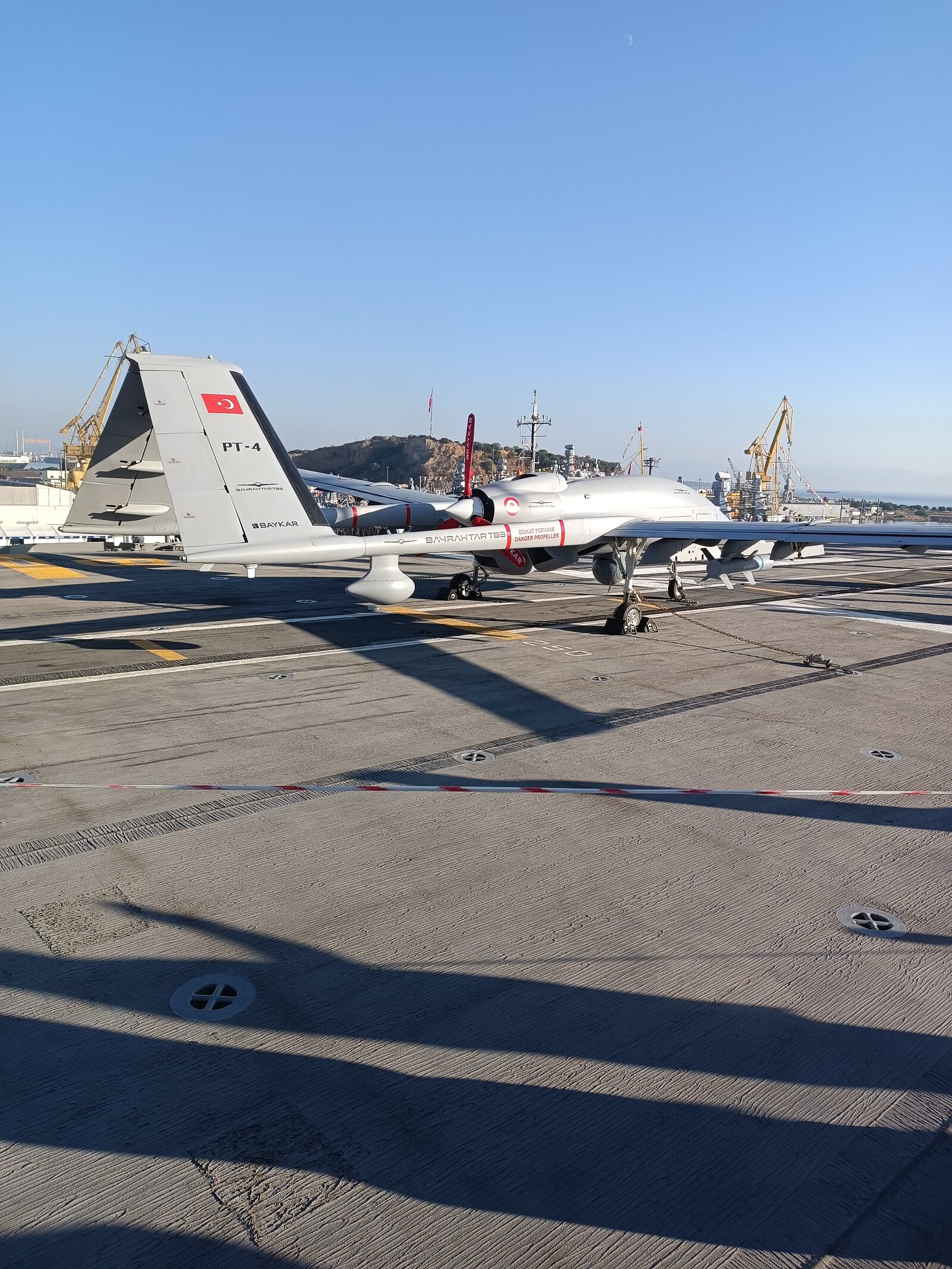
In 2019, Turkey was formally ejected from the F-35 program after purchasing Russia's S-400 Triumf air-defense system. The diplomatic fallout left TCG Anadolu (L-400) — Turkey's flagship amphibious assault ship, designed around the F-35B's short-takeoff profile and fitted with a 12-degree ski-jump bow — without a fixed-wing air wing. The ship was commissioned regardless, in 2023, but the gap it represented was obvious. A billion-dollar hull with helicopter-only fixed-wing capacity is a political embarrassment as much as a military one.
Rather than accept that outcome, Ankara directed Baykar — the company behind the Bayraktar TB2, whose combat debut over Azerbaijan in 2020 had already redrawn assumptions about MALE UAS in peer-adjacent warfare — to build something purpose-designed for the ship. The result was announced in 2021, unveiled at TEKNOFEST Istanbul in late April 2023, and first flown on October 27, 2023, the date chosen to mark the centennial of the Turkish Republic. Selçuk Bayraktar, Baykar's CTO, framed the milestone in terms his audience understood: "On the Republic of Turkey's centennial, the Bayraktar TB3 uncrewed aerial vehicle successfully completed its maiden flight."
An Enlarged Derivative — With Critical New Engineering
The TB3 is not a clean-sheet design. It is a naval evolution of the TB2, but the changes run deep enough that calling it a derivative understates the engineering investment. The TB2's Austrian Rotax 912 engine is gone, replaced by the TEI-PD170 — an indigenous turbodiesel built by TUSAS Engine Industries. The PD170 is a straight-four, 2.1-liter unit producing 172 hp, compatible with JP-8 or Jet-A1 fuel. At 162 kg it is heavier than the Rotax, but it was specifically engineered for maritime atmospheric conditions: corrosive salt air, humidity cycling, and the thermal stress of prolonged low-altitude overwater flight. The engine alone represents years of domestic propulsion development that Turkey did not possess when the TB2 entered service.
The airframe grew substantially. Wingspan stretches from 12 meters (TB2) to 14 meters; maximum takeoff weight nearly doubles, from 750 kg to 1,450 kg; payload capacity more than doubles, from 130 kg to 280 kg. Six weapons hardpoints replace four. Reinforced landing gear handles the cyclic stress of repeated carrier deck operations. Cruise speed is 125 knots, with a maximum of 150–160 knots; service ceiling 25,000–30,000 feet; and endurance exceeds 24 hours. In December 2023, a TB3 set an endurance record of 32 hours covering 5,700 km. In June 2024 it reached 36,310 feet. The mission radius at 20,000 feet is 2,200 km — sufficient to range across the Eastern Mediterranean from a mid-Aegean operating position.
The ISR suite centers on an EO/IR sensor with laser designator, enabling target acquisition and strike designation. The TB3 can designate targets for other platforms and strike — often in the same sortie.
The Deck Problem: Folding Wings, No Arresting Wires
Every design choice above flows from a hard physical constraint: TCG Anadolu is an amphibious assault ship, not a fleet carrier. It has no catapults, no arresting wires, and no angled deck. Launches must use the 12-degree ski-jump ramp. Recovery must be entirely autonomous — the TB3 must guide itself to a rolling deck landing with no hook and no external assistance, backed only by roller launch systems and recovery safety nets.
The folding wing is the entry price. A 14-meter fixed wing cannot be stowed in Anadolu's hangar bays. Carrier aviation has solved this problem with manned aircraft since World War II, but applying folding-wing engineering to a MALE UAV at this weight class required Baykar to solve structural load paths, fold actuators, and wing-lock mechanisms without the benefit of a standard naval aviation supply chain. The ship has capacity for 30–50 TB3s and can surge to 10 simultaneous armed sorties.
Autonomous recovery was the harder challenge. Baykar ran thousands of simulated landings — in software and hardware-in-the-loop rigs — before attempting the real thing. On November 19, 2024, the TB3 executed autonomous takeoffs and landings from TCG Anadolu, without external pilot input, without arresting gear, and without incident. Jane's Defence was direct about the significance: "The Bayraktar TB3 has made history as the first unmanned aerial vehicle (UAV) to successfully take off and land on the short-runway carrier TCG Anadolu."
Live Targets and the Strike Demonstration
October 9, 2025 — the Sea Wolf-I (Denizkurdu) exercise off Antalya — removed any remaining ambiguity about whether the system was operationally credible. Two TB3s launched from TCG Anadolu, acquired surface targets, and struck them with Roketsan munitions. The compatible stores are MAM-L (22 kg, approximately 15 km range) and MAM-T (95 kg, 30-plus km range), both laser-guided. A Bayraktar Akinci simultaneously engaged three additional targets. It was the first live-fire proof of the Anadolu–TB3 combination at scale.
Selçuk Bayraktar had laid out the strategic logic years earlier: "With their deployment on board, they will become a major force multiplier in overseas operations thanks to their long-term reconnaissance and strike capabilities." The October 2025 live-fire exercise demonstrated that the Anadolu–TB3 combination had moved from developmental trials to operational strike capability.
Why It Matters
Turkey's "Blue Homeland" (Mavi Vatan) maritime doctrine asserts sovereign rights over large portions of the Aegean, Eastern Mediterranean, and Black Sea — claims that put Ankara in recurring friction with Greece, Cyprus, and EU members who depend on American security guarantees in the region. TCG Anadolu with its TB3 air wing is the kinetic expression of that doctrine: a ship that projects fixed-wing ISR-strike power without the basing agreements, treaty constraints, or aircrew exposure of a conventional carrier.
To be clear about what the TB3 is not: it is a turbodiesel MALE UAS survivable against non-peer, non-integrated air defenses. It does not contest airspace against a modern IADS. The ski-jump geometry caps launch weight relative to a catapult, limiting maximum payload per sortie. And the TB3's intended partner — Kızılelma (formerly MIUS), Baykar's jet-powered UCAV intended to provide supersonic combat air patrol — is still in developmental testing. Kızılelma completed its first air-to-air intercept, destroying an aerial target with the indigenous GÖKDOĞAN missile, only in November 2025. Supersonic variants are planned but not yet flying. Together, the pair aims to constitute a two-tier drone air wing: TB3 as the long-endurance ISR-strike layer, Kızılelma as the fast-mover fighter layer — as Baykar put it, to operate "together at TCG Anadolu for the safety of our Blue Homeland."
The concept's leverage, however, does not depend on peer-level capability to matter. A ship carrying 30–50 armed drones with 24-hour loiter and onboard targeting capability represents persistent maritime strike capacity that mid-tier navies have never been able to deploy from a seagoing platform. Baykar has committed roughly $300 million over five years to indigenous jet engine development — a fraction of a conventional carrier air wing's lifecycle cost. That ratio, as much as the TB3's specs, is what mid-tier navies from Southeast Asia to the Middle East are studying. The platform is the proof of concept. The concept is that you do not need a superpower budget to field one.
Sources
- Jane's Defence — Türkiye flies TB3 UCAV from Anadolu aircraft carrier (November 2024)
- Jane's Defence — Turkey debuts prototype TB3 UAV (April/May 2023)
- Naval News — TB3, the new shipborne variant of TB2 Bayraktar, makes first flight (November 2023)
- Naval News — Turkey to deploy MIUS unmanned combat aircraft from LHD Anadolu (July 2021)
- Army Recognition — Türkiye demonstrates carrier-capable Bayraktar TB3 drone launches from TCG Anadolu (2025)
- Army Recognition — Turkish Bayraktar TB3 UCAV successfully performs first takeoff and landing on TCG Anadolu (November 2024)
- Baykar — Naval variant of the famous Bayraktar drone ready for first flight (October 2023)
- Naval Technology — Bayraktar TB3 Armed UAV (Turkey)
- The War Zone — Turkey's Bayraktar TB3 Drone Has Taken Its First Flight (October 2023)
- Army Recognition — Focus: Türkiye's Bayraktar TB3, a new era in carrier-based drone warfare (2024)
