
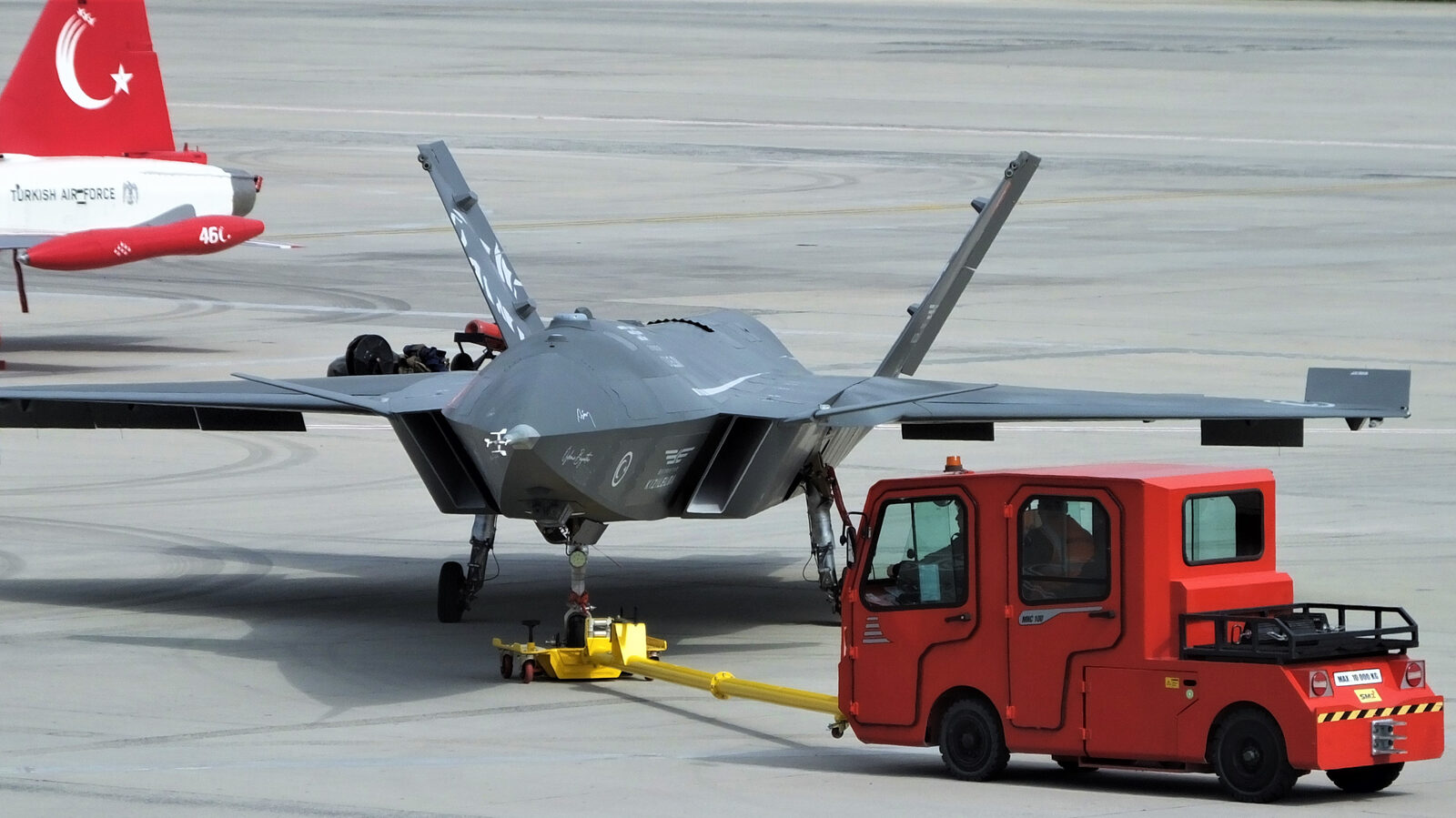
On November 29, 2025 (some reports, including The Aviationist, cite November 28), a prototype designated PT-5 climbed over the Black Sea near Sinop, locked a radar track on a jet-powered target drone, and fired a Gökdogan beyond-visual-range air-to-air missile. The target did not survive. It was the first time an unmanned combat aircraft had engaged and destroyed an aerial target at BVR range using an active radar-guided missile — and the platform that accomplished it was not the product of a U.S. or European defence prime, but of Baykar, the Turkish family firm whose TB2 rewrote ground-combat calculus over Nagorno-Karabakh.
That intercept crystallizes what the Bayraktar Kızılelma actually is: not another armed ISR drone elevated to strike duty, but a purpose-built, jet-powered, internally-armed, low-observable unmanned fighter with a sensor suite designed to go to war against other aircraft. In the taxonomy of unmanned combat systems, it occupies a category that barely existed before it flew.
Nine Years from Concept to Combat Prototype
Baykar's internal programme began as early as 2013 under the designation MIUS. The name Kızılelma came later — "Red Apple" invokes a concept in Turkish mythology: a shimmering, perpetually receding objective that defines civilizational aspiration. The platform went public in July 2021 and made its first flight on December 14, 2022, at Çorlu Airport roughly 50 miles west of Istanbul; that sortie lasted 18 minutes. By aviation-programme standards, 15 months from public unveil to airborne prototype is a sprint.
The test campaign accelerated from there. On April 24, 2023, Kızılelma and the Bayraktar Akıncı performed the world's first unmanned-to-unmanned formation flight during Kızılelma's ninth and tenth test sorties at Akıncı Flight Training and Test Center in Çorlu. The production-standard prototype, designated PT-3, completed its maiden flight on September 25, 2024 — 21 months after the design prototype's debut. Autonomous formation flight between PT-3 and PT-5 was demonstrated in December 2025.
The November 2025 BVR test was not a solo event. Five Turkish Air Force F-16s from the 5th Main Jet Base Command at Merzifon flew manned-unmanned teaming profiles alongside PT-5; both the Baykar and Aselsan CEOs rode twin-seat F-16Ds during the engagement. The manned aircraft functioned less as overseers than as coordination nodes — a sketch of what mature MUM-T doctrine may look like as autonomous decision loops compress.
Airframe, Sensors, and an Entirely Indigenous Arsenal
The Kızılelma is a mid-size combat aircraft: 14.5 metres long, 10-metre wingspan, 3.5 metres tall, maximum takeoff weight reported variously as 6,000 kg (Janes, C4ISRNET) and approximately 8,500 kg (Airforce Technology, Baykar 2023), payload capacity 1,500 kilograms. The current production-representative variant is powered by a single AI-322F turbofan from Ukraine's Ivchenko-Progress, generating 4,200 kilogram-force with afterburner. That engine caps the aircraft at a subsonic envelope — cruise Mach 0.6, maximum Mach 0.9 — with an operational ceiling of 35,000 to 40,000 feet, four-to-five-hour endurance, and a combat radius of approximately 500 nautical miles. SATCOM provides the beyond-line-of-sight control link.
The airframe incorporates low-observable shaping and an internal weapons bay, architectural choices that distinguish Kızılelma from the hard-point-hung predecessors in Baykar's lineup. The primary sensor is Aselsan's MURAD Active Electronically Scanned Array radar, providing multi-target tracking in air-to-air and air-to-ground modes with wide-area airspace search capability. Complementing it: an Aselsan infrared search and track system, and the TOYGUN electro-optical targeting system, successfully integrated in November 2025. AESA plus IRST plus EOTS creates redundant, independent detection channels that complicate jamming-only countermeasures. Autonomous AI systems for mission execution are also embedded; their operational scope has not been publicly detailed.
The weapons suite is almost entirely Turkish. Air-to-air ordnance comprises two dedicated missiles: the Bozdogan for within-visual-range engagements and the Gökdogan for BVR. Developed by TÜBİTAK SAGE with active radar guidance, the Gökdogan provides active radar homing capability for BVR engagements. The November 2025 Black Sea intercept marked the first time any UCAV replicated — against an aerial target — the BVR engagements manned fighters have prosecuted with active-radar missiles for decades. Air-to-surface options include the SOM-J cruise missile with range exceeding 250 kilometres and the Roketsan MAM family of guided munitions that established the TB2's strike reputation. TOLUN and TEBER-82 guided bombs completed live-fire trials in October 2025. All ordnance deploys from internal bays, preserving the low-observable profile across an engagement envelope that now demonstrably includes aerial intercept.
"Our country has stepped into the domain of unmanned fighter aircraft, which is ushering the future of air warfare." — Selcuk Bayraktar, Baykar Technology Chief
Carrier Operations, the Export Pipeline, and a Supersonic Roadmap
Kızılelma was designed from the outset for shipboard operations aboard Turkey's TCG Anadolu landing helicopter dock, incorporating short-runway take-off and arrested or rolling-vertical landing capability. Deploying a jet-powered, BVR-armed UCAV from an LHD that carries no manned fixed-wing aircraft gives Turkey a power-projection configuration structurally different from traditional carrier air wings — and one exportable to navies without nuclear-powered supercarriers.
That market potential is already converting to contracts. At the SAHA 2026 defence exhibition in Istanbul, Baykar signed with Indonesia's Republikorp Group for an initial batch of 12 Kızılelma UCAVs, with an option to expand to 48, deliveries scheduled from 2028. The deal includes MRO facilities, building on a February 2025 joint venture covering local TB3 and Akıncı production. Turkish Air Force deliveries are planned to begin in 2026 as domestic series production ramps.
A supersonic successor — informally designated Kızılelma-B — is on the roadmap, integrating an afterburning turbofan for sustained Mach 1-plus flight. Baykar characterises it as a future iteration rather than an active programme, a qualification that carries less weight given the pace at which PT-1 through PT-5 moved through the test campaign.
Why It Matters
Janes characterises Kızılelma as a "loyal wingman" UCAV built to operate alongside manned fighters. The November 2025 intercept and the MUM-T trials with F-16s complicate that framing. A loyal wingman is typically conceived as subordinate and enabling; an aircraft that independently tracks, locks, and fires on aerial targets with active-radar missiles at beyond-visual range is something closer to a peer-minus that happens to fly without a pilot aboard.
For the UCAV market broadly, Kızılelma sets a proof-of-concept for a category that until recently existed mainly in programme slides: jet-powered, stealthy, internally armed, carrier-capable, and now with a combat-confirmed BVR intercept on its record. Whether performance holds in actual contested airspace — against effective jamming, maneuvering targets, and real threat timelines — remains an open question. The November test was controlled; the target drone cooperative relative to a crewed adversary. But the milestone sequence through late 2025 is unambiguous: the aircraft is real, the weapons work, and a paying customer has signed before the first Turkish Air Force delivery.
"As the Commander of the Turkish Air Force, I believe we are witnessing a historic day, and when we look back in the future, everyone will better understand what this truly means." — Gen. Ziya Cemal Kadıoğlu, Turkish Air Force Commander
Sources
- C4ISRNET — Turkey's future unmanned fighter jet conducts first flight (2022)
- Janes — Türkiye flies first production-standard Kızılelma loyal wingman UCAV (2024)
- Janes — SAHA 2026: Baykar signs agreement to export Kızılelma to Indonesia (2026)
- C4ISRNET — Turkey's Kızılelma combat drone hits test target in all-Turkish setup (2025)
- Airforce Technology — Bayraktar Kızılelma Fighter UAV, Turkey (updated 2025)
- Baykar Technology — Turkish Unmanned Jet Kızılelma & Drone Akıncı Conduct Formation Flight (2023)
- The Aviationist — Turkey's Kızılelma Gökdogan live-fire test (2025)
