In the spring of 2022, as Russian armor pushed into Ukraine, a Ukrainian soldier named Taras Borovok wrote a folk song — not about a commander or a battle, but about a weapon. The song was called "Bayraktar." It named a combat drone built by a privately held Turkish family company that most Western defense analysts had barely registered five years earlier. The chorus captured the moment in a way no press release could: "A diligent shepherd that drives them afar…Bayraktar!"
The song went viral, spawning remixes and an internet radio station that renamed itself "Radio Bayraktar." That cultural moment also serves as the sharpest entry point into a company that achieved something the conventional defense industry logic said was improbable. Baykar Technology — still family-owned, still headquartered in Istanbul — built a combat-proven UCAV line that now holds an estimated 65 percent of the global unmanned combat aerial vehicle export market. It accomplished this without state subsidies, inherited procurement infrastructure, or Cold War legacy programs. It is now embedding that industrial capability inside Europe.
Family Name, National Mission
"Bayraktar" means "flag holder" in Turkish. The drone line carries the surname of Özdemir Bayraktar, the company's founder and chairman, who built Baykar initially as a supplier of CNC precision automotive components before pivoting to aerospace. The company today describes itself as Turkey's first technology company to develop indigenous UAVs — a statement that functions simultaneously as a historical claim and a founding rationale.
Leadership has remained within the family. Haluk Bayraktar serves as CEO; Selçuk Bayraktar holds the dual roles of CTO and Chairman. The company has earned 90 percent of its revenue from exports as of 2024 — a figure that makes clear the domestic market was always a launchpad rather than a destination.
The TB2 program began in the late 2000s with a specific strategic mandate: reduce Turkey's dependence on foreign unmanned systems that could be withheld during a conflict. That concern was not theoretical in the Turkish context. The company's stated localization rate of 93 percent domestic industry contribution reflects that founding design philosophy, baked into the supply chain from the outset rather than retrofitted later.
The TB2: Specs, Records, and Combat History
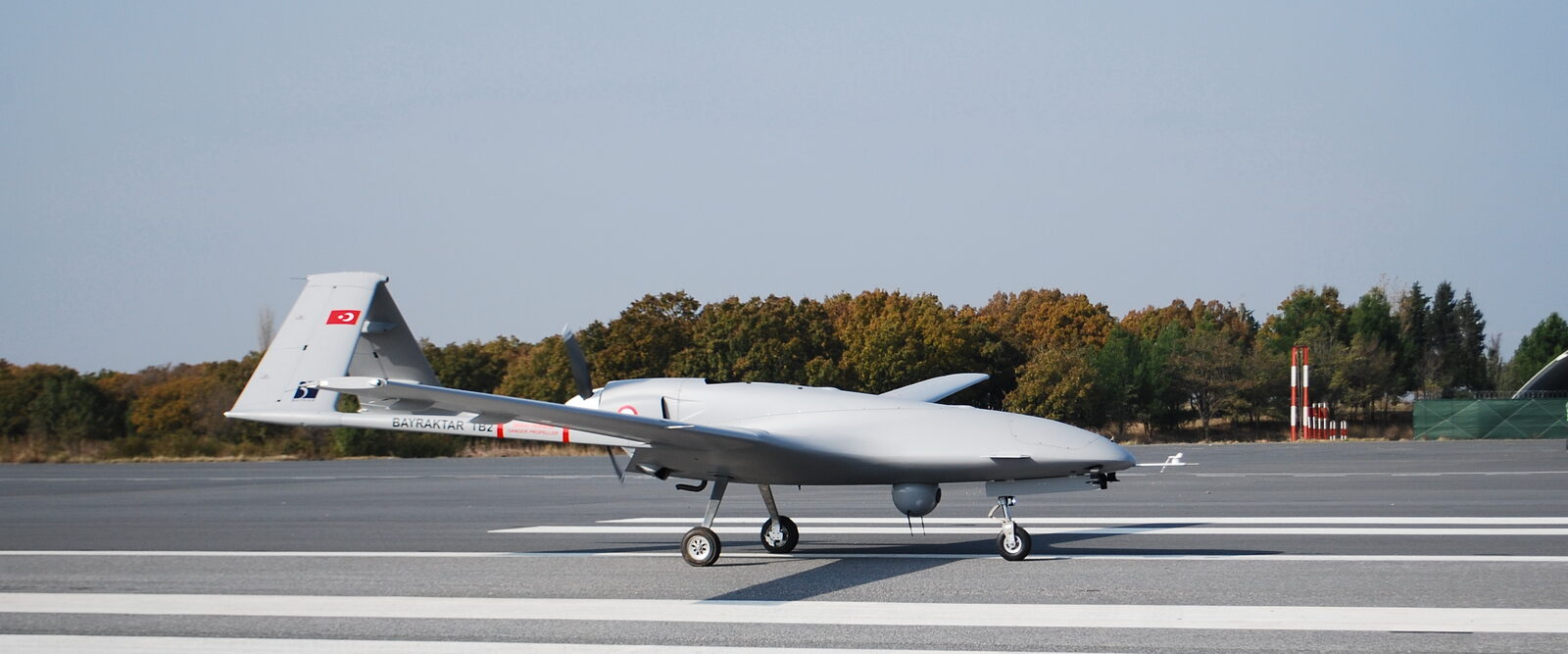
The Bayraktar TB2 is a medium-altitude, long-endurance UCAV: 12-meter wingspan, 6.5-meter length, 700 kg maximum takeoff weight, 150 kg payload capacity, rated endurance exceeding 24 hours. In July 2019, during a Kuwait demonstration, the platform validated that endurance figure in the field — logging 27 hours and 3 minutes of continuous flight. A subsequent test set a Turkish national altitude record at 30,318 feet. As of Baykar's most recent published figures, the global TB2 fleet has accumulated 1.25 million flight hours and covered approximately 150 million kilometers — equivalent to circling Earth 3,742 times.
Each TB2 "system" is sold as a complete package: six aerial vehicles, two ground control stations, three ground data terminals, two remote video terminals, and support equipment. Ukraine's 2019 purchase — six systems for $69 million, including ammunition for armed configurations — gave Kyiv its initial UCAV capability. In September 2021, Ukraine announced plans to acquire 24 additional Turkish UCAVs.
The combat record spans multiple theaters and geopolitical contexts. Turkish-backed forces deployed TB2s in Syria and Libya. Azerbaijan used the platform to decisive effect against Armenian armor and air defense systems during the 2020 Nagorno-Karabakh conflict — the engagement that generated the first serious Western analytical attention to the TB2's capabilities. Ukraine's first documented combat use came on October 26, 2021, when a TB2 destroyed a Russian-separatist howitzer in eastern Ukraine. When the full-scale invasion began in February 2022, the drone's operational role expanded and Borovok's song followed.
"Today, with $1.8 billion in exports in 2024, Baykar stands as the undisputed leader in the global UAV export market." — Haluk Bayraktar, CEO of Baykar
Baykar has continued pushing the platform's technical envelope beyond its established combat role. In May 2024, a TB2 completed the first autonomous barrel roll ever performed by a UAV. In a subsequent test, it became the first armed UAV to execute an autonomous spin recovery — demonstrations that suggest ongoing work toward expanding autonomous flight certification, rather than treating the airframe as a mature, static design.
Global Reach, European Footprint
The TB2 anchors a broader and expanding product portfolio. The Akıncı is a heavier, high-altitude MALE platform; the Kızılelma is an unmanned fighter concept. The TB3 — whose prototype debuted at Teknofest in Istanbul in 2023 — is a carrier-capable TB2 derivative with foldable wings, retractable landing gear, a 14-meter wingspan, 1,450 kg maximum takeoff weight, 280 kg payload capacity, and six hardpoints versus the TB2's four. Designed to operate from Turkey's TCG Anadolu amphibious warship, it carries a rated mission radius of 2,200 km at altitude and a service ceiling of 30,000 feet. The loitering munitions line includes KEMANKEŞ 1 and 2, the MIZRAK with a claimed range exceeding 1,000 km, and the K2 Kamikaze UAV.
The export footprint is the more consequential number. Thirty-six countries have signed agreements for the TB2. Among TB2 operators, six are NATO member states and four are EU members — an unusual penetration into Western alliance procurement for a non-Western, non-legacy OEM. A Center for a New American Security report, cited by Baykar, attributes approximately 65 percent of the global UCAV export market to the company.
Turkey's total defense and aerospace exports crossed $4 billion for the first time in 2022, reaching $4.3 billion. An industry observer at the time noted that growth "should be attributed primarily to aerospace, and homemade drones in particular." Baykar's share was near-total: its exports represented 98 to 99 percent of its 2022 revenue. In 2023, Baykar's $1.8 billion represented roughly one-third of Turkey's $5.5 billion in total defense exports; in 2024, approximately one-quarter as the sector total rose to $7.15 billion. In 2024, the company ranked first among all Turkish defense exporters, ahead of Turkish Aerospace Industries at $750 million and ASFAT at $644 million.
The Piaggio Aerospace acquisition, completed June 30, 2025, is the most significant expansion of Baykar's industrial geography. Piaggio is a 140-year-old Italian aviation company; the deal required approval from the Italian Prime Minister's Office under Italy's "Golden Power" foreign investment review mechanism. At the signing ceremony in Rome — attended by Italian Minister Adolfo Urso, Haluk Bayraktar, and Piaggio's extraordinary commissioners — Urso framed the transaction in sovereign industrial terms: "With this operation, we are safeguarding a strategic industrial asset for the country and laying the foundation for a concrete relaunch of the Italian aerospace sector." Under Baykar ownership, Piaggio will produce both the P.180 Avanti EVO turboprop and Akıncı and TB2 UCAVs, serving as a European manufacturing hub and maintenance center. Baykar also holds a separate existing joint venture with Leonardo, Italy's largest defense prime, for UAV development.
In Ukraine, Baykar committed $100 million across three projects: a production unit, service center, and head office. The Ukrainian government authorized local production of TB2 and Akıncı drones in June 2023; construction began the following month, with a planned workforce of at least 300 when operational. Haluk Bayraktar described Ukraine as "a long-term, strategic partner rather than just a market."
Why It Matters
Baykar's trajectory compresses several defense industry trends into a single, readable case study. A family-owned firm — without state subsidies, cost-plus contracts, or inherited Cold War infrastructure — built a platform that proved itself across multiple live combat environments and used that proof to dominate a market that better-resourced competitors had largely left uncontested. The TB2 was not the most capable UCAV available when Ukraine bought it in 2019; it was the most accessible one that demonstrably worked.
The 93 percent localization rate is both a manufacturing statistic and a strategic doctrine. Turkey's earlier UAV programs were disrupted when foreign suppliers withheld components during politically inconvenient moments. Baykar built its supply chain to eliminate that leverage — and then made the same independent capability available to other countries facing structurally similar dependencies on Western or Russian systems. The TB2's price-to-capability ratio did the commercial work from there.
What the Piaggio acquisition and the Ukraine plant together represent is a transition from export-dominant arms supplier to embedded European manufacturer. For NATO members weighing UCAV procurement against industrial sovereignty concerns, a Baykar that manufactures inside Italy and Ukraine alters the political calculus significantly. For Western defense primes, a family-run Turkish firm that undercuts on cost, delivers on combat-proven performance, and now produces inside EU borders is a structural competitive shift — one that most long-range acquisition planning did not anticipate and that most procurement offices are still working out how to respond to.
Sources
- C4ISRNET — Turkey's Baykar to spend $100 million on Ukraine production plant
- C4ISRNET — Turkish defense exports pass $4 billion in 2022, says procurement boss
- C4ISRNET — Turkey and Ukraine to coproduce TB2 drones
- Janes — Turkey debuts prototype TB3 UAV
- Baykar Technology — Baykar finalizes acquisition of Italian aviation giant Piaggio
- Baykar Technology — Bayraktar TB2 breaks new ground once again
- Baykar Technology — Official website
- Daily Sabah — Baykar remains Turkey's top defense exporter in 2024
- The Defense Post — Bayraktar TB2 drone guide
- Euromaidan Press — Ukrainians love the TB2 so much they wrote a song about it
- Vice — Ukraine has written a folk song about its drone