
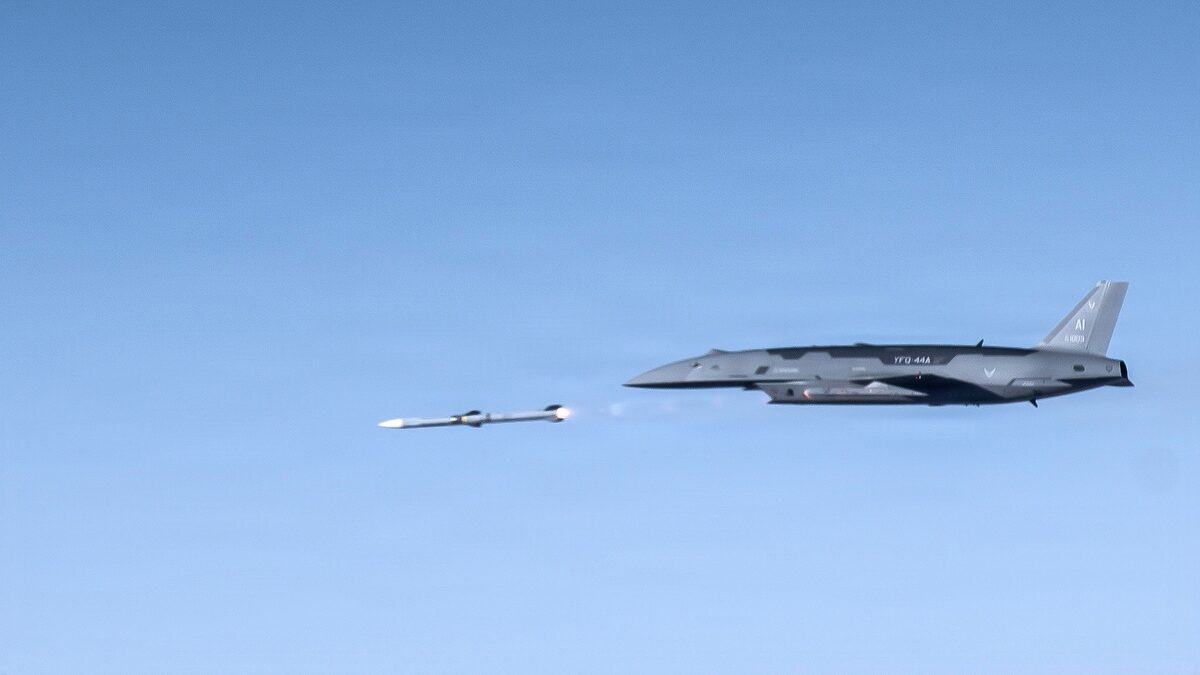
The most consequential thing BAE Systems did at Farnborough this week was not rolling an airframe under the lights. It was the sequence: build the aircraft first, on company money, then let the Defence Secretary walk up to it in front of the international press and say the government will take it.
On July 22, at the Farnborough International Airshow, BAE unveiled Brontanax — described by the company as the first British-designed Collaborative Combat Aircraft. The name is derived from the ancient Greek words for "thunder" and "king." The aircraft itself is a prototype designed and built at BAE's Warton site in Lancashire, and it is now being prepared for ground-based testing there ahead of flight testing in UK airspace.
That last detail is the story. Most combat-aircraft programmes are announced as requirements, then funded, then designed. Brontanax arrived in the opposite order.
What Was Actually Unveiled
Brontanax is roughly the size of a BAE Hawk trainer — small, by fast-jet standards, and deliberately so. BAE classifies it as a Collaborative Combat Aircraft: a machine designed to fly alongside crewed fighters as a loyal wingman, with Streeting's own keynote framing CCAs as integrating with crewed platforms like the Typhoon.
The mission set BAE describes is two-part: electronic warfare, and precision strike against both airborne and ground targets. The company claims enhanced stealth relative to rival designs and projects the aircraft at 70 to 80 percent of a crewed fighter jet's capability. The cost claim is the one that will get scrutinised hardest — an estimated around $25 million per copy, which BAE frames as under a quarter the price of a traditional fighter.
Underneath is an open architecture with a modular design, the now-standard pitch for any 2020s combat aircraft: swap payloads and push software updates to chase threats rather than freezing capability at the moment the airframe leaves the factory. Development began in 2022. Flight testing is expected in 2027 — BAE's release puts the prototype as "expected to fly next year" — with planned availability to enter service before the end of the decade, which Reuters reports as 2030.
The industrial numbers BAE put on the release are substantial for a self-funded effort: more than 500 BAE employees involved to date, and over 75 large companies and SMEs from Britain's aerospace sector engaged. The aircraft was designed by FalconWorks, BAE's advanced-development team.
The Money Question, and Who Blinked
BAE developed Brontanax without initial government co-investment — self-funded through the company's own R&D to date. BAE put in hundreds of millions of pounds of its own money; its release notes more than £400 million invested in self-funded R&D in 2025, and the company carried the programme all the way to a finished prototype, on the ramp and headed into ground testing, before a customer signature existed.
CEO Charles Woodburn's framing at the unveiling was blunt: "We've put our money where our mouth is."
That risk converted on the show floor. Defence Secretary Wes Streeting called the unveiling "a testament to the extraordinary talent and innovation across our sovereign defence industry" — and then went considerably further than a compliment: "We will adopt this as our operational concept demonstrator, and we're going to get it in the air in 2027." In his keynote later that day he returned to it: "Just this morning, we saw a British company, BAE, launch their sovereign CCA programme. This signals the enormous opportunity on offer in advantage, jobs and exports."
Brontanax now slots into StormFighter, the UK's Collaborative Combat Air programme, backed by a £300 million UK government commitment (roughly $401 million) allocated in the Defence Investment Plan. Air Marshal Sir Harv Smyth, Chief of the Air Staff, framed the RAF's side of it: "The RAF is determined to become Europe's first 6th Generation Air Force, driving innovation and accelerating the adoption of cutting-edge technology to stay ahead in an increasingly complex and contested battlespace." Simon Barnes, BAE's Group Managing Director for the Air sector, described the aircraft's purpose as providing "the ability to extend the reach of crewed aircraft, generating greater combat mass at lower cost, while keeping pilots out of harm's way."
Streeting's Numbers
The Defence Secretary's keynote at the AGF Defence Summit the same day put StormFighter inside a much larger spending picture, and it is worth reading the figures as context for what BAE just bought itself a seat at.
Streeting cited a £298 billion defence commitment over four years, an additional £15 billion beyond the previous settlement, and £11.8 billion in contracts agreed within 10 days of the Defence Investment Plan's publication. Broken out: more than £1 billion for Typhoon fleet upgrades extending capability into the 2040s, £8.6 billion pledged to GCAP, and a £708 million BAE contract extension for sovereign technologies.
His operational description of CCAs was more specific than the usual loyal-wingman boilerplate. "These uncrewed autonomous fighter jets will provide us with eyes and ears, carry missiles and confuse the enemy," he said — operating at "a fifth of the price" of Typhoon aircraft. He described them working "five at a time and 500 miles ahead" of crewed platforms, and noted that "we've just upgraded our Typhoons with a new precision weapon system that can defeat drones at a fraction of the price of the missiles currently used" — an acknowledgement that the cost-per-kill problem cuts both ways.
The demonstrator is targeted to fly next year, with operational deployment by the end of the decade. Full production, Streeting said, would support "2,000 jobs when the full production line is up and running." He valued the global CCA sector at "more than £125 billion to 2050" and positioned the outcome as making the RAF "Europe's first sixth-generation air force."
The Field It Enters
Brontanax does not arrive in an empty market. Boeing's MQ-28 Ghost Bat is already in flight testing and could fly for Australia by 2028 — which is to say Boeing is roughly a programme-phase ahead. Airbus, Boeing, Anduril and General Atomics are all named competitors in the same segment.
That is the honest read on BAE's timeline: a 2027 first flight and end-of-decade service entry puts Brontanax behind at least one rival that is already flying. What BAE has instead is a finished airframe, a national customer that has publicly adopted it as the operational concept demonstrator, and a supply chain of 75-plus UK firms already spun up.
Why It Matters
The interesting precedent here is commercial, not aerodynamic. Combat aircraft are the archetypal cost-plus product — governments specify, governments fund, and the prime carries little development risk. BAE inverted that, spending company money to a finished prototype, and was rewarded with a £300 million programme commitment and a public adoption statement from the Defence Secretary in the same news cycle. If that pattern holds, it changes the negotiating position of every prime that can afford to front the R&D, and it disadvantages every one that cannot.
The claimed economics are the second thing to watch. Around $25 million per aircraft at 70 to 80 percent of fighter capability, and Streeting's "fifth of the price" line, are the whole argument for CCAs — mass that a defence budget can actually absorb. Those numbers are currently projections attached to an aircraft that has not flown. The 2027 flight test is where they start becoming falsifiable.
Third, the doctrine. Five uncrewed systems ranging 500 miles ahead of their controlling pilots is a materially different concept from a wingman flying formation, and it implies autonomy, datalink resilience and command authority arrangements that no air force has yet demonstrated at scale. The airframe is the easy part of that sentence.
Sources
- Defence Secretary Wes Streeting MP, keynote speech at AGF Defence Summit, Farnborough International Air Show — GOV.UK, 22 July 2026
- UK's BAE enters uncrewed fighter competition with 'Brontanax' — Defense News (Reuters, Sarah Young), 22 July 2026
- First British Designed Collaborative Combat Aircraft Unveiled — BAE Systems release via GlobeNewswire, 22 July 2026