
On the first day of fighting, Armenian radar operators tracking an Antonov An-2 biplane lumbering into their air defense envelope did what training demanded — they fired. The An-2 was unmanned, fitted with a remote-control system, and sent deliberately into the engagement zone. When the radar activated and the missile left the rail, Azerbaijani TB2s orbiting at altitude had their target. The launcher was destroyed.
That exchange — cheap decoy draws fire, medium-altitude drone kills the radar — was replicated across 44 days that ended with a Russian-mediated ceasefire on November 9–10, 2020. Azerbaijan recovered approximately one-third of Nagorno-Karabakh, including the strategically significant city of Shusha, and the global defense community was left running an urgent reassessment of what it assumed about conventional air defense and drone warfare.
The Arsenal Gap Azerbaijan Built
The asymmetry was not improvised. Between 2006 and 2019, Azerbaijan spent $29 billion on its military; Armenia spent $6 billion over the same period. That investment bought a drone order-of-battle Armenia had no meaningful counter to.
The Bayraktar TB2 was its centerpiece — acquired from Turkey in June 2020, just months before the conflict opened. The TB2 carries laser-guided smart munitions and high-definition cameras that serve as both targeting infrastructure and propaganda production capability. Early 2020 Turkish military sales to Azerbaijan exceeded $120 million.
Israeli-supplied systems filled out the rest. Pieter Wezeman of the Stockholm International Peace Research Institute was direct: “Israeli arms have played a very significant role in allowing the Azerbaijani army to reach its objectives.” Per C4ISRNET’s reporting, those systems comprised approximately 70 percent of Azerbaijan’s military hardware between 2016 and 2020. The drone complement included IAI Harop and SkyStriker loitering munitions, plus Orbiter-1K, Hermes 450, Hermes 900, Aerostar, and Heron platforms.
Armenia’s Ambassador to Israel, Arman Akopian, summarized the other side of that supply chain: “For us, it is a major concern that Israeli weapons have been firing at our people.”
Against this, Armenia deployed Soviet-era layered air defense: S-300, Tor-M2KM, Buk, 9K35 Strela-10, 2K12 Kub, 9K33 Osa, and 2K11 Krug systems — almost entirely 1970s–1980s hardware. Armenia fielded only a small number of Tor-M2KM systems, far too few to provide overlapping coverage across mountainous terrain.
The An-2 Gambit: Wild Weasel Logic with Cold War Airframes
Azerbaijan’s suppression-of-enemy-air-defense approach inverted standard logic. Rather than deploying expensive dedicated SEAD platforms, Baku retrofitted Antonov An-2 biplanes — slow, cheap, and expendable — with remote-control systems and flew them at low altitude into Armenian engagement zones. Armenian SAM crews, unable to distinguish the decoys from real threats, activated their radars and fired. The emissions located them. TB2s orbiting at higher altitude destroyed the revealed launchers and radar arrays.
The tactic mirrored the Vietnam-era Wild Weasel hunter-killer concept, but executed with Cold War airframes costing a fraction of a modern SEAD aircraft. Once Armenian operators recognized the gambit, their only counter was to hold fire — which meant ceding air defense coverage. Either choice handed Azerbaijan the opening it needed.
Harop loitering munitions handled the harder targets. Per Azerbaijani President Ilham Aliyev’s wartime claims, at least three S-300 SAM systems were destroyed by Harops, along with seven S-300 transporter-erector-launchers, two guidance stations, and one radar. Dismantling S-300 coverage early removed Armenia’s only long-range intercept capability and opened the airspace for sustained TB2 operations.
Russia’s Polye-21 electronic warfare systems disrupted Azerbaijani drone operations for approximately four days before Azerbaijan adapted.
563 Documented Destructions, Two TB2s Lost
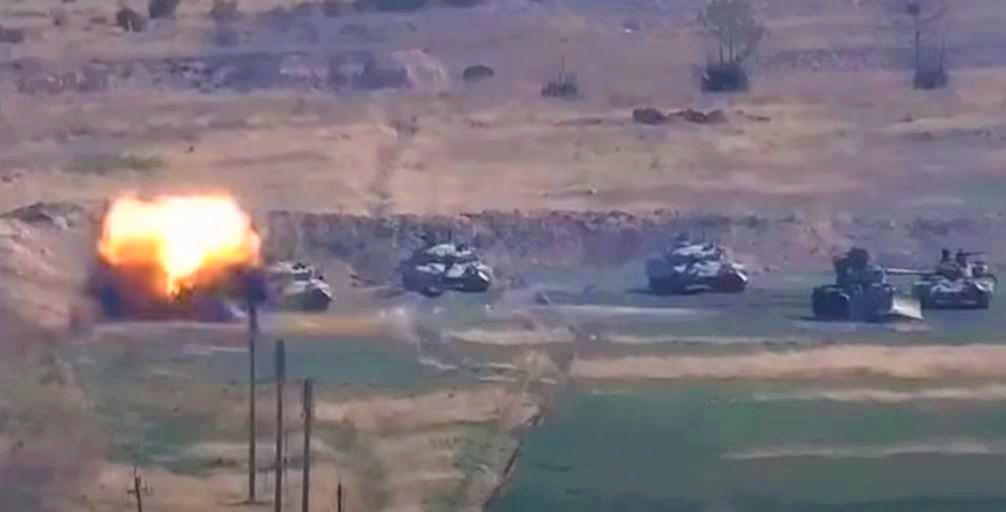
Open-source documentation by Oryx provides the most conservative confirmed figures. Of 292 Armenian tanks and armored fighting vehicles claimed destroyed by Azerbaijan, Oryx confirmed 91 via photographic evidence. Of 370 claimed artillery systems, 140 were confirmed. Azerbaijan's stated claims included 73 air defense systems destroyed. Approximately 75 percent of all photographically confirmed Armenian equipment losses were definitively attributed to drones.
Total confirmed drone destructions across the 44-day campaign reached 563 — an average of 13 documented targets per day. Military Strategy Magazine’s analysis estimates the actual rate was roughly 22 per day accounting for strikes without photographic documentation. Azerbaijan’s cost in TB2s to achieve that: approximately two airframes.
The human toll was severe on both sides. Armenia suffered approximately 4,000 dead and missing. Azerbaijan acknowledged a minimum of 2,900 killed. Military Strategy Magazine noted plainly: “This ground force had to fight casualty-intensive battles to defeat a determined enemy, no less well equipped and no less proficient than itself.” Ground combat continued throughout at high cost. Drone dominance reshaped who could sustain that fight, not whether close combat occurred at all.
Doctrinal failure on both sides compounded drone lethality. CSIS noted that forces operated “out in the open, static or moving slowly; poorly camouflaged; and clumped in tight, massed formations.” Robert Bateman, quoted in Small Wars Journal’s analysis, put it plainly: “Neither [side] seems to have grasped the idea that even the most high-tech tank (or armored vehicle) is only so much scrap metal if you do not have a trained and disciplined fighting force.”
Azerbaijan released TB2 strike footage systematically on social media and state television — a deliberate information warfare layer that simultaneously demoralized Armenian forces and demonstrated drone kill capability to outside audiences in real time.
Why It Matters
The 2020 war stress-tested two load-bearing assumptions: that capable air defense could blunt airpower, and that armor remained a decisive instrument of conventional conflict. Both failed under drone saturation in a degraded SEAD environment.
CSIS Missile Defense Project analysts Shaan Shaikh and Wes Rumbaugh distilled the core finding: “The primary lesson from the air war over Nagorno-Karabakh is the importance of full-spectrum air defense.” European defense establishments cited the conflict directly when justifying SHORAD procurement investments. TB2 export demand surged globally. Lines were drawn directly from the 44-day campaign to early Ukraine war drone assessments.
The U.S. military extracted seven concrete recommendations, among them: integrating conventional air defense with counter-UAS, incorporating machine learning into command-and-control, and increasing investment in non-materiel solutions — doctrine and training — rather than hardware alone. The battlefield demonstrated that doctrinal failure multiplied drone lethality regardless of what systems were fielded.
“Drones did not change how wars are fought; they changed who can win them.” — Vikramaditya Shrivastava, Global Security Review
For any military still organized around massed armor formations and Soviet-derived air defense architectures, Nagorno-Karabakh 2020 is documented evidence, not a thought experiment. A medium-income state, given the right drone and loitering munition mix, combined a Cold War biplane deception with modern precision strike to systematically dismantle a peer adversary’s combined arms inventory — and streamed the proof to the world in real time.
Sources
- CSIS Missile Defense Project — Air and Missile War in Nagorno-Karabakh: Lessons for the Future of Strike and Defense
- C4ISRNET — Israeli Arms, Drones Quietly Helped Azerbaijan Retake Nagorno-Karabakh
- Military Strategy Magazine — Drones in the Nagorno-Karabakh War: Analyzing the Data
- Small Wars Journal — Drones in Nagorno-Karabakh (October 2020)
- Small Wars Journal — What the United States Military Can Learn from the Nagorno-Karabakh War
- Global Security Review — Drones and the Death of Deterrence: Lessons from Nagorno-Karabakh
