
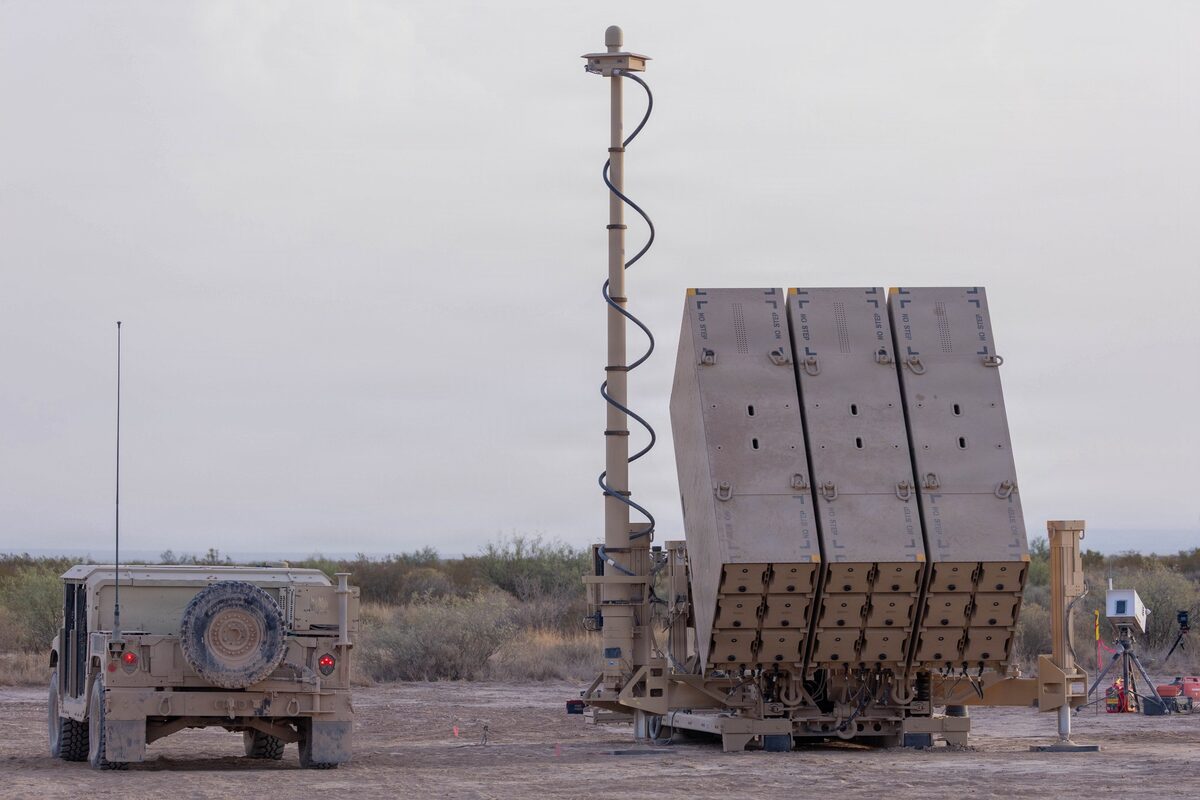
The US Army has trimmed its field of contenders for a new fixed- and forward-base air-defense interceptor, advancing Lockheed Martin and a Boeing-Anduril Industries team into the demonstration phase of the Indirect Fire Protection Capability (IFPC) Increment 2 Second Interceptor program while eliminating the American subsidiary of Israeli defense firm Rafael. The decision, confirmed by the Army on September 10, 2026, and announced separately by Boeing on September 9, narrows what had been a three-way competition down to two teams that will now move into the demonstration phase of the program's development effort.
An Army statement said the two companies were "selected to advance to the demonstration phase of the development effort," a formal gate that follows nearly a year of parallel other-transaction-authority (OTA) work by the competitors. Rafael's US arm is out of the running, leaving Lockheed Martin and the Boeing-Anduril pairing to carry their interceptor designs forward.
A Gap Between Short-Range Defenses and Patriot
IFPC Increment 2 exists to close what the Army and industry describe as a seam in the layered air-defense architecture: a capability gap between short-range air defense systems designed to protect maneuver forces and the high-end, long-range coverage provided by systems like Patriot and THAAD. According to a Congressional Research Service (CRS) brief on the program, IFPC Increment 2 is a mobile, ground-based system intended to protect critical fixed- and semi-fixed assets against cruise missiles, unmanned aircraft systems and rocket, artillery and mortar (RAM) attacks — threats that fall below the threshold Patriot and THAAD are built to handle.
Aviation Week's reporting on the September selection reinforces that framing, confirming that the interceptor Boeing and Anduril are advancing is meant to protect both fixed and forward bases. Breaking Defense's coverage of the announcement similarly frames IFPC Increment 2 as filling the capability gap between short-range air defenses and the Patriot/THAAD tier — the kind of saturation and mixed-threat attack scenario, from one-way drones to low-flying cruise missiles, that has driven demand for a layered, lower-tier intercept option.
The CRS brief also notes that this is not IFPC Increment 2's first interceptor. Per Breaking Defense's reporting, the Army previously paired the Dynetics-built Enduring Shield launcher with RTX's AIM-9X Sidewinder missile as the program's first interceptor. The Second Interceptor competition now underway with Lockheed and Boeing-Anduril is meant to add a complementary interceptor option to that same launcher architecture, broadening the mix of munitions IFPC Increment 2 batteries can bring to bear against a given threat.
How the Field Narrowed
The path to this week's cut ran through a series of staggered awards. According to Breaking Defense's account of the timeline, Lockheed Martin received the first OTA award for IFPC Increment 2's Second Interceptor phase one work in October 2025. Boeing, teamed with Anduril, was added to the competition in December 2025. Rafael followed in February 2026, bringing the field to three. Seven months later, in September 2026, the Army cut the field back down to two by advancing Lockheed and Boeing-Anduril and eliminating Rafael's US subsidiary.
Neither Breaking Defense nor Aviation Week's coverage detailed the specific technical or programmatic reasons behind Rafael's elimination; both outlets reported the outcome and the Army's confirmation of it without further elaboration on the selection rationale.
Anduril's Rocket Motor Role
One detail that distinguishes the surviving field is the supply chain behind Boeing's entry. Breaking Defense reports that the Boeing-Anduril interceptor proposal "combines seeker technology, a compact form factor, a solid rocket motor supplied by Anduril Rocket Motor Systems and a Modular Open Systems Architecture." That puts Anduril in a dual role on the Boeing team: as a systems partner on the broader interceptor effort and as the motor supplier underpinning it, at a moment when the Pentagon has been pushing to diversify solid rocket motor production beyond the handful of legacy prime suppliers that have historically dominated that market.
Lockheed Martin's interceptor proposal, by contrast, is being advanced without the same rocket-motor partnership detail disclosed in the available reporting.
What Comes Next
With the field cut to two, both teams now move into what the Army calls the "demonstration phase of the development effort" — the gate that follows the parallel OTA work the competitors have carried out to date. That phase is expected to culminate in a head-to-head demonstration informing a future down-select or fielding decision, though none of the available reporting specifies a date for that next milestone.
Why It Matters
IFPC Increment 2's Second Interceptor competition sits at the center of one of the Army's most operationally urgent modernization problems: how to defend fixed bases against the low-cost, high-volume aerial threats — armed drones, loitering munitions and cruise missiles — that have proliferated among both state and non-state actors. Existing high-end interceptors like those fielded by Patriot batteries are effective but expensive per shot, creating a cost-exchange problem against cheap drone swarms. A second, complementary interceptor on the Enduring Shield launcher is meant to give base commanders a more flexible, lower-cost option to pair with AIM-9X for that mission set.
The elimination of Rafael's US subsidiary is also notable in the broader context of the US defense industrial base: it narrows this particular competition to two American primes — Lockheed Martin and Boeing, the latter teamed with Anduril, one of the most prominent of the new generation of venture-backed defense technology companies now competing directly against legacy primes for major weapons programs. Anduril's role supplying solid rocket motors for Boeing's interceptor also reflects a broader Pentagon push to bring new entrants into a rocket-motor supply chain that has long been dominated by a small number of established manufacturers, a concentration that has periodically constrained production of guided munitions across multiple programs.
For the drone and counter-UAS community specifically, the outcome of this demonstration phase will help shape what tools base defenders have against the cruise-missile and drone threats that IFPC Increment 2 is explicitly designed to counter — making the eventual down-select between Lockheed's and Boeing-Anduril's designs one worth watching closely.
Sources
- Army selects Lockheed, Boeing-Anduril team for next phase in IFPC Inc 2 competition — Breaking Defense
- Boeing-Anduril Team Advances In Army Interceptor Competition — Aviation Week
- Boeing, Anduril Team Moves Ahead in Race for New Interceptor — RealClearDefense
- The U.S. Army's Indirect Fire Protection Capability (IFPC) System — Congressional Research Service