
In March 2026, the U.S. Army awarded Anduril Industries a 10-year enterprise agreement worth up to $20 billion—the single largest contract ever given to a venture-backed defense company. The deal consolidated over 120 separate procurement pathways into a single framework centered on one product: Lattice, Anduril’s AI-powered command-and-control software platform. That number, and what it represents, is a bet that the next generation of warfare will be won not by the country that fields the most hardware, but by whichever force runs the best operating system.
Three Layers, One Common Picture
Lattice is built on three interlocking components. Lattice Mesh is the decentralized data distribution layer—a peer-to-peer network that enables frontline forces to pull data from over 100 different sensor types without routing through any central hub. New sensor translators are added weekly. The design is deliberate: in a degraded or contested environment, central hubs are single points of failure, and Lattice Mesh is architecturally hostile to them.
Lattice C2 sits above the mesh as the command-and-control intelligence layer. It ingests the unified sensor feed, runs deep-learning threat classification, and presents engagement recommendations to human operators—who retain final authority over any kinetic decision. This is not autonomous killing; it is autonomous sensing and reasoning, with a human closing the loop. The platform aggregates air, land, sea, and subsurface data into a unified common operational picture with minimal latency.
Lattice Edge completes the architecture by pushing capability into austere environments. Purpose-built hardware from the Menace device family runs the Lattice software stack at the tactical edge, where connectivity is scarce and compute must be local. The three layers together form a graph—each sensor, drone, and effector is a node, and Lattice is the graph database that knows where everything is and what it’s doing.
At Yuma Proving Grounds, the architecture proved its integration speed: during a seven-day trial, Lattice successfully absorbed a previously undisclosed sensor and effector within hours of exposure, then executed four live-fire drone intercepts with successful neutralization outcomes. Army Chief Technology Officer Alex Miller has been blunt about the operational imperative: ”We can’t wait a year for a new sensor or effector to be integrated,” Miller said, adding that the system must support platoon leaders on the move as well as forward operating base commanders.
How the Sensor Fusion Actually Works
Anduril’s Sentry autonomous surveillance towers offer a concrete illustration of Lattice’s sensor fusion in practice. The towers combine visual, radar, and thermal sensors, with Lattice software constructing 3D environmental models from the combined feeds in real time. One design detail stands out: Lattice uses machine learning to activate radio transmission only when algorithms identify relevant objects. In a border or perimeter surveillance context, this matters—constant radio emissions are a detection and jamming target. Selective transmission is both a security feature and a bandwidth optimization.
The tactical data generated by Sentry and other edge nodes doesn’t stay at the edge. All feeds flow into government cloud enclaves, where they’re used for continuous model retraining. Each confirmed classification—correct or not—updates the model, progressively reducing error rates and adapting to novel threat signatures the system has never seen. The perimeter of today trains the classifier for the threat of next year.
Lattice also integrates with Palantir’s Maven Smart System, but at a different layer of the kill chain: Lattice handles tactical autonomy and real-time sensor fusion; Maven handles intelligence analytics and longer-cycle pattern-of-life analysis. The two platforms are complementary rather than competing, operating at different layers of the kill chain.
Mission Autonomy: One Operator, Many Machines
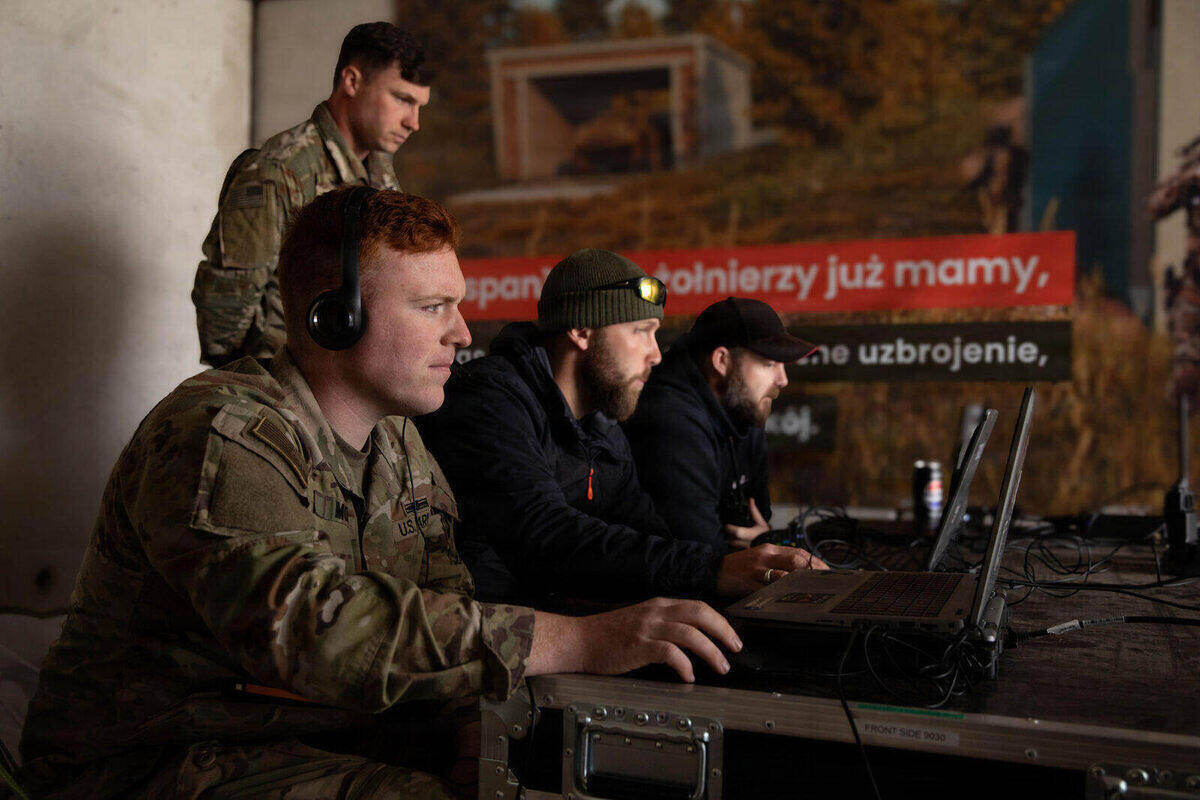
The Lattice for Mission Autonomy module handles the coordination problem that emerges when a single operator is responsible for multiple simultaneous autonomous systems. Using tactical operations center screens, tablets, or rugged laptops, one operator can task and manage swarms—setting objectives while Lattice handles low-level routing, deconfliction, and coordination between individual platforms.
The hardware ecosystem those operators manage is substantial. Ghost-X is Anduril’s company-level reconnaissance drone, with approximately 75–90 minutes of endurance and a range measured in tens of kilometers. Anvil and Anvil-M are kinetic C-UAS interceptors designed for drone interception. Roadrunner is a reusable VTOL twin-turbojet autonomous air vehicle used in air defense roles; it saw operational use during Middle East counter-drone operations against Iranian Shahed threats in what was designated Operation Epic Fury, with Lattice serving as the command layer. Bolt-M handles autonomous precision strike. Copperhead is an autonomous underwater vehicle capable of 30 knots. Ghost Shark XL-AUV, built for the Royal Australian Navy under an approximately A$1.7 billion program, extends Lattice-native operations into the undersea domain.
U.S. Special Operations Command has moved aggressively into this architecture. In March 2025, SOCOM selected Anduril as Mission Autonomy Systems Integration Partner under an $86 million, three-year contract—with the explicit goal of using Lattice to coordinate operations across multiple drones and robotic platforms simultaneously. SOCOM has separately awarded Anduril a $1 billion, 10-year counter-drone IDIQ. One analyst assessment from Fed-Spend concluded that SOCOM has been the “earliest and most aggressive adopter of Anduril’s technology.” The SOCOM relationship also connects Lattice to the Pentagon’s Replicator initiative—the 2023 program aimed at fielding “multiple thousands” of attritable autonomous systems to counter China’s numerical advantages. Anduril’s Ghost-X, ALTIUS, and Dive-LD were among systems associated with the Replicator initiative.
“This agreement provides common air domain awareness through a proven command-and-control platform—Lattice—allowing us to build a cohesive defensive ecosystem.” — Col. Tony Lindh
The Platform Play: Open SDK and Software-Defined Defense
The most strategically significant development in Lattice’s recent history may be the least flashy: the launch of an open SDK. Lattice exposes capabilities through REST and gRPC APIs, with libraries in Go, Java, TypeScript, and Python. The Pentagon’s Chief Digital and AI Office awarded Anduril a $100 million, three-year contract in December 2024 specifically to expand Lattice Mesh and open it to third-party developers. The initial partner cohort of ten companies includes Apex (space systems), Saronic (unmanned surface vessels), Oracle, and Textron.
CDAO Principal Deputy Margaret Palmieri described the shift plainly: ”We can use the data mesh back end that Anduril has, but we don't only have to rely on Anduril apps.” Thomas Keane, Anduril’s Senior Vice President, framed the company’s intent the same way: “We want to remove Anduril as any form of bottleneck.”
This is the platform thesis made explicit. Traditional defense primes sell hardware with software as an integration afterthought. Anduril inverts the model: Lattice is the product, and hardware—including Anduril’s own—is simply a node. Once a military force integrates its sensors and effectors through Lattice’s data model and trains operators on its interfaces, switching costs become substantial. The platform accumulates network effects as more sensor translators, partner applications, and retraining data accumulate inside its graph.
The contract scorecard reflects the trajectory. CBP has deployed over 300 Autonomous Surveillance Towers on U.S. borders under a $2 billion IDIQ ceiling, with approximately $818 million obligated as of late 2025. JIATF-401, the Pentagon’s joint C-UAS task force, selected Lattice as its enterprise tactical C2 platform, with a first task order of approximately $87 million. Anduril won a $99.7 million Space Surveillance Network contract, with full deployment targeted by end of 2026. In November 2025 it was selected for the Army’s IBCS-M fire control platform. Total known contract ceiling now exceeds $25 billion.
Anduril’s valuation has tracked the contract growth: from $14 billion (Series F, 2024) to $30.5 billion (Series G, 2025). Markets are reading Lattice as platform economics, not product economics. Palmer Luckey, Anduril’s CEO, has acknowledged publicly that Anduril fails regularly. The failures are, in part, the point—the architecture is designed to learn from them, ingesting confirmed misclassifications back into training pipelines and updating the model continuously. The question for competitors and adversaries alike is not whether Lattice will make mistakes. It’s how fast it corrects them.
Sources
- Army Recognition — U.S. Army Awards $20B Anduril to Deploy Lattice AI Open Architecture for Battlefield Integration
- Inside Unmanned Systems — U.S. Army Enterprise Contract with Anduril Positions Lattice as Core Platform for C-UAS Operations
- DefenseScoop — Anduril SOCOM Contract Award: Autonomy Software, $86M
- FedScoop — Anduril Sentry Towers, CBP
- Breaking Defense — Decentralizing Battle Data: CDAO, Anduril Open Tactical Mesh to Third-Party Developers
- Foreign Affairs Forum — Anduril’s Lattice Platform: Architecture, Accountability, and the Future of Autonomous Warfare
- BUVCG Research — Anduril Industries Deep Dive
- GovConWire — Anduril UAV/UUV Lattice Homeland Security
- Army Technology — Anduril Lattice, U.S. Army UAS
- Fed-Spend — Anduril Federal Contracts Deep Dive
- Anduril — Lattice for Command & Control (official product page)