
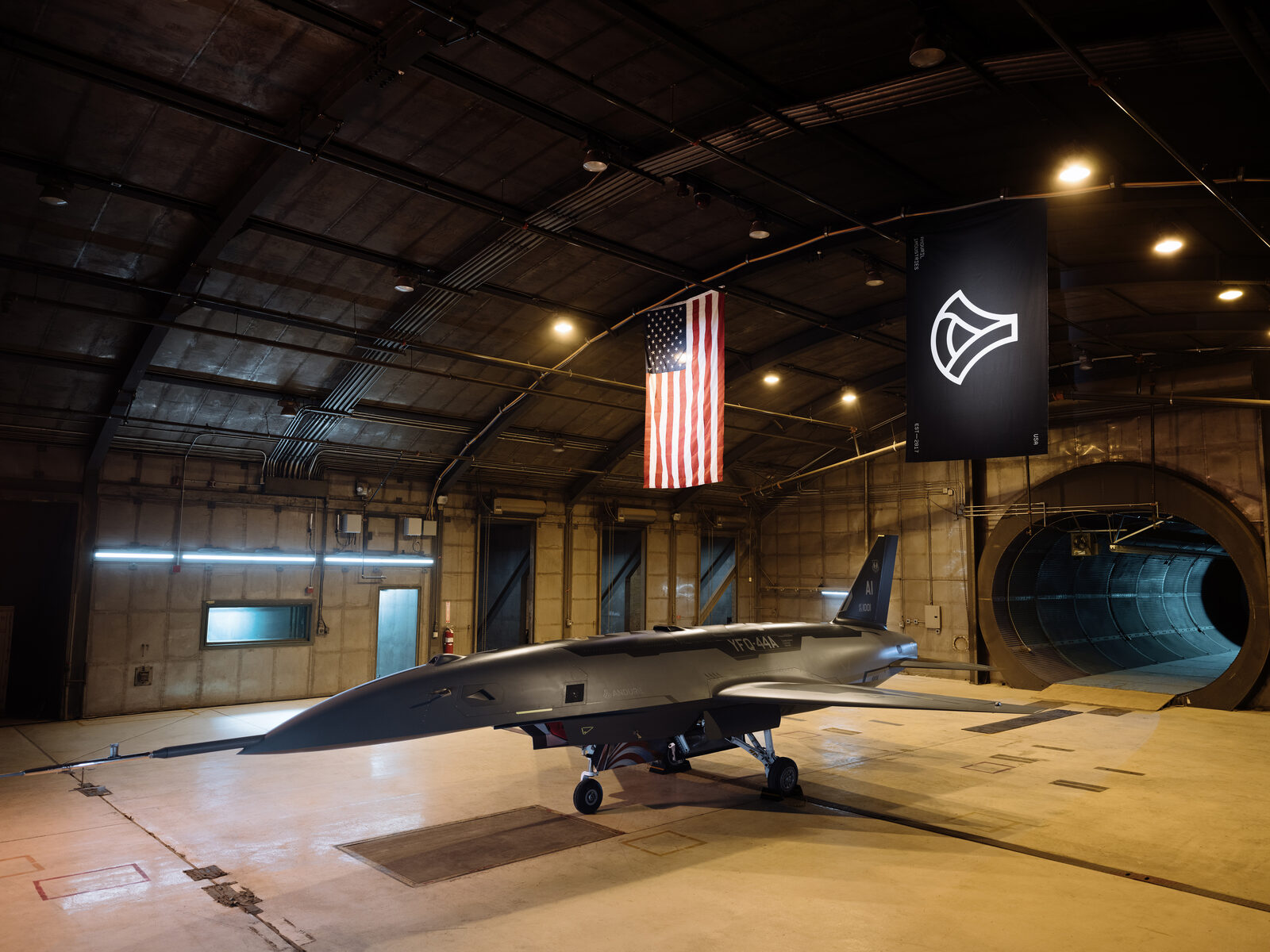
The company Palmer Luckey and four co-founders assembled in June 2017 was not conceived as a defense contractor in any traditional sense. Luckey, freshly fired from Facebook over a reported political donation, called Trae Stephens — a Founders Fund partner — and together they set about applying Silicon Valley's engineering culture to the Pentagon's most persistent structural failure: an inability to produce capable autonomous systems quickly, cheaply, and at scale. The founding team, assembled largely through personal networks and Palantir-era connections, named the company Anduril and made a foundational bet that software-first architecture could outcompete primes that had spent decades optimizing for cost-plus billing rather than operational performance.
That bet, now valued at $30.5 billion at the Series G close in June 2025, has been validated enough that legacy contractors are paying attention — not always graciously. Anduril crossed $1 billion in annual revenue in 2024, representing more than 100 percent year-over-year growth, with 7,651 employees and a 5 million-square-foot autonomous weapons factory under construction in Ohio.
Lattice as the Operating Thesis
Every hardware platform Anduril builds is designed to connect to Lattice OS, the company's AI-powered platform for sensor fusion and autonomous command-and-control. Lattice for Mission Autonomy, representing at least four years of accumulated R&D at the time of its May 2023 public unveiling, is explicitly hardware-agnostic — intended to integrate across air, ground, and sea systems regardless of who manufactured the underlying platform.
The central pitch is force multiplication: fewer operators managing more assets across wider battlespaces. "Lattice for Mission Autonomy provides the brains, the glue, to drive all these systems to be able to be effective" with fewer personnel required, CEO Brian Schimpf told C4ISRNET at the launch. Chief Strategy Officer Chris Brose described it in terms of command precision: "It is the ability of this software system to control assets in place and time, to actually process mission systems." Schimpf has argued that the integration burden is lower than skeptics assume: "it's actually very trivial to integrate this into new aircraft, new vehicles, [new boats], whatever you need."
Space Force validated the architecture in 2024, selecting Lattice OS for surveillance network management — a decision that extends the platform beyond Anduril's own hardware into broader joint force infrastructure.
A Portfolio Organized by Domain
Anduril's hardware catalog has expanded faster than most defense primes can launch a single program, spanning three operational domains.
In the air domain, the Ghost and Ghost-X UAS serve reconnaissance and surveillance missions; the Ghost-X holds a slot on the Defense Innovation Unit's Blue UAS List. The U.S. Army selected the Ghost X in September 2024 for the Company-Level Small Uncrewed Aircraft System Directed Requirement for Brigade Combat Teams, awarding a $14.417 million Tranche 1 contract under a 10-year Indefinite Delivery Indefinite Quantity vehicle with the Defense Logistics Agency. The tasking covers reconnaissance, surveillance, and target acquisition with reconfigurable modular payload capabilities. The Roadrunner is a reusable jet-powered drone; Fury is a collaborative combat aircraft designed to fly alongside crewed fighters; Barracuda is an expendable autonomous air vehicle optimized for mass attrition scenarios; and the Altius family handles air-launched loitering munitions.
Below the surface, the Dive-LD and Dive-XL autonomous underwater vehicles serve as carrier platforms for the Copperhead AUV family, unveiled in April 2025. Copperhead-M is a torpedo-like munition variant that deploys from Dive-LD and Dive-XL; the family exceeds 30 knots at maximum speed. Anduril describes Copperhead as enabling "a comprehensive, intelligent maritime capability that allows operators to quickly respond to threats in the undersea battlespace, at a fraction of the cost of legacy options." Ghost Shark, the company's large AUV, is under a $1.1 billion program of record with the Australian Navy.
On the electronic warfare and ground surveillance side: Sentry towers were the original product, evolving from a CBP pilot into up to a $400 million program of record. Pulsar handles electronic warfare and jamming. EagleEye provides augmented-reality headset capability for dismounted operators.
The Business Model Is the Differentiator
Anduril's financial architecture compounds advantages that traditional primes structurally cannot replicate. The company pursues fixed-price contracts rather than cost-plus arrangements, funds more than 60 percent of revenue into its own R&D, and posts gross margins of approximately 40–45 percent — against the 8–10 percent typical for legacy defense contractors. Schimpf has diagnosed the incumbent problem plainly: "When you're tooled to not require efficiency, it's corrosive."
The funding timeline reflects sustained investor confidence. The Series E in December 2022 valued the company at $8.48 billion. The Series F in August 2024 raised $1.5 billion at a $14.0 billion valuation. The Series G in June 2025 pushed that figure to $30.5 billion, with Founders Fund — the firm Trae Stephens came from before co-founding Anduril — committing $1 billion of the round. Total capital raised since founding: $6.26 billion.
Arsenal-1, the manufacturing facility under construction in Pickaway County, Ohio, is where Anduril's production thesis gets its hardest test. At 5 million square feet with nearly $1 billion in company investment, the site was chosen partly for proximity to Wright-Patterson Air Force Base and Rickenbacker International Airport's dual 12,000-foot runways, enabling direct large-cargo logistics. Production of Fury, Roadrunner, and Barracuda began in March 2026, three months ahead of the original July 2026 schedule, with full-scale employment projected at 4,008 jobs by 2035.
Anduril describes the facility as "a software-defined manufacturing platform optimized for the mass production of autonomous systems and weapons," built on four principles: designs optimized for simplicity and scale, a resilient supply chain, software-defined production processes, and centralized infrastructure. Nearly 90 percent of Anduril's designs are claimed compatible with hyperscale manufacturing using commercially available components. Brose framed the talent strategy behind it: "We're taking many of the people who lead those processes at some of these world-leading commercial companies that have achieved this type of hyperscale production before and we're bringing this into the defense industrial base to fundamentally transform how we build weapons, how we design weapons."
Why It Matters
Anduril's contract portfolio now spans some of the Pentagon's most strategically significant programs. SOCOM awarded a $1 billion indefinite-delivery counter-UAS contract. The TITAN targeting system, co-developed with Palantir, holds a $178 million prototype contract with full-production potential exceeding $2 billion. The Space Surveillance Network contract runs $99.7 million over a five-year program of record. Ghost Shark's $1.1 billion Australian Navy commitment establishes a major allied foothold. And in February 2025, Microsoft transferred the IVAS Integrated Visual Augmentation System program to Anduril — a contract with total program value potential of up to $22 billion. Schimpf's framing of the urgency has been unambiguous: "We need to manufacture more weapons faster to support that effort."
That IVAS transfer is the clearest structural signal. A major platform program, once awarded to a Big Tech incumbent with decades of government contracting experience, moved to a defense-native software company less than eight years old. It is not an isolated event — it is a pattern.
The company has not escaped controversy. Luckey's 2017 departure from Facebook over a reported pro-Trump political donation remains a recurring undercurrent.
With $1 billion in annual revenue, a $30.5 billion Founders Fund-backed valuation, and an autonomous weapons factory in Ohio, the more consequential question is what an Anduril IPO means for an industry whose procurement culture has resisted disruption for decades.
Sources
- U.S. Army — Army selects vendors for Company-Level Small UAS Directed Requirement for Brigade Combat Teams (September 2024)
- C4ISRNET — Anduril unveils software to manage hordes of drones (May 2023)
- The War Zone — Hyperscale weapons factory vision outlined by Anduril
- Manufacturing Dive — Anduril Industries Arsenal-1 hyperscale facility in Ohio (January 2025)
- Contrary Research — Anduril Industries company profile (April 2026)
- C4ISRNET — Anduril unveils Copperhead line of autonomous underwater vehicles (April 2025)
- Acquinox Capital — Anduril Industries investor insights: rewriting the defense industrial base at a $30.5B valuation (2025)
