
Anduril Industries is going into submarine construction, and the work starts with torpedo tubes, not drones. On Oct. 6, the State of Maryland and Baltimore County announced that Anduril will invest $3.7 billion in Arsenal-2. The company describes it as a 2-million-square-foot "software-defined shipyard" at Tradepoint Atlantic, within Sparrows Point in Baltimore County. Its stated purpose is to expand America's submarine industrial base.
The deal comes with a Navy contract worth up to $2.9 billion. The White House adds the two figures together and calls the result a $6.6 billion investment. At the announcement, though, President Trump described a project that differs in two ways from what the state, the company and the Navy deal describe. According to DroneXL's reporting, he said Sparrows Point would build autonomous submarines and that taxpayers would get a 40% stake. Neither claim appears in any of the official documents.
Below is what each source actually says.
What the official documents say Arsenal-2 will build
The Maryland Department of Commerce release describes a shipyard that will expand the submarine industrial base, and the only program it names is the Virginia-class attack submarine. In the release, Anduril CEO Brian Schimpf says the facility is about "adding the production capacity that the Navy needs to meet its Virginia-class requirements." The release does not mention uncrewed vessels.
Anduril's own release, reproduced by Naval News, says the same thing in more detail. Arsenal-2 will build "complex components and large-scale assemblies" of the Virginia class. It will deliver them to General Dynamics Electric Boat and HII's Newport News Shipbuilding, the two prime yards that do final assembly. Permitting and site preparation begin immediately, and initial operations are expected in 2030.
The first products will be modest. Anduril president Chris Brose said the work starts with torpedo tubes, then moves to modules and potentially bows and sterns, DroneXL reported. According to The War Zone, the plant will eventually produce torpedo tubes and spherical air flasks for Electric Boat and Newport News. Before Baltimore is running, Anduril is opening a 160,000-square-foot plant in Orange County, California. That plant will prototype torpedo tubes and work toward SUBSAFE-qualified production; DroneXL describes SUBSAFE as the Navy's submarine safety certification program.
An industry official told TWZ that it will be years before any Anduril-built component goes on a submarine, and that no specific timelines have been set. TWZ also notes that Anduril's shipbuilding portfolio so far has been limited to smaller craft.
The money: $3.7B private, up to $2.9B Navy
The numbers break down like this:
- $3.7 billion in private investment from Anduril for the facility, according to Maryland Commerce.
- Up to $2.9 billion in a Navy contract for submarine components, including torpedo tubes and doors. Payments are tied to production (DroneXL; Naval News).
- $6.6 billion, the combined figure White House spokesperson Anna Kelly gave TWZ.
Anduril's release says the contract's payments are "tied directly to demonstrated production outcomes," so that Anduril, "not the taxpayer," carries most of the execution risk. Citing Fox45, DroneXL reports that the administration is looking mainly to fiscal 2028 and later budgets to fund the contract. That suggests most of the Navy money would depend on future budgets and on Anduril actually delivering hardware.
The state is promoting the economic impact heavily. Maryland Commerce calls it the largest single private investment and the largest job creator in Maryland in more than a decade. It projects the project will support more than 14,000 jobs, including over 3,100 new permanent positions, and generate more than $2 billion in annual economic output, including an estimated $312 million a year in wages. Anduril's figures match: 3,100 direct jobs and more than 11,000 indirect. A senior administration official told TWZ that the facility could add about 9 million labor hours a year, which the official described as the equivalent of roughly a 15% increase.
Gov. Wes Moore, Baltimore County Executive Kathy Klausmeier and Tradepoint Atlantic managing director Kerry Doyle are also quoted in the state release.
What Trump added
DroneXL reports that Trump made the announcement on Oct. 6 at the former Bethlehem Steel site. He said Sparrows Point would build autonomous submarines and that taxpayers would get a 40% stake. DroneXL says it checked Anduril's release, Anduril's Arsenal-2 web page and the Maryland Commerce announcement on Oct. 6, and that none of them mentions either point.
Our reading of the Maryland release matches: it says nothing about a government equity stake. Anduril's release, as Naval News reproduces it, describes Virginia-class components and assemblies, not uncrewed vessels. Until a contract document, filing or company statement confirms them, the drone-sub production line and the 40% stake are only claims from the president's remarks.
Where Anduril actually builds its drone subs
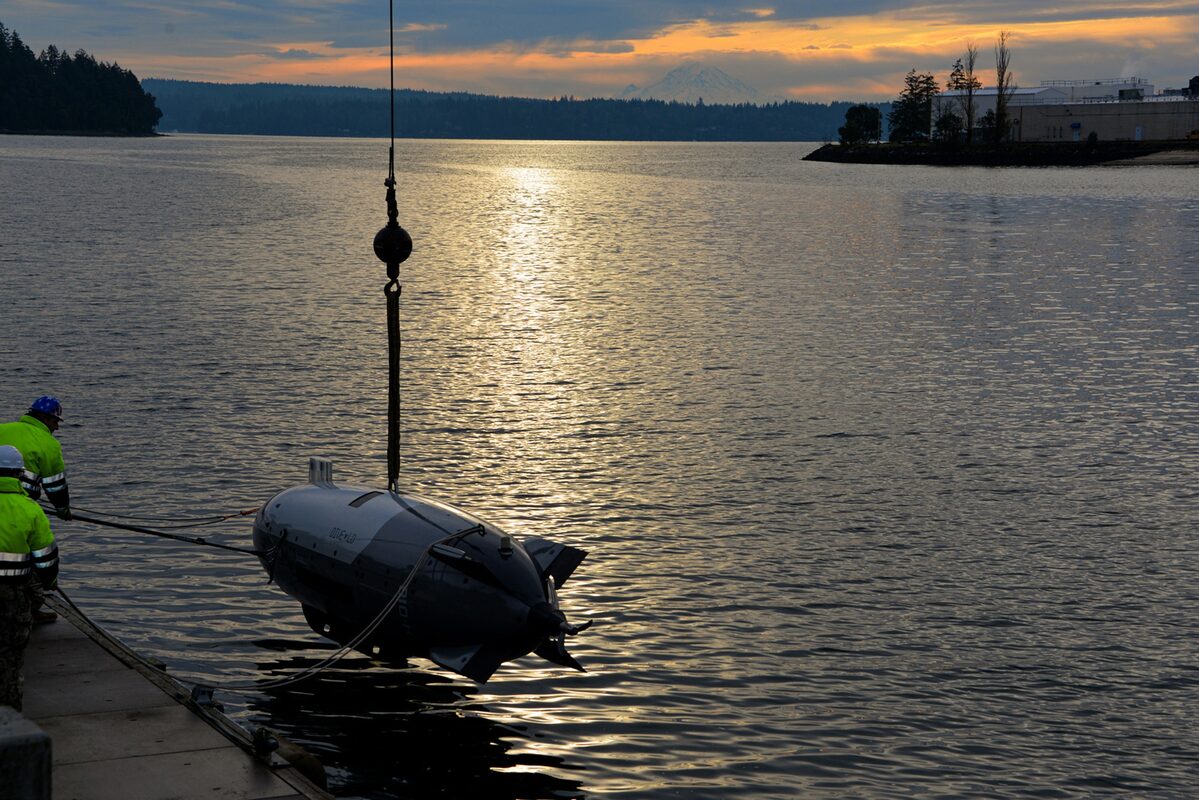
Anduril does build uncrewed undersea vehicles, which may explain why the president linked the company to "drone subs." According to DroneXL, those vehicles are built elsewhere:
- Ghost Shark and Dive-XL are built in Sydney, Australia.
- Dive-LD is built at a 150,000-square-foot plant at Quonset Point, Rhode Island.
Arsenal-1, the first of Anduril's large "Arsenal" factories, is near Columbus, Ohio, and is set up to build FURY drones. Arsenal-2 shares the naming convention and the pitch of software-heavy, high-throughput manufacturing. Its stated product is pieces of crewed nuclear attack submarines.
The problem Arsenal-2 is meant to address
Virginia-class production has fallen behind demand for years. An Anduril chart cited by DroneXL puts the current build rate at 1.2 to 1.4 boats a year, against a need of two to three. TWZ cites a Congressional Research Service report from January that puts actual production at about 1.1 to 1.2 boats a year since 2022.
The Navy has 26 Virginia-class boats in service, according to TWZ, with two more expected next spring. It needs 31 more to reach its 59-boat plan. Chief of Naval Operations Adm. Daryl Caudle told Congress in May that the service would meet its two-boat-a-year rate by 2032.
Final assembly is not the only constraint. The CRS report quoted by TWZ lists material and supplier delays among the drivers of lower production, and Anduril argues that meeting Navy requirements takes more suppliers working in parallel. Arsenal-2 is meant to become one of those suppliers, and Anduril aspires eventually to build full ship sections such as bows and sterns, an industry official told TWZ.
Why It Matters
For the drone and autonomy sector, Arsenal-2 shows how far Anduril has moved from its drone roots. It now builds uncrewed undersea vehicles, is standing up a FURY drone factory in Ohio, and has signed on to make parts of nuclear submarines under SUBSAFE-qualified production. If a company that styles itself as software-first can qualify torpedo tubes and air flasks on schedule, it will strengthen the argument that new entrants can expand capacity in legacy programs, not only sell new autonomous systems.
The announcement also shows why the official record matters when politics shapes how a deal is presented. "Drone subs" and a 40% public stake would mean a different program with different ownership and different risks, and none of the documents released on Oct. 6 describes either one. What is documented is narrower: a privately funded component plant, a production-gated Navy contract worth up to $2.9 billion that the administration expects to fund mainly from fiscal 2028 and later budgets, first operations in 2030, and an industry estimate that it will be years before Anduril hardware goes on a boat. Those are the commitments to measure Arsenal-2 against.
Sources
- State of Maryland, Baltimore County Announce Anduril Industries to Invest $3.7B, Create Over 3,100 Jobs with New Shipbuilding Facility (Maryland Department of Commerce)
- Anduril's $3.7B Maryland Shipyard: Trump Adds Drone Subs, 40% Stake (DroneXL)
- Anduril Dives Into Submarine Construction With New Baltimore Plant (The War Zone)
- Anduril, U.S. Navy Invest $6.6 Billion to Expand America's Submarine Industrial Base (Naval News)
