
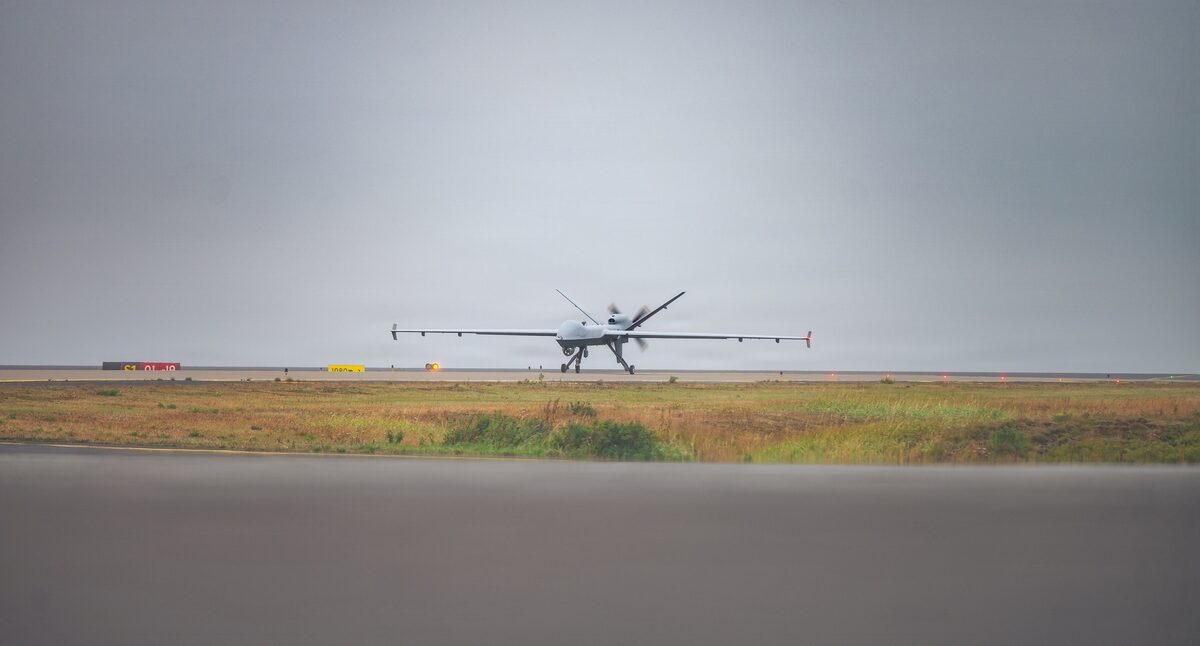
Start with the arithmetic. At the beginning of fiscal 2026 the U.S. Air Force had 165 MQ-9A Reapers. By May it had 135, 54 short of its stated requirement of 189. Since Operation Epic Fury began against Iran in February, at least 45 Reapers have been lost, roughly one in four of the airframes the service owned when the war started, and that is on top of the dozens shot down over Yemen by the Houthis in 2025. The production line that built them closed last year.
That is the backdrop against which Air Force and Defense Innovation Unit officials sat down with reporters at the Pentagon on Sept. 3 to say that Air Force Secretary Troy Meink has ordered the service's planned Reaper successor, the DIU-run Massed Modular Aircraft (MMA), to move faster. The program's original goal, 20 mission-ready aircraft by fiscal 2031, could be pulled forward by about two years, which would put an initial operational capability around fiscal 2029.
"Although we have plenty of MQ-9As today, we are going through them at a rate that is concerning to us," said Lt. Gen. Christopher Niemi, the Air Force's chief modernization officer, according to Defense News. He was blunter still in remarks reported by Janes: "There's not a lot of good options to immediately replace those aircraft that have been lost."
A Fleet Shrinking Faster Than the Replacement Plan
The loss figures have climbed steadily through the year. A Congressional Research Service report dated May 13 counted 24 MQ-9 losses as of April 9. By Aug. 13, the Washington Post was reporting at least 45, or about 25 percent of the fleet. Those numbers, cited across Defense News, DefenseScoop and Breaking Defense, describe an aircraft being fed into a theater with layered air defenses at a pace the inventory cannot sustain.
The obvious stopgap, buying more Reapers, is not available in any timely form. MQ-9A production ended in 2025, and Niemi told reporters that budget constraints mean the service is "not going to buy a whole lot of MQ-9Bs today either," per Janes; Defense News characterized a large buy of the upgraded MQ-9B SkyGuardian as unrealistic. Replacing the lost MQ-9As, per Janes, would take years even if the money existed.
Niemi framed the underlying lesson in structural terms: "You need to have a portfolio of assets that's more attritable than the ones we've historically had." The Air Force, in other words, is no longer planning around aircraft it expects to bring home every time.
What the Air Force Actually Wants
The MMA requirements, which Niemi signed in May, are not exotic. DIU's solicitation, PROJ00626, describes a lower-cost theater-range unmanned aircraft for contested environments with the following floor:
- Payload of at least 2,800 pounds
- Unrefueled combat radius of at least 2,300 nautical miles with payload
- One-way self-deployment range of at least 8,000 nautical miles
- Modular open systems architecture for payload integration
The solicitation also calls for a true airspeed of 200 knots or better and operation from runways of 6,000 feet or shorter, and lists one-to-many control, so a single crew can manage several aircraft, and hybrid satellite and mesh-network communications among its desired attributes. DefenseScoop reports the planned configuration is a turboprop with a high-aspect-ratio wing.
Set that against the Reaper and the point becomes clear: the MMA is meant to carry more and fly farther, but it is not meant to be a technological leap. "There's no cutting-edge technology for how fast it flies, how high it flies, how far it flies," Niemi said, per The War Zone. The novelty is in the price and the volume, not the airframe.
The $10 Million Number
The program's target is roughly $10 million per air vehicle. That figure, as The War Zone emphasizes, covers the airframe only; sensors and mission equipment are extra. For comparison, a fully missionized Reaper runs between $30 million and $50 million, and the Air Force's Collaborative Combat Aircraft target is about $20 million per air vehicle after full-rate production. The MMA is meant to come in at roughly half the cost of a CCA and a fraction of the cost of the aircraft it replaces.
The argument behind the July solicitation, as DefenseScoop summarized it, is that the Reaper has become an exquisite platform that is too expensive to risk losing against inexpensive, layered air defenses. Niemi made the same argument from the acquisition side: "If we try and pursue the exact same approach that we had with things like the MQ-9, we're going to get something that costs about the same as an MQ-9."
Holding that line will mean trade-offs. "You're going to have to certainly give up something," Niemi acknowledged. Lt. Gen. Luke Cropsey, the Air Force's military deputy for acquisitions, cast the cost discipline as a design input rather than an afterthought: "Applying those to a clean-sheet design like we're doing now gives us the ability to impose that up front."
The service plans to buy at least 180 of them.
How the Timeline Compresses
The competition opened on July 7 and closed on July 23. It is being run under an Other Transaction Authority, open to both U.S. and international vendors, with the possibility of a follow-on production award without a separate competition for whoever wins. Concept-refinement awards are expected in the first quarter of fiscal 2027.
The original solicitation called for a full-scale prototype within 21 months of award, with IOC of 20 aircraft in fiscal 2031. Under the accelerated plan, Maj. Gen. Joseph Kunkel, DIU's military deputy, described a compressed DIU model: the intent, he said, is "to get to a prototype within a year, [and] fielded at scale within three years."
Niemi was candid that the fiscal 2031 target for 20 aircraft is now the old plan. That schedule, as Defense Daily reported, is "closer to where we were until fairly recently."
General Atomics Wants Its Own Successor
The Reaper's builder is not conceding the field. General Atomics is pitching a design it calls Wildfire, and spokesman C. Mark Brinkley told Defense News it "meets every wish on the [MMA] list and exceeds most of them." Asked about competing proposals, Brinkley offered a line to The War Zone that captures the incumbent's argument in miniature: rival bids, he said, are "unscratched lottery tickets, promising all of the win and none of the lose."
It is a fair point as far as it goes. General Atomics has a production base and a fielded family of aircraft; a clean-sheet competitor will have to prove it can hit both the performance floor and the $10 million ceiling. Whether the Air Force's stated preference for a clean-sheet design leaves room for an incumbent's offering, or whether Wildfire is far enough from the MQ-9 lineage to qualify, is something the concept-refinement round will begin to answer.
Why It Matters
The MMA acceleration is the most concrete procurement response the Air Force has yet made to the Reaper losses over Iran, and it tells you what the service concluded from them. The problem was not that the MQ-9 was a bad aircraft; it was that a $30 million to $50 million platform cannot be expended at the rate modern air defenses demand, and a fleet of 135 with no open production line cannot absorb 45 losses without changing how it fights.
The answer, at least on paper, is to make the next aircraft cheap enough that losing it is a cost of doing business rather than a headline. That is the same logic driving the CCA program, applied a tier lower and a good deal cheaper. If DIU and the Air Force can hold the $10 million air-vehicle target while delivering 2,300 nautical miles of combat radius and 2,800 pounds of payload, they will have redefined what a theater-range strike and surveillance drone costs. If they cannot, they will have spent the compressed timeline discovering why nobody has done it before.
Either way, the schedule is now the test. Concept-refinement awards land in early fiscal 2027; a prototype is supposed to fly within a year of contract award. The Reaper fleet will keep shrinking in the meantime, and the Air Force has already said it has no good way to backfill it.
Sources
- USAF moves to accelerate massed modular aircraft development (Janes)
- US Air Force speeds Reaper successor timeline after Iran losses (Defense News)
- USAF Wants MQ-9 Reaper Successor At A Fraction Of The Cost At $10M Each (The War Zone)
- Air Force moves to accelerate effort to replace MQ-9 Reaper after combat losses in Iran war (DefenseScoop)
- After 'concerning' losses, Air Force pushes to replace Reaper faster (Breaking Defense)
- Meink Directs MMA Acceleration, USAF Eyes $10 Million Unit Cost for Air Vehicle (Defense Daily)
- DIU Issues Solicitation for Massed Modular Aircraft (ExecutiveGov)