
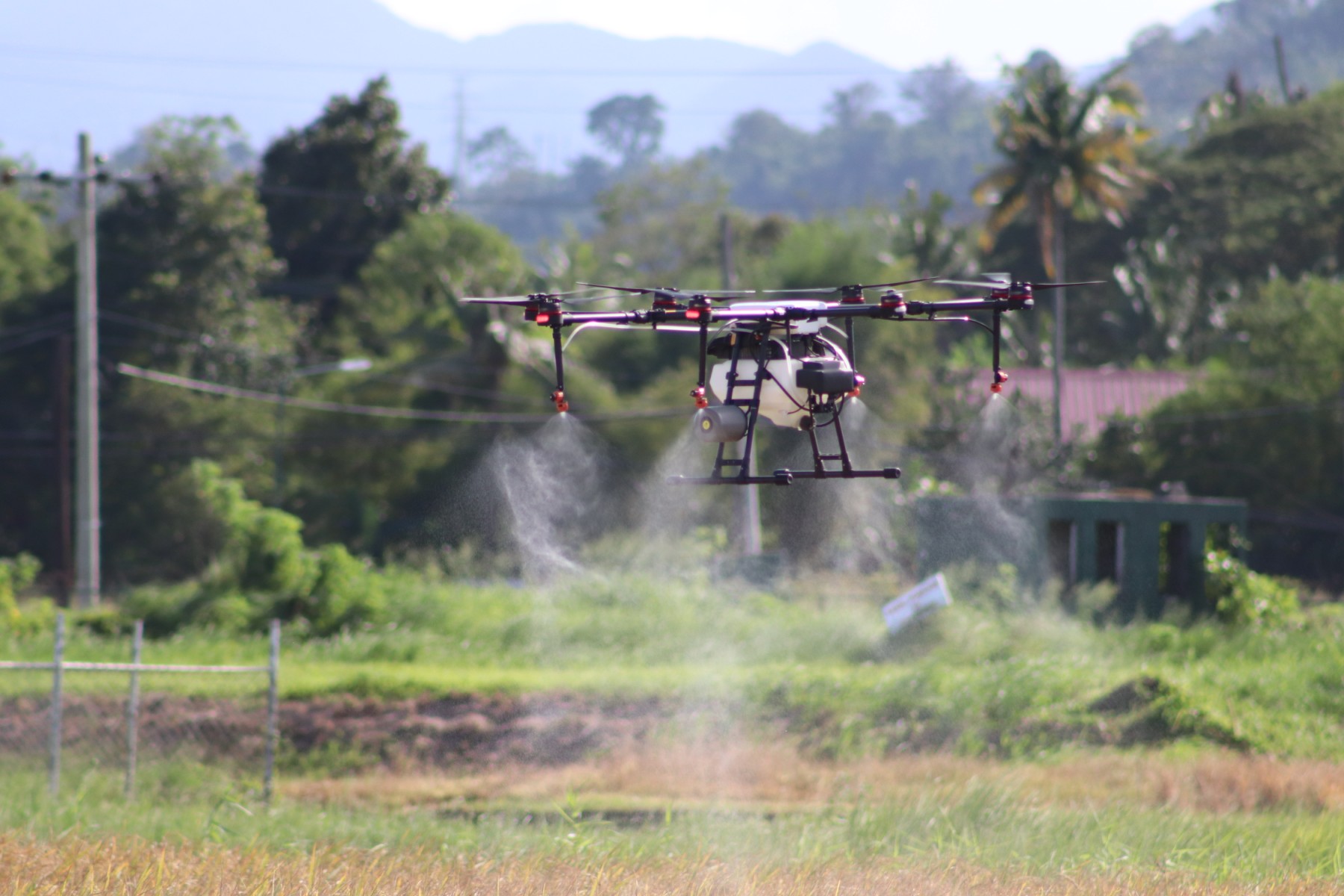
The agricultural spray drone traces its commercial origin not to Silicon Valley or Shenzhen but to rural Japan. Yamaha flew the RMax unmanned helicopter commercially beginning in 1997 — a single-rotor UAS helicopter with a tank exceeding four gallons, designed to replace the backpack sprayer on steep terraced rice paddies. The multi-rotor variant arrived in China in 2009, and by 2016 that country had 200 manufacturers producing more than 169 distinct models and selling over 10,000 units annually. Agriculture had found its drone use case, and it wasn't photography.
Modern platforms are sophisticated flying chemical delivery systems. A typical unit combines a 6-to-8 rotor frame, a sealed spray tank (commonly 19 to 68 liters), centrifugal or hydraulic nozzles producing droplets in the 50–500 micron range, and real-time kinematic GPS for sub-centimeter positioning. Terrain-following radar holds altitude 7 to 12 feet above the canopy — close enough to concentrate deposition and cut the drift that plagues manned fixed-wing applicators. Battery endurance under full payload is 5 to 20 minutes, a constraint that shapes field logistics entirely.
The Platform Landscape
DJI's Agras T50 is the globally dominant product: a 40-liter tank, 40-kilogram spraying payload, dual atomizing sprinklers delivering up to 16 L/min (expandable to 24 L/min), and a claimed 50 acres per hour at two gallons per acre. Battery recharge runs roughly nine minutes, designed to finish simultaneously with tank refill. A ready-to-fly bundle costs approximately $29,000–$32,500. Prior to potential federal NDAA restrictions, DJI held an estimated 80–90% of U.S. spray drone sales — a concentration that has drawn national security scrutiny and prompted federal NDAA restrictions on Chinese-manufactured drones.
XAG's P100 occupies a similar tier: 40-liter liquid tank, 60-liter granule container, 12 L/min flow, and dual-antenna RTK. U.S.-manufactured alternatives carry a significant premium. Hylio's AG-272, built in Houston, carries a 68.2-liter tank, 40-foot swath, and claims 50 acres per hour — but entry-level Hylio products start around $20,000 and the AG-272 exceeds $30,000, versus Chinese equivalents available under $10,000.
The most technically ambitious U.S. attempt ended in failure. Guardian Agriculture's SC1 was a different class of machine: 600 pounds, four 80-inch propellers, a 20-gallon tank on an 18-foot spray boom, 200-pound payload, 60 acres per hour, with combined tank refill and recharge under one minute. It received FAA approval as the first commercially authorized eVTOL aircraft in the United States in early 2023 and launched commercial operations in California's Salinas Valley in December 2023 with four aircraft. Guardian had raised $51.7 million across five rounds when CEO Ashley Ferguson disclosed in August 2025 that the company lacked enough cash on hand to bring folks back to work next week (or cover benefits going forward).
The shutdown — after manufacturing eight SC1 units — illustrates the capital depth required to commercialize novel agricultural robotics hardware at scale.
Adoption: A Study in Regional Divergence
Asia's deployment numbers make U.S. figures look embryonic. China had more than 120,000 agricultural drones in operation by 2021, treating 153 million acres that year — up from 64 million in 2020 — with over 200,000 registered pilots. South Korea applies roughly 30% of its pesticide volume via drone. Thailand went from near-zero to drones covering 30% of its farmland between 2019 and 2023. Japan, where the market began, had approximately 2,800 unmanned helicopters registered by 2016, spraying over a third of the country's rice fields.
The United States registered approximately 1,000 drones for agricultural work in January 2024, rising to an estimated 5,500 by mid-2025 — with actual numbers likely higher due to underreporting, per Michigan State University researchers. One leading U.S. spray service grew from 1,000 acres treated in 2019 to approximately 200,000 in 2023. The agricultural drone market overall is projected to grow from $4.98 billion in 2023 to $18.22 billion by 2030, a 20.3% compound annual growth rate.
Regulation explains part of the gap. Japan has 390-plus pesticide products registered for drone application; South Korea approximately 203; India more than 470. The United States, as of the most recent Ohio State University Extension review, had no pesticide labels that specify drone application instructions at all.
The FAA's Two-Part Certification Gauntlet
Agricultural spray drones sit at the intersection of two distinct regulatory frameworks, and operators must satisfy both. 14 CFR Part 107 governs small UAS commercial operations and mandates a Remote Pilot Certificate, but Section 107.36 prohibits hazardous material carriage — which pesticides are — making an exemption petition mandatory before any spray operation. Separately, 14 CFR Part 137, originally written for manned crop dusters, applies to any aircraft dispensing substances for pest control or crop protection and requires an Agricultural Aircraft Operator Certificate (AAOC) from the local FSDO. The Part 107 Remote Pilot Certificate remains mandatory regardless of AAOC status.
Weight is the primary branch point:
- Under 55 pounds (with payload): Operate under Part 107. File exemptions from Section 107.36 and several manned-aircraft Part 137 provisions (pilot certificate requirements, certificate carriage, safety belt mandates). Registration via FA-number on FAADroneZone.
- 55 pounds and over: Comply with 14 CFR Part 91 and petition for a Section 44807 exemption before layering on Part 137. Registration requires an N-number; pilot documentation standards are comparable to manned aircraft.
The AAOC application runs through five phases: FSDO pre-meeting, formal application via FAA Form 8710-3 to [email protected], document review, a practical skills test with a water-loaded tank, and certificate issuance. Exemption petitions must be filed at least 120 days before operations; AAOC review takes 60–90 days independently. Total realistic timeline from initial application to first legal spray flight: 4–6 months. As of February 2021, only 37 U.S. companies held Part 137 certification. State pesticide applicator licenses — required separately in most states, sometimes demanding 125 or more documented flight hours — and EPA certification for restricted-use pesticides add further layers the FAA process does not satisfy.
Efficiency Claims and Genuine Limits
A 2024 life-cycle assessment (wheat, Lorestan province, Iran; ISO 14040/14044 methodology) compared drone and tractor-mounted spraying across 15 environmental midpoint categories. Drones consumed 146.84 MJ per hectare versus 365.26 MJ conventionally — a 2.43-times energy advantage that widens to roughly 12 times when the identical pesticide load is excluded. Global warming potential fell 65% (14.485 versus 41.284 kg CO₂/ha). Terrestrial ecotoxicity dropped 96.8%, primarily due to diesel tractor emissions eliminated by battery-electric operation.
Ohio State University Extension cautions explicitly that published research evaluating drone spray performance is «very limited» and that direct comparisons are difficult. Coverage uniformity can be worse than ground equipment: one study measured a spray deposition variation coefficient of 87.2% for UAVs versus 31.2% for boom sprayers. Drone operation requires wind speeds below 7 mph for adequate performance, against 15 mph tolerance for conventional aircraft — materially narrowing operational windows. Where drones clearly outperform alternatives is on irregular or terrain-constrained fields, situations where applicator chemical exposure is a concern, and operations where ground equipment cannot access the soil without causing damage. Researchers estimate a single spray drone can cover the equivalent effort of between 30 and 100 manual workers for equivalent acreage — a labor-displacement concern in high-employment agricultural economies, and a safety and cost argument in labor-constrained U.S. markets.
Sources
- Ohio State University Extension / CFAES — Drones for Spraying Pesticides: Opportunities and Challenges
- Ohio State University Extension / Agronomic Crops Network — Using Drones for Spray Application: Adoption Trends in US and Worldwide
- FAA — Dispensing Chemicals and Agricultural Products (Part 137) with UAS
- Pilot Institute — Part 137: Using Drones for Agricultural Spraying
- EAVision — FAA Regulations for Agricultural Drone Spraying: Part 137 Explained
- PLOS ONE — Reducing energy and environmental footprint in agriculture: A study on drone spraying vs. conventional methods
- The Conversation (Michigan State University) — Agricultural drones are taking off globally, saving farmers time and money
- Agriculture Dive — Guardian Agriculture launches commercial operations
- The Robot Report — Drone startup Guardian Agriculture shuts down
- ABJ Drone Academy — Best American and Allied Drones for Agriculture in the U.S. (2026)
- Talos Drones — The Ultimate Guide to DJI Agras T50: Features, Specs, and Pricing
- XAG — P100 product page
- Drone Spray Pro — FAA Part 137 Rules for Spray Drones
