
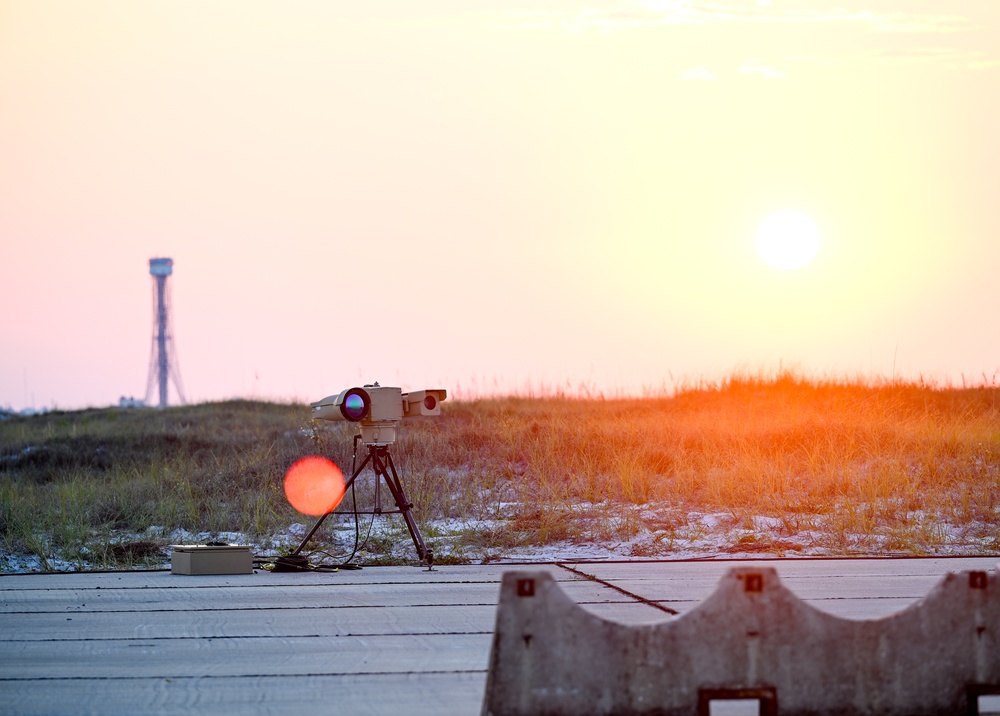
The U.S. Army has issued the first task order under a half-billion-dollar counter-drone contract, sending $80.5 million worth of AeroVironment sensors and defeat systems to Air Force Global Strike Command bases that have spent months of 2026 fending off unidentified drones.
Army Contracting Command-Detroit Arsenal awarded the task order on July 6, 2026, on behalf of Joint Interagency Task Force 401 (JIATF-401), the Pentagon's homeland counter-UAS coordination cell. The award appeared in the Department of War's routine daily contracts announcement, but its significance is anything but routine: it is the first money to move under AeroVironment's $500 million "Domestic Shield" indefinite-delivery/indefinite-quantity (IDIQ) contract, which the Department of War announced on July 1, 2026, just days before the task order followed.
The system going into the field is AeroVironment's Titan-MS, an AI-powered, multi-sensor fusion platform the company describes as capable of detecting, identifying, tracking, defeating and reporting on unmanned aircraft threats. Unlike counter-drone tools built around a single sensor type, Titan-MS is designed to fuse multiple detection modalities to catch both radio-frequency-controlled drones and autonomous systems that don't emit a traceable RF signature — a distinction that has become operationally critical as hobbyist and commercial drones increasingly fly pre-programmed routes with no live pilot link to jam or track.
Why Barksdale
The lead beneficiary is Barksdale Air Force Base in Louisiana, home to Air Force Global Strike Command's B-52 bomber force and a nuclear command-and-control node. Air Force Global Strike Command disclosed in a March 2026 press release that Barksdale had "experienced several unauthorized drone incursions that varied in duration and number of drones" — incidents that drew renewed scrutiny to the gap between the Air Force's static base-defense posture and the growing volume of small drones operating near restricted airspace.
Barksdale is not an isolated case study; it's a proof point. The base incursions were serious enough to become the public rationale AeroVironment and the Pentagon cited when explaining why the first Domestic Shield task order went where it did. Air Force Global Strike Command's broader network of bases — which also includes bomber, missile, and nuclear-mission installations — is the named deployment target for this tranche of Titan-MS systems, not Barksdale alone.
"This investment provides operators with the tools to detect, track, and defend against illicit drones," said Col. Jason Idleman, in comments tied to the announcement.
What Domestic Shield Actually Is
Domestic Shield is JIATF-401's vehicle for procuring counter-UAS capability to protect U.S. military installations from drone threats — a mission category the Pentagon has increasingly treated as distinct from, and just as urgent as, counter-drone work in overseas combat zones. The IDIQ ceiling of $500 million sets the maximum value of task orders that can be issued over the life of the contract; it does not guarantee that amount will be spent, but it does establish AeroVironment as a go-to vendor for domestic base-defense counter-drone work for the duration of the agreement.
The $80.5 million task order announced July 6 is the first draw against that ceiling — roughly 16 percent of the total IDIQ value committed in a single order, an indicator of how much hardware and integration work the Air Force Global Strike Command rollout is expected to require.
Why It Matters
Domestic base incursions by small drones have moved from novelty to recurring operational problem at U.S. military installations, and Barksdale's 2026 incidents at a nuclear-capable bomber base put a fine point on the stakes: unidentified drones loitering over or near strategic assets are a detection and attribution problem the Pentagon has struggled to solve with legacy air-defense systems built for manned aircraft, not small, inexpensive commercial quadcopters.
The Titan-MS award matters for three reasons. First, it's a signal of intent — the first task order under a new IDIQ tends to set the template for how a contract will actually be executed, and a $80.5 million opening order suggests JIATF-401 intends to move quickly rather than let Domestic Shield sit dormant. Second, it validates AI-driven sensor fusion as the Pentagon's preferred architecture for base defense, rather than single-sensor RF detection or kinetic-only defeat systems that struggle against autonomous, non-emitting drones. Third, it puts a name and a number to what has largely been an abstract policy conversation about "protecting the homeland from drones" — Barksdale's bombers and the personnel who fly and maintain them are the concrete stakes.
For the counter-UAS industry, the award also confirms that Air Force Global Strike Command bases — a small, high-value set of installations tied to the nuclear triad and long-range strike mission — are near the front of the line for funded base-defense upgrades, ahead of the broader universe of domestic military installations still waiting on their own Domestic Shield task orders.
What's Still Unclear
The public record does not yet specify how many Titan-MS units are being delivered, an installation timeline, or which additional Air Force Global Strike Command bases beyond Barksdale will receive systems under this specific task order. AeroVironment's own announcement and the Department of War's contract notice confirm the dollar figure, the date, and JIATF-401 as the awarding authority, but neither document breaks out a per-base allocation or fielding schedule. Those details will likely surface as the systems are installed and as follow-on task orders are issued against the remaining balance of the $500 million ceiling.
Sources
- Contracts for July 6, 2026 — U.S. Department of War
- Pentagon awards $80M task order for AI-enabled tech to defend Air Force bases against small drones — DefenseScoop
- AV's Titan Selected by JIATF-401 for $80.5m Award — AeroVironment
- AV's New C-UAS Deal Begins With $80 Million Titan Order To Air Force Global Strike Command — Defense Daily
