
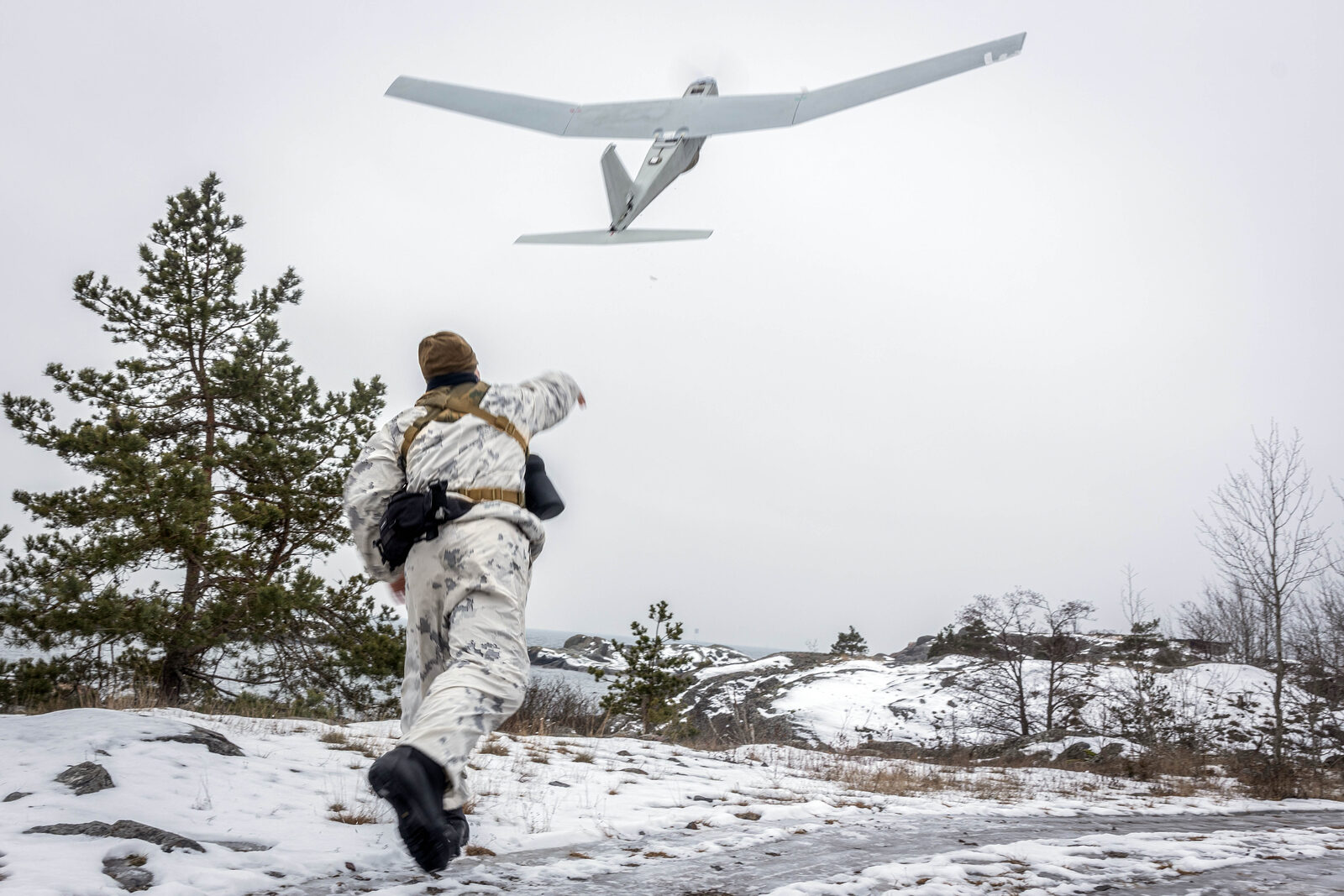
One operator grips the fuselage of a 14-pound aircraft at its center of gravity, takes a few steps into the wind, and releases it into the air off the stern of a Navy patrol ship. No catapult, no runway, no ground crew. The RQ-20 Puma AE is airborne in seconds, streaming thermal imagery to a laptop-sized ground control station before the operator finishes logging the launch. At mission's end, the aircraft can autonomously deep-stall onto the water and wait for small-craft recovery. That combination — man-portable launch, no-infrastructure operation, ocean-landing capability — explains why AeroVironment's Puma has quietly become the baseline ISR reference platform for roughly 19 nations and counting. It is also why, after two decades of continuous procurement, the U.S. Department of Defense keeps writing contracts for more.
An Airframe That Goes Anywhere
"AE" stands for All Environment, not the more commonly mislabeled "All Weather." The distinction is structural. The Puma AE's reinforced shell fuselage and fully waterproof airframe are not simply weather hardening — they are a mission enabler. The aircraft can deep-stall land onto open water and be recovered by a small watercraft, making it genuinely amphibious in a way few fixed-wing platforms at any size can claim. Optional rail launch capability is available, but the design case is hand-launch: one soldier, no auxiliary equipment, ready to go.
The core numbers: 2.8-meter wingspan, 1.4-meter length, 5.9–6.3 kg gross weight depending on configuration. High-wing monoplane with a two-blade propeller in tractor configuration; battery-electric propulsion suppresses acoustic signature for covert surveillance. Maximum speed is 83 km/h; cruise can drop as low as 37 km/h for persistent loiter. Standard communications radius is 15 km. The operating envelope runs from −29°C to 49°C with winds up to 25–29 mph and light rain. Maximum altitude is 10,500 ft MSL; typical ISR altitude is 500 ft AGL.
A standard system includes three air vehicles, one ground control station, and one remote video terminal. Two operators run it: one forward for launch and recovery, one at the GCS. The standard LE battery configuration delivers 3+ hours of endurance. A Solar Puma prototype, tested in August 2013, integrated thin-film solar cells into the wing surface and demonstrated 9+ continuous hours of flight — a figure that starts to blur the distinction between tactical UAS and near-persistent surveillance asset. The earlier endurance records are telling: AeroVironment demonstrated 7+ hours on a PTX.L fuel cell system in October 2007 and 9+ hours via a fuel cell–battery hybrid in March 2008, showing that the platform's extended-endurance ambitions predate current battery technology by nearly two decades.
What the Payload Sees
The primary sensor is the Mantis i45 EO/IR gimbal, combining a conventional camera and a thermal imager. Naval Technology describes it as "an electro-optical / infrared (EO / IR) camera system and illuminator in a lightweight, mechanically-stabilised gimbal payload pod fitted beneath the fuselage." The IR illuminator enables active night operations — not passive thermal reliance, but active illumination in wavelengths invisible to the naked eye, giving operators usable imagery in complete darkness without a visible signature.
The Transit Bay, an under-wing payload station, can carry a laser marking system, a communications relay node, or a geolocation sensor depending on mission requirements. Two software modes make small-unit employment practical: "follow-me" mode maintains the aircraft's relative position to the ground operator without manual piloting input, and automatic moving-target tracking keeps a designated object in frame while the operator focuses on the feed rather than the stick. The combination allows a two-person team to generate targeting-quality data without breaking the aircraft out of orbit every time they need to update the track.
From SOCOM Select to NATO Baseline: The Development Record
SOCOM selected the All Environment Capable Variant through full and open competition in 2008. The U.S. Army assumed program management from SOCOM in 2011, and 2012 became the platform's breakout year: formally designated RQ-20A in April, the Puma received Army, Marine Corps, and Air Force procurement orders in rapid succession, with the 1,000th unit delivered that same year.
The Block 2 variant — RQ-20B — arrived in October 2013 with a more powerful and lighter propulsion system, a strengthened airframe, extended LE battery, improved GCS interface, and the Mantis i45 sensor suite that remains standard.
Contract volume tracks the expansion. Major awards include an $35.3 million DoD contract in August 2010, a $65.5 million SOCOM contract in August 2011, a $20.4 million Army contract in March 2012 for systems earmarked for Afghanistan, and a $248 million multi-company Army vehicle contract running through 2017. Allied procurement began in parallel: Denmark inked a $9.6 million contract in June 2012; Sweden took 12 air vehicles the same period. Today, approximately 19 nations operate the Puma AE, among them Albania, Belgium, Canada, Czech Republic, France, Germany, the Netherlands, Norway, Spain, Sweden, and the United Kingdom. For most NATO allies, Puma is the Group 1/2 small UAS against which alternatives are benchmarked during procurement evaluation.
Active U.S. operational use remains continuous. DVIDS documentation from the 379th Expeditionary Security Forces Squadron at an undisclosed CENTCOM location in June 2024 notes that operators fly monthly proficiency flights, with primary missions including intelligence, surveillance and reconnaissance operations and providing force protection for installation members.
By October 2025, the 332nd Expeditionary Security Forces Squadron Electronic Warfare Division was conducting Puma operations in the same AOR, with the platform described officially as "a hand-launched, tactical, unmanned aircraft" used "primarily for intelligence, surveillance, and reconnaissance" — language indistinguishable from the program's initial operational documentation, which speaks to how little the core mission has shifted even as the hardware has evolved.
Why It Matters
Ukraine provided the sharpest combat test in the platform's history and, arguably, in the history of the Group 1/2 UAS category. Seven weeks after Russia's February 24, 2022 invasion, the U.S. obligated $19,737,523 under a firm-fixed-price contract through Army Contracting Command, Redstone Arsenal — covering Puma AE systems, RSTA kits, spares, contractor logistics support, and training. Ukrainian forces integrated the Puma for battlefield ISR, targeting, and battle damage assessment.
The December 2023 contract amendment adding another $32 million in RQ-20B procurement, with work centered at Mechanicsburg, Pennsylvania and a completion date of September 2024, confirmed continued DoD and Congressional commitment to the platform.
What the Ukraine experience is doing in parallel is feeding tactical lessons back into SUAS doctrine at a pace that no peacetime exercise program can match. How small fixed-wing ISR platforms survive in environments with man-portable air defense systems, how their sensor data integrates with fires timelines, how operator proficiency degrades under sustained combat attrition — all of that is being written in real time, with the Puma AE as one of the primary data points. For procurement offices across the alliance, the platform's two-decade track record across Afghanistan, CENTCOM installations, ship decks, and now a peer-adversary conflict in Europe constitutes a body of operational proof that no datasheet can replicate and no newcomer can shortcut.
Sources
- DVIDS — 379th ESFS Defenders Showcase RQ-20 Puma Proficiency (June 2024)
- DVIDS — RQ-20 Puma Drone B-Roll Package, 332nd ESFS (November 2025)
- Naval Technology — RQ-20B Puma AE Small Unmanned Aircraft System
- GlobalSecurity.org — RQ-20 Puma
- Army Technology — Puma Unmanned Aircraft System
- Military Factory — AeroVironment RQ-20 Puma AE
- Army Recognition — AeroVironment Puma AE UAS Provided to Ukraine (April 2022)
- Army Recognition — DoD Awards $32M Contract for Additional RQ-20B Pumas (December 2023)
- Military Aerospace Electronics — Ukraine Unmanned Reconnaissance (April 2022)
- Janes — Kosovo receives RQ-20 Puma UAS from US
