
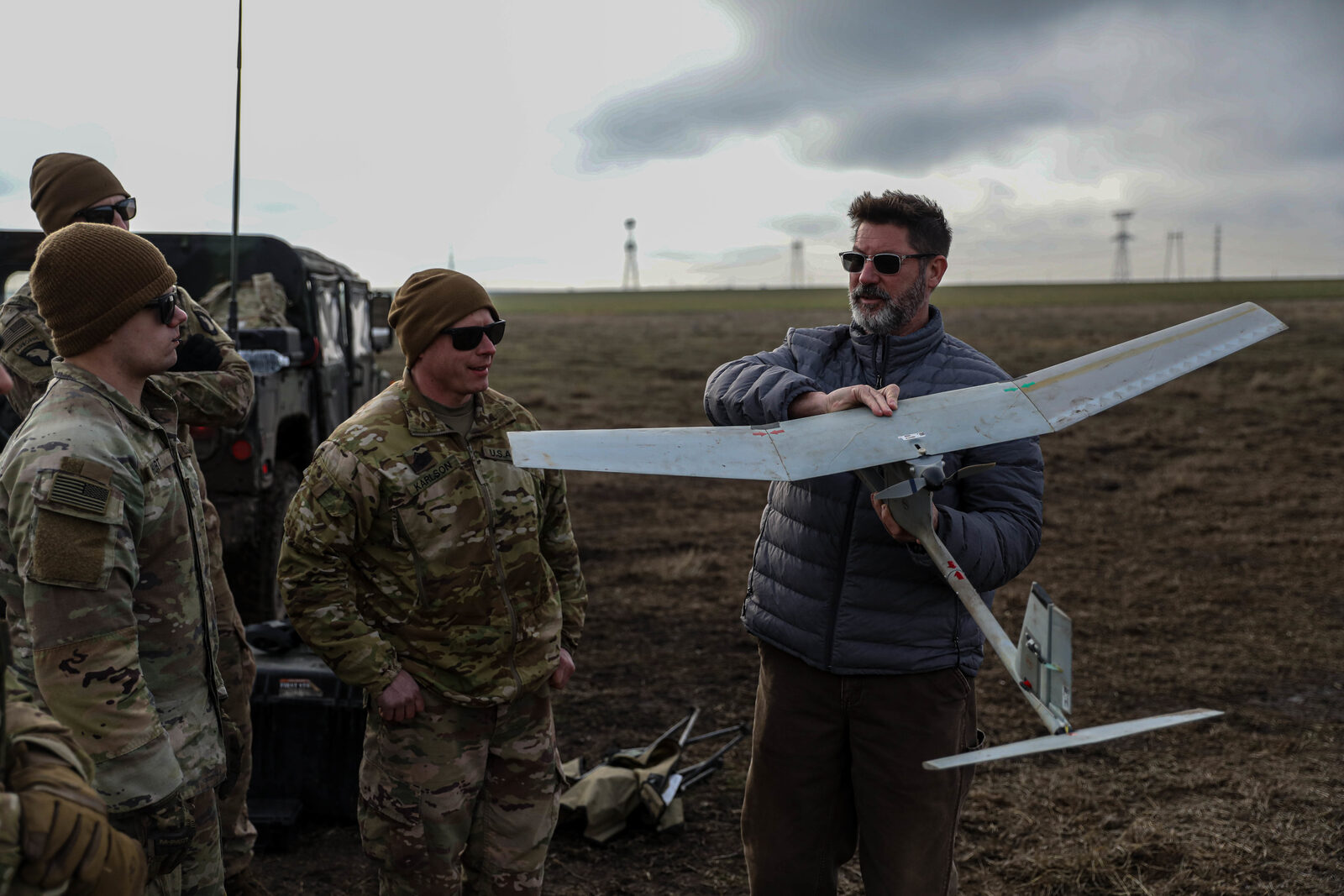
The U.S. Army has fielded more small UAS of one type than any other in its inventory — and that type is the RQ-11 Raven, a 4.2-pound, hand-launched drone that a two-soldier team can assemble in five minutes and fly 10 kilometers without a dedicated MOS. AeroVironment built it, and then built most of what followed it in American tactical airspace. Over five decades the company quietly became the default vendor for the Pentagon's close-range reconnaissance, then pivoted hard into lethal autonomy, and in 2025 completed a $4.1 billion merger that rewired it into something broader: a multi-domain defense-tech mid-prime capable of shooting down drones, burning out electronics from a directed-energy beam, and still shipping the Raven to 11 allied nations.
A Glider Champion Who Taught Drones to Fly Light
Paul MacCready Jr. is best remembered as the man who built human-powered aircraft, but his instincts ran deeper than spectacle. He trained as a physicist at Yale and earned a doctorate in aeronautical engineering from Caltech, then spent the 1940s and 1950s dominating competitive soaring — U.S. champion in 1948, 1949, and 1953; world champion in 1956, the first American to hold that title. What MacCready understood intuitively was that most aircraft are grotesquely inefficient: they burn far more energy than physics demands. That insight defined everything he built afterward.
AeroVironment was founded in 1971 to commercialize that philosophy. Six years later, the Gossamer Condor became the first human-powered aircraft capable of controlled, sustained flight, winning the inaugural Kremer Prize. In 1979, the Gossamer Albatross crossed the English Channel under human power alone — 36.2 kilometers in 2 hours 49 minutes on June 12 — claiming the second Kremer Prize worth £100,000. MacCready followed those landmark designs with the Solar Challenger (solar-powered flight), the Sunraycer (winner of the 1987 Australian solar car race), and the Helios Prototype, a solar flying wing that reached 96,863 feet on August 13, 2001. He died in 2007, but the engineering discipline he ingrained in AeroVironment — mass-efficient airframes, clean electric propulsion, obsessive drag reduction — maps directly to the product line that made the company a defense prime.
The translation from aeronautical elegance to military utility came early. AeroVironment's FQM-151 Pointer was the first backpackable reconnaissance UAS deployed by the military, measuring 6 feet long with a 9-foot wingspan and weighing 9 pounds. By the time the Raven debuted in 2002 and was locked into the Army's 2005 contract, AV had compressed all of that utility into 4.2 pounds with a 4.5-foot wingspan — a system that operates at 500 feet AGL, endures roughly 90 minutes per battery set, and carries gimbaled electro-optical and infrared sensors with a laser illuminator.
The Army describes the RQ-11B Raven as a hand-launched, remote-controlled aircraft that gives combat units organic intelligence, surveillance, and reconnaissance capability without requiring a dedicated operator MOS.
Foreign sales reached Bulgaria, Denmark, Estonia, Hungary, Kenya, Lebanon, Macedonia, Romania, Uganda, Uzbekistan, and Yemen — a footprint that simultaneously embedded AeroVironment in allied intelligence-sharing networks and generated recurring sustainment revenue that competitors could not easily displace.
The Product Ladder: Pointer to JUMP 20
AeroVironment's catalog traces the Army's appetite for smaller, longer-loitering, payload-heavier platforms across successive decades. The 1999 Black Widow, at 3 ounces, was the world's first micro air vehicle. The Puma (RQ-20), introduced in 2008, climbed in endurance and payload while remaining man-portable; in 2013 it became one of the first UAS to receive FAA commercial certification for civil operations, opening parallel revenue lines outside the DoD. Neither system displaced the Raven — they complemented it, giving infantry commanders layered ISR capability from a single vendor's logistics chain.
The acquisition of Arcturus UAV in January 2021 moved AeroVironment into the Group 3 tier with the JUMP 20, a VTOL fixed-wing system offering extended endurance and significant payload capacity — all without a runway. The Army formalized that positioning in August 2022, awarding AV an $8 million contract for one JUMP 20 system (six air vehicles plus ground equipment) for a single brigade combat team under the Future Tactical UAS program. FTUAS had been shopping for a Shadow UAS replacement since 2018; a competitive evaluation at Fort Benning, Georgia in spring 2021 narrowed the field before AeroVironment prevailed. The Army's justification was direct: "AeroVironment met performance requirements while offering high technology and manufacturing readiness levels, thereby reducing the need for additional development."
Switchblade and the Loitering Munitions Surge
If the Raven and Puma were AeroVironment's calling card, Switchblade has become its financial accelerant. The family — comprising the 300 Block 20, the 400, the 600, and the 600 Block 2 — translates the company's efficiency engineering into a different mission set: not just observing targets but striking them. Demand for the family spiked after Switchblade's combat use in Ukraine demonstrated that attritable, tube-launched munitions could blunt armored advances without risking pilots or expensive platforms. The capability description carries its own precision: "The Switchblade family of loitering munitions offers precision flight control, greater lethality against fortified targets such as armored vehicles and tanks, and the ability to track and engage moving non-line-of-sight targets."
On August 28, 2024, the U.S. Army Contracting Command-Aberdeen Proving Ground awarded AeroVironment a five-year, $990 million IDIQ contract for Switchblade systems under the Lethal Unmanned Systems Directed Requirement. In Q4 FY2025, the loitering munitions segment grew 87% year-over-year, making it the company's fastest-expanding revenue line by a significant margin, ahead of the MacCready Works segment (up 24%) and Uncrewed Systems (up 9%).
Why It Matters
The BlueHalo merger — announced November 19, 2024 and closed May 1-2, 2025 — is the structural bet that defines AeroVironment's next decade. The all-stock transaction, valued at approximately $4.1 billion at enterprise value, brought BlueHalo's directed-energy weapons, space communications, and cyber capabilities into a combined organization of more than 3,750 employees across 40-plus U.S. states, headquartered in Arlington, Virginia.
The post-merger entity reorganized into two segments: Autonomous Systems (UAS, loitering munitions, ground and maritime robotics) and Space, Cyber and Directed Energy (everything BlueHalo contributes). Wahid Nawabi serves as Chairman, President and CEO; Trace Stevenson leads Autonomous Systems; Trip Ferguson, BlueHalo's former COO, leads Space, Cyber and Directed Energy. The rationale from AeroVironment's press release is precise: "By bringing together two mission-focused organizations, the new AV is built to accelerate innovation, strengthen our customer partnerships, and deliver operational impact across every domain."
The financials give that framing weight. In FY2025, AeroVironment (NASDAQ: AVAV) posted $820.6 million in revenue, up 14% year-over-year, with Q4 alone reaching $275.1 million — a 40% year-over-year jump. Full-year bookings hit $1.2 billion, a record, with backlog approximately double FY2024 levels. Net income reached $43.6 million; Adjusted EBITDA of $146.4 million also set a record.
What AeroVironment represents, fifty-plus years after MacCready founded it to probe the physics of efficient flight, is a company that reached scale through engineering discipline rather than platform monopolies or cost-plus inertia. The Raven became ubiquitous because it genuinely excelled at being easy to operate and hard to match at its weight class. Switchblade generated nearly half a billion dollars in 12 months of orders because it existed and worked at the moment demand materialized. The BlueHalo merger extends that logic — adding directed energy and cyber capabilities at precisely the moment the Pentagon is funding C-UAS, electromagnetic warfare, and space resilience as first-tier modernization priorities. The result is a mid-cap defense-tech firm that occupies a defensible position between the legacy top-five primes and the venture-funded UAS startups: an established vendor with decades of Army trust, a hot-segment loitering munitions line, and a new set of high-growth capabilities still climbing their own adoption curves.
Sources
- U.S. Army — RQ-11B Raven Small Unmanned Aircraft Systems (SUAS)
- AeroVironment — AV Secures $990M Contract to Supply U.S. Army with Switchblade Loitering Munitions
- AeroVironment — AeroVironment and BlueHalo Complete Transaction Creating a Global Defense Technology Company
- Army Technology — AeroVironment-BlueHalo Acquisition
- Defense News — Army Taps AeroVironment's JUMP 20 to Replace Shadow UAS
- SEC 10-K via last10k.com — AeroVironment FY2025 Annual Report
- Academy of Achievement — Paul B. MacCready, Ph.D.
- Inside Unmanned Systems — Imagination Meets Innovation: AeroVironment's 50 Years Leading the Way