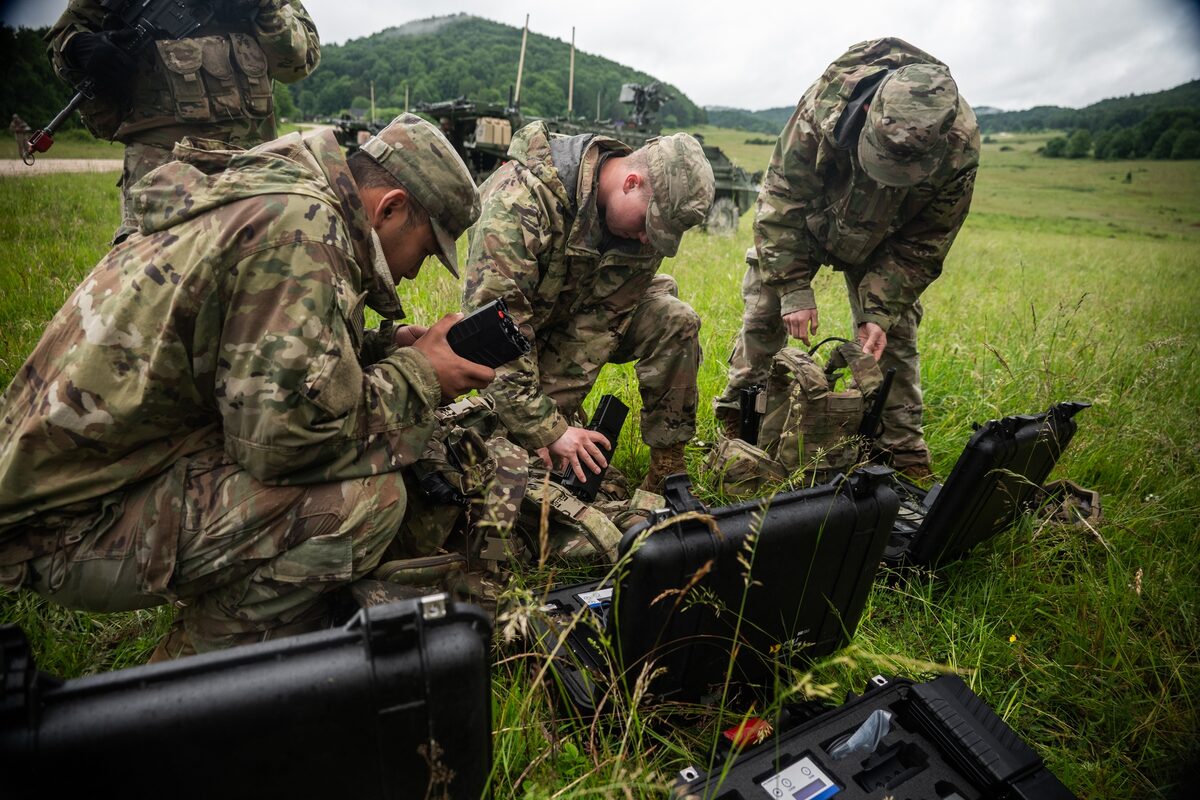
The U.S. Army has handed AeroVironment a ceiling of half a billion dollars to buy counter-drone gear off the commercial shelf, formalizing a shift from bespoke, program-by-program purchases toward a standing pipeline for knocking small drones out of the sky. In a July 1 Department of War contract announcement, the Simi Valley, California company was awarded a $500,000,000 firm-fixed-price contract for the procurement of commercial counter-unmanned aerial systems and counter-small-unmanned aerial systems capabilities.
The award (contract W912CH-26-D-A073) runs through June 29, 2029 and is managed by Army Contracting Command at Detroit Arsenal, Michigan. Rather than specifying a fixed list of hardware up front, the vehicle sets specific work locations and funding with each order — an arrangement that lets the service pull commercial counter-UAS kit against Group 1, 2, and 3 threats, from first-person-view attack quadcopters to larger reconnaissance and one-way attack drones, as fast as it can write delivery orders.
A standing pipeline, not a one-off buy
The structure is the story. Counter-drone procurement has historically moved in fits and starts: a rapid-fielding order here, a quick-reaction contract there, each negotiated on its own timeline. A three-year, $500 million ordering vehicle instead gives the Army a pre-competed lane to buy layered defenses at scale — jammers, sensors, interceptors, and the command-and-control to tie them together — without restarting the acquisition clock every time a new threat shows up on the battlefield.
The emphasis on commercial systems is deliberate. Small-drone threats evolve on a consumer-electronics cadence, faster than traditional defense programs can track, and the Pentagon has increasingly leaned on off-the-shelf and lightly modified gear to keep pace. AeroVironment is well positioned to supply it: the company rounded out its counter-UAS portfolio through its roughly $4 billion acquisition of BlueHalo, a specialist in directed energy, electronic warfare, and drone-swarm technology, and it markets the LOCUST laser weapon system, which it has pitched as firing for as little as $3 a shot against a target that might otherwise demand a missile costing orders of magnitude more.
It is also a familiar supplier to this customer. The Army buys AeroVironment's Switchblade loitering munitions under a separate vehicle worth up to $990 million, and the company agreed last year to deploy counter-drone technology at Grand Forks Air Force Base in North Dakota — experience that maps directly onto the layered, sensor-plus-effector approach the new contract is meant to field.
Why the Army is buying commercial counter-drone gear now
Senior defense officials have spent the past year warning that the force is under-equipped against cheap, mass-produced drones, and they have pointed to the war with Iran as exposing the gap in stark terms. The core problem is the cost curve: intercepting a few-thousand-dollar Iranian-designed Shahed with a multimillion-dollar interceptor is a trade the United States cannot sustain at volume. Systems like a laser that charges pennies per engagement, or jamming that costs nothing per shot, are the Pentagon's answer to that math.
The urgency has been institutionalized. The Defense Department stood up a dedicated counter-drone task force, JIATF 401, to coordinate what had been a scattered set of efforts, and the "Replicator 2" initiative was explicitly oriented toward countering the same class of small drones the department is buying in bulk under Replicator's first phase. A large commercial counter-UAS ordering vehicle is the acquisition machinery that lets those policy signals turn into fielded hardware.
Why It Matters
For the Army, the contract is less about any single gadget than about tempo. Drone threats now change faster than the budget cycle, and a pre-competed, $500 million lane collapses the time between "we need a counter to this" and "a unit has it in hand." That is the capability the service has been missing, and it is the reason officials keep describing counter-UAS not as a program but as a permanent line of business.
For AeroVironment, the award deepens a relationship that already spans loitering munitions, radio-frequency work, and next-generation interceptors, and it validates the bet behind the BlueHalo deal: that the future defense buyer wants an integrator who can field the sensor, the jammer, the laser, and the software as one layered system. The timing underscored the momentum — the contract landed just days after the company reported record fourth-quarter results for fiscal 2026, and its shares jumped by double digits on the news.
The open question is execution. An ordering vehicle is a ceiling, not a guarantee; the $500 million converts into capability only as fast as the Army writes orders and AeroVironment delivers against them, and each delivery order will still have to prove itself against a threat that is not standing still.
Sources
- U.S. Department of War — Contracts announcement, July 1, 2026 (AeroVironment, W912CH-26-D-A073)
- DefenseScoop — "Pentagon awards $500M contract for counter-drone tech to AeroVironment"
- ClearanceJobs — "Army Awards AeroVironment $500M Counter-Drone Contract"
- Defense News — "AeroVironment to deploy counter-drone tech at Grand Forks USAF base"