
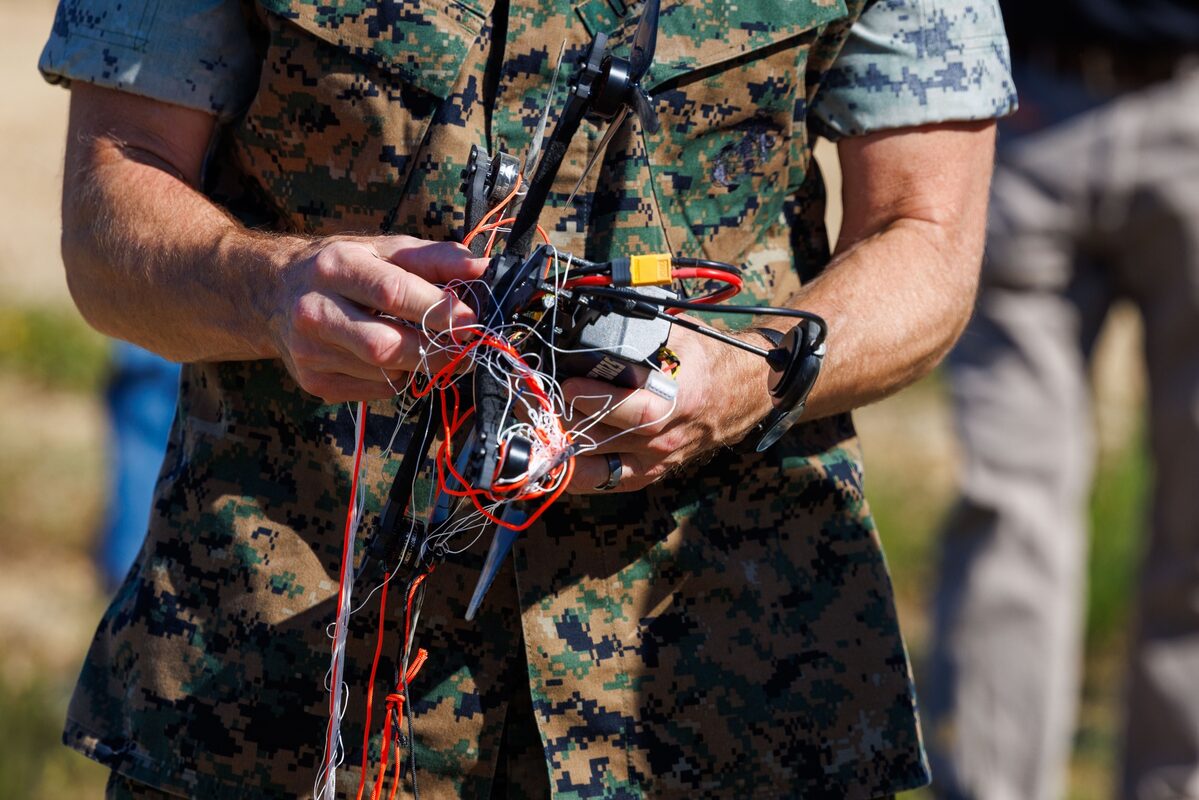
The U.S. Navy's Office of Naval Research has awarded Epirus an $11 million contract to move its High-Power Microwave Autonomous Vehicle Operational Capability (HAVOC) system toward production for the Marine Corps, the company confirmed August 10, 2026. The deal marks another step in the service's push to field directed-energy and low-cost kinetic defenses against a drone threat that has outpaced traditional missile-based air defense both in scale and in economics.
HAVOC is a vehicle-mounted, high-power-microwave weapon designed to disable multiple unmanned aircraft simultaneously rather than picking them off one at a time. Instead of tracking and destroying a single drone with a guided interceptor, a high-power microwave system floods an area with electromagnetic energy intended to fry the electronics of any drone caught in its beam — a capability increasingly seen as necessary against swarms that can overwhelm gun- or missile-based defenses by sheer numbers.
According to Breaking Defense, the system rides on a "universal sled" mount that can be fitted to both manned and unmanned vehicles, giving Marine Low Altitude Air Defense (LAAD) units flexibility in how they deploy it. The intended mission set is point defense: protecting ground-based air defense assets, refueling points, and radar installations — high-value, relatively static assets that are also prime targets for cheap first-person-view or loitering munitions.
HAVOC is not a clean-sheet design. It is an upgraded, autonomy-enabled iteration of Epirus's ExDECS (Expeditionary Directed Energy Counter-Swarm) system, which the company delivered to the Marine Corps in 2025. ExDECS is itself an evolution of Epirus's earlier Leonidas Expeditionary high-power microwave line. That lineage matters: it signals the Marine Corps is iterating on hardware it has already fielded and evaluated rather than betting on an unproven concept, a distinction that carries weight for a program office trying to move quickly without repeating the acquisition delays that have historically slowed directed-energy weapons from demonstration to deployment.
Epirus CEO Andy Lowery, quoted in the Breaking Defense report, framed the contract around the need for "software-defined systems" to keep pace with what he called a "complex and rapidly evolving drone threat" — language that reflects the broader industry pitch for high-power microwave weapons: unlike a missile with a fixed warhead, an HPM system's effective range, beam shape, and targeting logic can be updated through software as adversary drones and tactics change, without swapping hardware.
Aviation Week's Pentagon coverage, byline Brian Everstine, corroborated the contract value and funding source and described HAVOC in similar terms: a vehicle-mounted point-defense system meant to protect deployed troops from unmanned aerial systems in the field.
Why It Matters
The HAVOC award does not stand alone. It lands just under three weeks after C4ISRNET reported that the Marine Corps had adopted a very different kind of counter-drone tool — Allen Control Systems' AI-cued Bullfrog gun system — under the service's Ground Based Air Defense (GBAD) program, with the Marine Corps planning to incorporate Bullfrog into its Light Marine Air Defense Integrated System (L-MADIS). Bullfrog is already in use by the Army and Navy and has been approved by Joint Interagency Task Force 401, the Pentagon's unit for streamlining counter-drone acquisition. Its selling point is blunt economics: a cost-per-kill as low as $10, against interceptor missiles that can run into the millions when used against Shahed-type drones that themselves cost roughly $35,000 to build.
Read together, the HAVOC and Bullfrog awards outline a Marine Corps counter-drone strategy that is explicitly moving away from expensive, single-target interceptors. A guided missile costing millions of dollars intercepting a $35,000 attack drone is a losing cost exchange the longer a conflict runs, and cheap, mass-produced drones have become common enough in recent conflicts that magazine depth, not accuracy, is increasingly the limiting factor for defenders. Directed-energy weapons like HAVOC sidestep that math almost entirely: a microwave shot costs a fraction of a dollar in generator fuel and, in principle, never runs out of ammunition the way a missile battery does. The tradeoff is that microwave weapons are area-effect rather than precision tools, effective against multiple simultaneous targets at relatively short range but less suited to picking off a single high-value drone at distance — which is likely why the Marine Corps is fielding HAVOC and Bullfrog as complementary systems rather than one replacing the other. HAVOC covers swarms and saturation attacks against fixed high-value sites; Bullfrog's AI-cued gun offers precision engagement at low per-shot cost.
For LAAD units specifically, the contract signals that the Corps intends to protect the assets that are hardest to disperse or hide — ground-based air defense radars and refueling points — with a weapon that does not need to distinguish one drone from ten. That is a meaningful capability gap to close: static, radar-emitting, and expensive-to-replace assets like these have long been attractive targets for even unsophisticated drone attacks.
The $11 million figure itself is modest by defense-acquisition standards — this is a step toward production readiness, not a full-rate production contract — but the funding source is notable. Routing the award through the Office of Naval Research rather than a standard Marine Corps procurement line suggests HAVOC is still being treated partly as a technology-maturation effort, even as the stated goal is a system ready for fielding. How quickly that changes will depend on how HAVOC performs in whatever operational testing follows this award, and on how the Corps balances near-term counter-swarm needs against the slower, more traditional acquisition path directed-energy weapons have historically faced.