
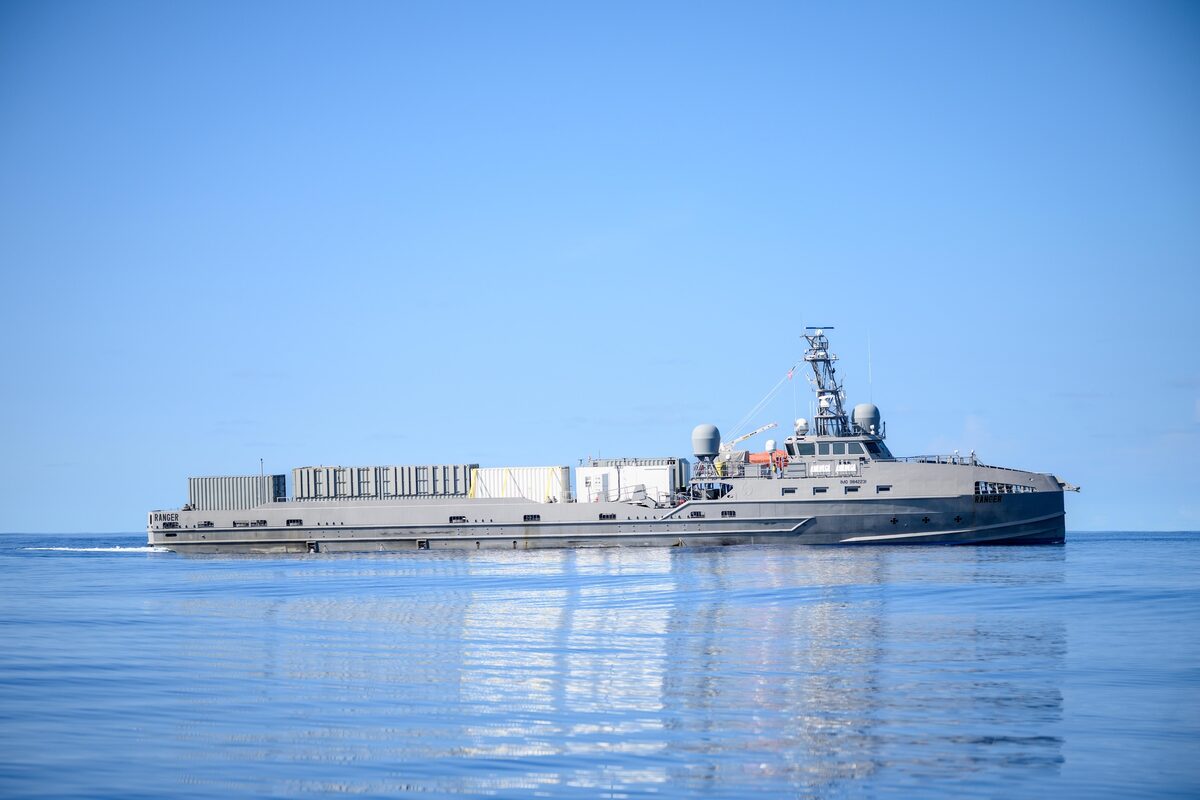
Ukraine's Navy says it has recorded the first battle in history fought entirely between uncrewed naval vessels, announcing on September 12, 2026, that one of its Sargan-3000 attack drone boats hunted down, engaged, and sank a Russian uncrewed surface vessel (USV) in the northwestern Black Sea. If the account holds up, it marks a new chapter in a war that has already redrawn naval combat around the Black Sea Fleet's retreat from Crimea — a shift now extending to the robotic vessels that increasingly patrol the waters Russian warships no longer dare to.
According to the Ukrainian Navy's official channel, the engagement unfolded after Ukraine's HUR military intelligence directorate located the Russian vessel and passed the cue to the naval drone unit. The Sargan-3000 — codenamed "Seawolf" and built by the Ukrainian firm Nordex — then closed on the target and destroyed it using its onboard weapon system. Ukraine has released video of the encounter alongside the announcement.
The Russian vessel has been identified by naval analysts as an improved variant of the Orcan-type attack USV, also referred to as Zefir or Zephyr. Naval News, which broke out the technical details of the engagement in a September 12 report, said the Russian boat was likely armed only with a ramming explosive charge — a design built to close on and detonate against a target rather than exchange fire at range. The Ukrainian boat, by contrast, carried a Kongsberg Protector remote weapon station mounted with a 12.7mm heavy machine gun, giving it the ability to engage from a standoff distance rather than needing to make contact.
That asymmetry in armament appears to have decided the fight. A ramming USV succeeds by closing the distance undetected; a gun-armed USV succeeds by spotting the threat first and putting rounds on it before it closes. In this case, Ukraine's side did both — intelligence cueing put the Sargan-3000 in position, and its remote weapon station did the rest.
How the Engagement Reportedly Unfolded
Naval News assessed the fight as most likely occurring in the northwestern Black Sea, in the waters between Odesa and Crimea, though it noted the exact location has not been disclosed. Independent Ukrainian outlet Euromaidan Press corroborated the Navy's account and video release, describing an uncrewed boat that "spots, fires on, and sinks" its Russian counterpart — a sequence consistent with the Naval News report's description of a machine-gun-armed vessel engaging a ramming-charge boat before it could close to detonation range.
Naval analyst H.I. Sutton, writing in the Naval News report, called the engagement significant less for the fact of the kill and more for the manner of it. "The loss of one unit in this way is not in itself significant from an attrition perspective," Sutton wrote, "but the way that it was done is consequential." He added that it will likely lead to an evolution of tactics on both sides of the Black Sea drone war.
An Unconfirmed, One-Sided Account — For Now
As of this writing, none of the Ukrainian or international reporting reviewed for this story — the Navy's announcement, Naval News, Euromaidan Press, or Defence Matters — cites any Russian confirmation, denial, or comment on the engagement. That leaves the claim resting entirely on Ukrainian sources: the Navy's own announcement, the released video, and analysis from Naval News built on that material. Independent, on-the-ground verification of a naval engagement between two small uncrewed boats in open water is inherently difficult — there is no independent radar track, no neutral observer, and no wreckage recovery to point to. Defence Matters, reviewing the same footage, noted that Ukraine's account does not disclose engagement distance, ammunition expended, or whether the weapon was remotely operated versus autonomously targeted — details that limit what can be concluded about performance. The video release strengthens the claim considerably, but a full accounting of the encounter — including the Russian vessel's exact type, its operating unit, and Moscow's version of events, if one ever comes — will depend on further corroboration.
Why It Matters
Uncrewed surface vessels have already reshaped the naval war in the Black Sea. Ukraine's Magura-class attack drones — cited by Naval News as a close analog in size and concept to the Russian Orcan — have been credited with sinking or damaging multiple Russian warships over the course of the war, part of a campaign that has pushed Russia's Black Sea Fleet away from its bases in Crimea. Russia has responded in kind, fielding its own USVs — including Orcan/Zefir-type boats — for reconnaissance, attack, and, evidently, contesting Ukraine's own drone operations.
Until now, that contest between USVs had largely played out asymmetrically: drone boats sinking or threatening crewed warships, or drone boats colliding with static or lightly defended targets. A boat-versus-boat engagement decided by sensor cueing and a remote weapon station — rather than mass, armor, or a human crew's judgment — is a different kind of fight, and one that maritime forces elsewhere are watching closely. If naval drones are now expected to defend themselves against other naval drones, that reshapes what capabilities future USVs need from the outset: onboard target detection, weapons that can engage before an adversary closes to ramming range, and the intelligence-sharing pipelines — like the HUR cueing described here — that get a drone to the right place before the fight even starts. For a domain that has moved from experimental to decisive over a war now in its fifth year, this engagement is a signal of where naval drone design is headed next: not just boat versus ship, but boat versus boat.
