
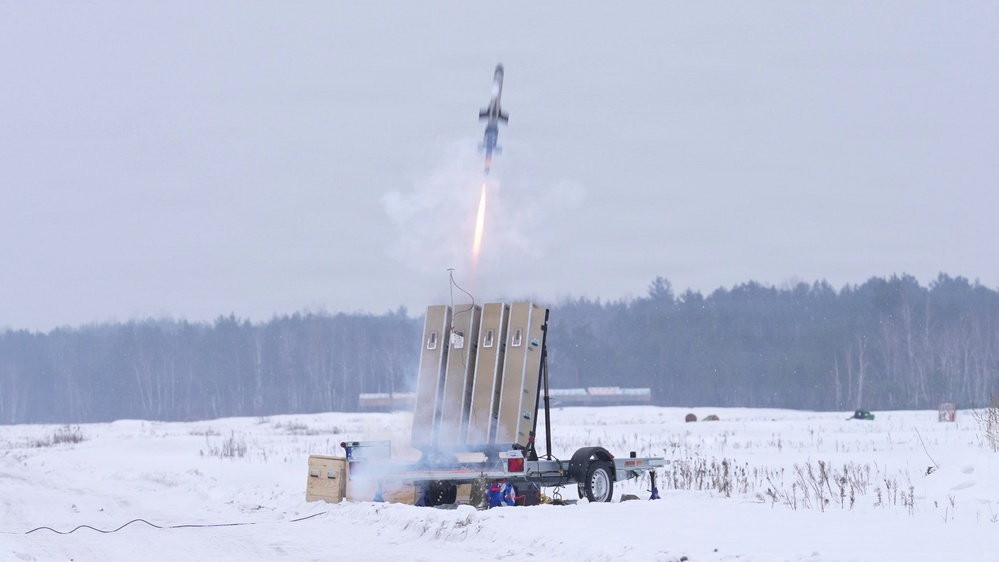
A Munich-based counter-drone startup is betting that the answer to Russia's swarms of cheap attack drones is not a better missile, but a factory. Tytan Technologies says it is opening a new German plant capable of producing 3,000 autonomous interceptor drones every month, with operations slated to begin in August 2026, according to parallel reports published June 26 by C4ISRNET and Defense News.
The pitch from CEO and co-founder Balázs Nagy is blunt about economics. By shifting the burden away from expensive hardware and toward scalable hardware paired with sophisticated software, Nagy says Tytan can protect "the same airspace 200 times cheaper than with legacy systems." That is the kind of claim that invites scrutiny, but it is also the calculation increasingly driving Europe's air-defense rethink: when the threat is a drone that costs a few thousand dollars, intercepting it with a multimillion-dollar missile is a losing trade.
What Tytan Actually Builds
Tytan's product line splits along the lines of the NATO threat classification system, which buckets unmanned aircraft by size and weight. The company fields two interceptors aimed at the two smallest and most numerous categories.
The first, called EOS, is a short-range multicopter designed to engage NATO Class I threats — the small drones at the lower end of the spectrum. The second, METIS, is a long-range fixed-wing interceptor built for NATO Class II targets, which are larger and typically operate at greater range and altitude. Together the two systems give Tytan coverage across the slice of the airspace where mass-produced attack and reconnaissance drones now operate in the largest numbers.
The design philosophy is the inverse of traditional air defense. Rather than concentrating capability and cost into a small number of exquisite, expensive effectors, Tytan's approach leans on autonomy and software to make each individual interceptor cheap enough to field at scale — and then builds enough of them to matter.
Combat-Proven in Ukraine
The production scale-up is not a speculative bet on an untested product. Tytan's interceptors have already seen extensive combat use in Ukraine, where they are employed as a cost-efficient counter to Russian airborne threats. Defense intelligence firm Janes reported that the German autonomous-systems maker confirmed its Interceptor UAV is in battlefield use there.
That combat record sits inside a broader shift on the front lines. According to Janes, the Tytan Interceptor was developed specifically to counter Shahed-136 drones — known in Russian service as the Geran-2 — that Russian forces use to attack Ukrainian cities and infrastructure. Meeting cheap, mass-produced loitering munitions with an equally cheap interceptor is precisely the dynamic Tytan is trying to industrialize.
Beyond Ukraine, the customer list already spans NATO members. Tytan's interceptors have been adopted by Germany and the Baltic States, with the company describing a rising number of allies turning to its systems. Both C4ISRNET and Defense News tie the demand surge directly to the Russian drone threat pressing on NATO's eastern flank.
Why the Factory, and Why Now
The recurring question in counter-drone procurement is not whether a given interceptor works, but whether a defender can produce enough of them to outlast a saturation attack. A single drone is cheap; a defense that runs out of interceptors before the attacker runs out of drones is no defense at all. That is the gap a 3,000-per-month line is meant to close.
Tytan is also signaling that the German plant is a template rather than a ceiling. The company has named Poland and Hungary as potential sites for additional factories, an expansion strategy aimed squarely at the new markets opening up as European governments accelerate counter-drone spending. The geography is telling: both candidate sites sit on or near the alliance's eastern frontier, where demand is most acute.
The move also slots into Germany's wider counter-drone buildup. As Army Recognition notes, Tytan has signed a memorandum of understanding with sensor maker HENSOLDT to integrate its kinetic interceptors with HENSOLDT's sensor and command-and-control systems, and the Bundeswehr procurement agency BAAINBw has signed a contract worth several hundred million euros for interceptor-drone development — evidence that the startup is being woven into the established German defense-industrial fabric rather than operating at its margins.
Why It Matters
The defining problem of modern air defense is cost-exchange. Russia's war in Ukraine has demonstrated that an adversary can field attack and reconnaissance drones by the thousands at a fraction of the price of the systems traditionally used to shoot them down. A defense that wins every engagement but loses on cost is unsustainable over a long campaign.
Tytan's wager is that the way out is industrial, not technical. If interceptors can be made cheap enough — and produced fast enough, at 3,000 a month and rising — then defenders can finally meet drone mass with interceptor mass without bankrupting themselves. CEO Balázs Nagy's claim of protecting airspace "200 times cheaper than with legacy systems" is a vendor figure that warrants independent verification, but the underlying logic is now widely shared across European defense planning, and Tytan's combat record in Ukraine gives the claim more weight than a typical startup pitch.
For NATO's eastern flank states, the stakes are immediate. The same drone threat that has reshaped the war in Ukraine is now a live concern for Germany, the Baltics, Poland and Hungary. Whether Tytan can actually hit its production targets — and whether a single German factory becomes the first of several across the region — will be one of the clearer tests of whether Europe can scale a counter-drone defense as fast as the threat itself is scaling.
Sources
- German counter-drone startup Tytan eyes 3,000 interceptors per month in new factory (C4ISRNET, June 26, 2026)
- German counter-drone startup Tytan eyes 3,000 interceptors per month in new factory (Defense News, June 26, 2026)
- Tytan Interceptor UAV being used in combat by Ukraine, says manufacturer (Janes)
- Germany Ramps Up TYTAN Counter-Drone Production to 3,000 Interceptors per Month (Army Recognition)
