
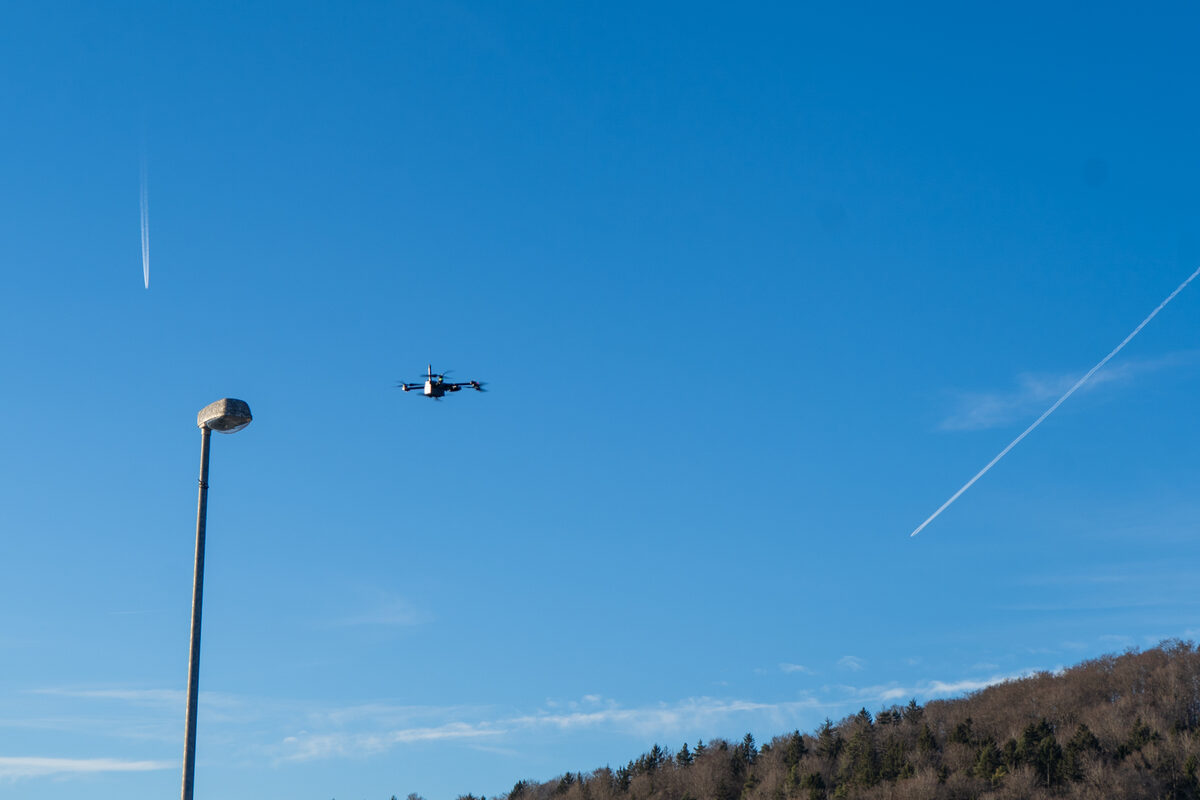
Federal drone policy is meant to move the market toward American and allied manufacturers. In county budgets it shows up as a line-item problem. Two pressures are hitting local law enforcement together. One is a Section 232 tariff schedule that has taxed drones with integrated thermal imagers at 100 percent since September 3. The other is a pending Federal Communications Commission proposal aimed at foreign "military-grade" drones that, according to DroneXL, exempts imports for federal government use but not for state and local agencies.
Reporting this week from NPR (October 12) and DroneXL (October 13) shows who absorbs the cost: sheriff's offices and police departments whose fleets are overwhelmingly built on DJI hardware.
One Deputy's Kit, Itemized
NPR reports that the Ocean County, New Jersey, Sheriff's Office runs a fleet of 25 drones, all DJI. Chief Warrant Officer Kevin Fennessy, who heads the office's drone program, itemized what one deputy's drone kit costs:
- DJI Matrice 300 RTK airframe: $13,699
- Two batteries: $1,400
- Thermal camera: $11,499
- Controller: $1,600
- Payload release: $1,099
- RESTUBE Automatic (a flotation device the drone can drop into water): $130.99
The total is $29,427.99; the components sum to that figure. NPR says the office paid for its equipment with asset-forfeiture proceeds and the municipal operating budget. The thermal camera alone accounts for more than a third of the price. That matters because thermal capability is the feature both the tariff schedule and the FCC proposal single out.
Fennessy told NPR that American models cost about three times as much as DJI. Jon Beal, who heads the Law Enforcement Drone Association (LEDA), gave a wider range: DJI sells a thermal-equipped drone for under $10,000, he said, while American thermal drones run $20,000 to $50,000. In NPR's own comparison, cited by DroneXL, a DJI Matrice 400 sells for about $10,500 and an Inspired Flight IF800 TOMCAT for $21,000 at a retailer, roughly double.
Those estimates don't agree, and they don't all compare the same aircraft. At the low end the US option costs about twice as much, and at the high end several times as much. LEDA estimates that about 6,000 US agencies fly drones and that 80 to 90 percent of them use DJI.
What the Tariff Proclamation Actually Says
The tariff side of the story has a primary source. Presidential Proclamation 11055, signed August 13, 2026, and published in the Federal Register on August 19 (FR Doc 2026-16979), sets the tiers:
- 100 percent ad valorem on unmanned aircraft systems over 25 kg maximum takeoff weight, on UAS that integrate thermal imagers, on UAS docking stations, and on certain components listed in Annex I.
- 25 percent on UAS of 25 kg or less, listed in Annex II.
- Both tiers took effect September 3, 2026.
- A 25 percent duty on Annex III components takes effect at 12:01 a.m. Eastern on February 9, 2027.
The proclamation also gives allied manufacturers a lower rate. Products of Japan, South Korea, Taiwan, Switzerland, Liechtenstein or EU member states are capped at 15 percent, and products of the United Kingdom at 10 percent. The cap applies only if substantially all critical components and technology are certified as coming from qualifying countries.
That explains the range in NPR's reporting, which describes tariffs of 15 to 100 percent on some foreign-made drones. A thermal-equipped public-safety drone is in the top bracket under the proclamation's text, because the 100 percent tier covers any UAS that integrates a thermal imager. NPR reports that police use drones for search and rescue, fire and crash investigations and tactical response, and that Ocean County uses thermal imaging to help find lost people or pets.
NPR says Fennessy itemized the kit in early August, before the September 3 effective date, though neither outlet reported when the equipment was bought. The $29,427.99 figure is best read as a pre-tariff baseline, not a post-tariff invoice.
The FCC Track, and the Exemption Gap
The second pressure is regulatory and less settled. According to DroneXL, the FCC's July 21 notice lists seven capabilities it treats as "military-grade," and thermal imaging is one of them. The notice exempts imports intended for federal government use. Comments closed September 2. As of October 13, DroneXL reported, the Federal Register showed no bureau order putting the proposal into effect.
The National Sheriffs' Association, which represents more than 3,000 sheriffs, filed in PS Docket 26-189, DroneXL reports. The association asked the commission to confirm that the domestic market can actually meet law-enforcement demand before restricting drones that meet its military-grade definition. It also asked for an exemption for state, local, tribal and territorial law enforcement until the domestic market can supply them, matching the carve-out the proposal already gives federal agencies.
The argument is simple. If federal agencies can keep importing the hardware because their missions require it, county deputies flying the same search-and-rescue and tactical missions want the same treatment. The proposal as described does not draw the line that way.
A caveat on sourcing: the description of the FCC notice above, including the seven capabilities, the federal exemption and the docket number, comes from DroneXL's and NPR's reporting. UASFeed could not read the FCC filing or the underlying national-security determination directly, so the exact scope of the proposal and any definitions it uses are unverified here.
Where States Have Already Gone Further
Local agencies have seen this before. NPR, as summarized by DroneXL, reports that agencies in Florida, Texas, Mississippi and Tennessee ended drone programs or dropped plans for them after their states banned foreign-made drones. NPR quotes Beal saying some of those agencies were left scrambling when tight budgets could not cover more expensive American alternatives. That is one way a federal squeeze could go.
Why It Matters
The FCC proposal as reported exempts federal buyers, while local law enforcement gets no such exemption. LEDA estimates that 80 to 90 percent of agencies flying drones use DJI, and Ocean County pays for its fleet with forfeiture funds and its operating budget.
The proclamation's own structure puts the heaviest duty on the aircraft that public-safety agencies use most. Thermal-integrated drones are in the 100 percent tier, and the main sensor in Ocean County's kit is a thermal camera that costs almost as much as the airframe. The component tier in February 2027 will reach further into the supply chain. The allied-country cap at 15 percent, or 10 percent for the UK, helps only if non-Chinese suppliers can deliver certified hardware at volume. That is the same "adequacy of the domestic market" question the sheriffs asked the FCC to answer.
Two things are worth watching: whether the FCC issues a bureau order in Docket 26-189, and whether it adds the state and local carve-out the sheriffs requested. Without that carve-out, agencies may cut programs, as some in Florida, Texas, Mississippi and Tennessee already have. That would be a loss of capability, not the switch to US suppliers the policy is meant to produce.
Sources
- Efforts to boost U.S. drone makers are costing U.S. police (NPR, Oct 12, 2026)
- DJI Curbs Hit Police Budgets: $10,500 Matrice vs. $21,000 US Rival (DroneXL, Oct 13, 2026)
- Proclamation 11055: Adjusting Imports of Unmanned Aircraft Systems and UAS Components Into the United States (Federal Register, Aug 19, 2026)
