
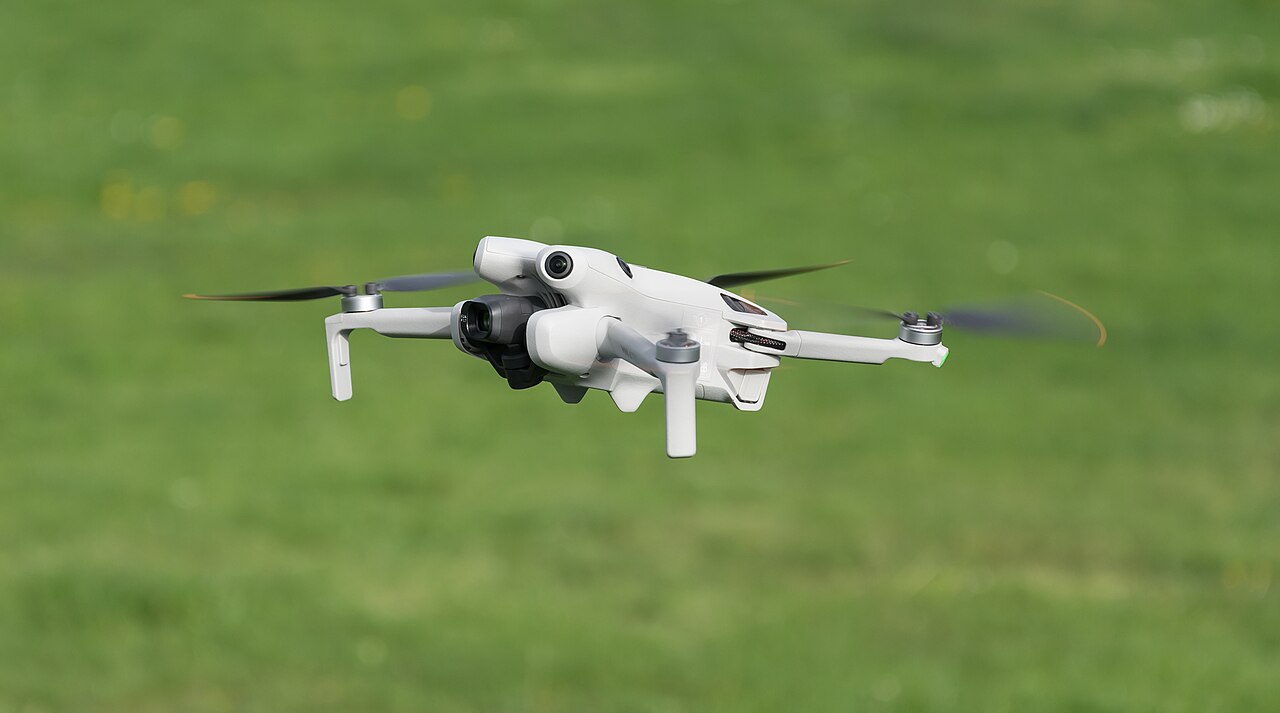
Skyrover's new V1 is the company's most expensive camera drone so far. On paper it is aimed squarely at DJI's mini class. It has a 1/1.28-inch sensor, 4K at 60 frames per second, 40 GB of onboard storage, a claimed 20 km video link and a rated flight time of up to 40 minutes, all in an airframe the company says weighs under 249 grams. The list price is $759, which is exactly what DJI's Mini 5 Pro lists for on Amazon.
A drone that costs the same as the class leader has to match it, not just come close. In the first week after launch, three things have come under scrutiny: whether the V1 really stays under the weight line, whether it gets near its rated endurance, and whether its obstacle sensing works the way the marketing says.
What Skyrover Is Selling
DroneDJ's Nov. 18 launch coverage presents the V1 as Skyrover's new flagship, sitting above the S1 (from about $289) and the X1 (from about $459). The listed specifications are:
- Imaging: 1/1.28-inch CMOS sensor, 4K video up to 60 fps, 4K/100 fps slow motion, 8K photos, SR-Log and 10-bit HLG profiles, and what the company calls true 2.7K vertical shooting.
- Endurance: up to 40 minutes, about 25 percent more than the X1's rated 32 minutes.
- Link: up to 20 km (12.4 mi) HD transmission, up from 15 km on the X1.
- Safety: 360-degree low-light obstacle sensing with enhanced forward detection, plus return-to-home route planning.
- Storage and control: 40 GB internal storage and an optional controller with a built-in 5.5-inch, 700-nit screen.
- Weight: "under 249 grams."
DroneXL reported on Nov. 19 that Skyrover's own store lists two packages: the V1 Standard at $759 and the Combo at $1,099. Both showed as unavailable that Thursday. Two weeks earlier the store did not list the V1 at all. UASFeed could not read Skyrover's own product page or blog, which returned an HTTP 403 error, so the V1 numbers in this article come from the press coverage cited below, not from Skyrover's pages.
The Price Moved Within Days
The list price did not last long. On Nov. 23, DroneXL found the V1 on Amazon at $607 for Prime members, 20 percent under the $759 list price. A bundle with the screen controller and three batteries was $879, down from $1,099. The DJI Mini 5 Pro was $759 on Amazon at the same time, so the V1 undercut it by $152. The Amazon seller is a storefront named Air Drone, and Amazon ships the order.
At $607 the V1 is a different proposition than at $759. The deal is framed as a Black Friday promotion for Prime members, and the listing shows non-members a higher price, so buyers should check what they would actually pay before assuming the lower figure.
The 250-Gram Line Is Where This Gets Serious
The weight question matters more than the price. DroneXL reports that the Amazon listing title says "Under 249g," while the product table on the same listing gives the weight as 8.9 oz, which is about 252 g. Skyrover's own store says the drone is just under 249 g.
As DroneXL points out, the gap is not a matter of rounding. Any weight that rounds to 8.9 oz is at least 250.9 g. The FAA exempts recreational drones from registration only below 250 grams and allows no manufacturing tolerance. A V1 that weighs 250 grams or more has to be registered before a recreational flight, and a registered drone has to comply with Remote ID.
DroneXL also notes that a catalog entry is not a scale reading, and that neither Dunnill nor Towne weighed the drone. When Towne weighed the X1 in October 2025, another Skyrover sold as under 249 g, it came in at exactly 250 grams. So no source has confirmed which V1 figure is correct, and the buyer carries the regulatory risk. DroneXL's advice is to put the drone on a kitchen scale with the battery in as soon as it arrives. Amazon's holiday return policy runs to Jan. 31, 2027.
Flight Time: 40 Minutes Advertised, About 25 in One Test
Early hands-on reports do not match the rated endurance. According to DroneXL, YouTuber Dustin Dunnill's first battery lasted about 25 minutes by his own estimate and landed with 11 percent remaining, against the 40 minutes Skyrover advertises. Another reviewer, Jack Towne of Half Chrome, flew past 30 minutes per battery in his first look.
DroneDJ itself notes that 40 minutes is a maximum rated figure under specified conditions, so some gap is expected. The two reports also differ from each other, and neither reaches the spec sheet. Endurance is one of the V1's main claimed advantages over the X1, which makes this more than a footnote.
Obstacle Sensing: Which Sensor Is It?
The sensing claims get murkier the closer you look. DroneDJ describes 360-degree low-light obstacle sensing. In Dunnill's video of his pre-launch unit, as reported by DroneXL, he found one camera on top, one underneath and a glossy insert in the nose. That is fewer sensors than the X1, which has four cameras up front. The Amazon listing also contradicts itself: its bullet points credit forward-facing LiDAR and vision sensors, while its comparison chart describes forward infrared for low light.
In Dunnill's testing the system did a lot right. The drone steered around him from every side when he flew it at himself. While following him on an electric skateboard, though, it clipped a bare tree and kept flying. Dunnill warns that thin branches and wires can still get past the sensors. Other limits showed up as well:
- Active tracking worked only from behind; when he moved the drone to his front or side, it swung back behind him.
- The Dronie and Helix QuickShots stopped and canceled when they met an obstacle instead of routing around it.
- Sport mode switches obstacle sensing off.
- Portrait mode crops the 16:9 frame in software because the camera does not rotate. DroneDJ notes the X1 keeps the advantage in native vertical resolution, and Skyrover's table lists the V1 as "True 2.7K Vertical Shooting," so buyers who care about vertical video should check what that means in practice.
Why It Matters
DroneDJ notes that the non-DJI drone market is attracting more attention from US buyers, which gives brands like Skyrover an opening. It also raises the bar: someone switching away from DJI is giving up a proven ecosystem and should get verified specifications in return.
Taken together, the V1 does not yet clear that bar. The specification sheet is competitive. The launch price matched DJI's mini flagship, and the Black Friday price undercuts it. But the key numbers are not consistent across the company's store, its Amazon listing and independent testing. The weight is "under 249 g" in one place and 8.9 oz (about 252 g) in another, and that difference decides whether a recreational flyer must register the drone. Flight time is 40 minutes on paper and about 25 to 30-plus in early flights. The forward sensor is described as LiDAR in the listing's bullets and infrared in its chart. None of these discrepancies would rule the drone out alone, but all of them point the same direction.
For a Part 107 operator, the weight ambiguity hardly matters, because the aircraft gets registered whatever it weighs. For a recreational buyer paying for the sub-250 g exemption, it is the whole point of the purchase. Until Skyrover publishes a single, consistent weight and independent reviewers confirm it, buyers should treat the "Under 249g" claim as unverified and plan as if the drone may need registration.
DroneXL's own view is that the V1 does not justify $759 and that it would still buy the X1, which was $413 at the time. At $607 the V1 may still appeal to buyers who want 4K/60 from a 1/1.28-inch sensor and 40 GB of onboard storage without buying DJI. At $759 it is asking to be judged against the Mini 5 Pro, and its own listings do not yet make that case.
