
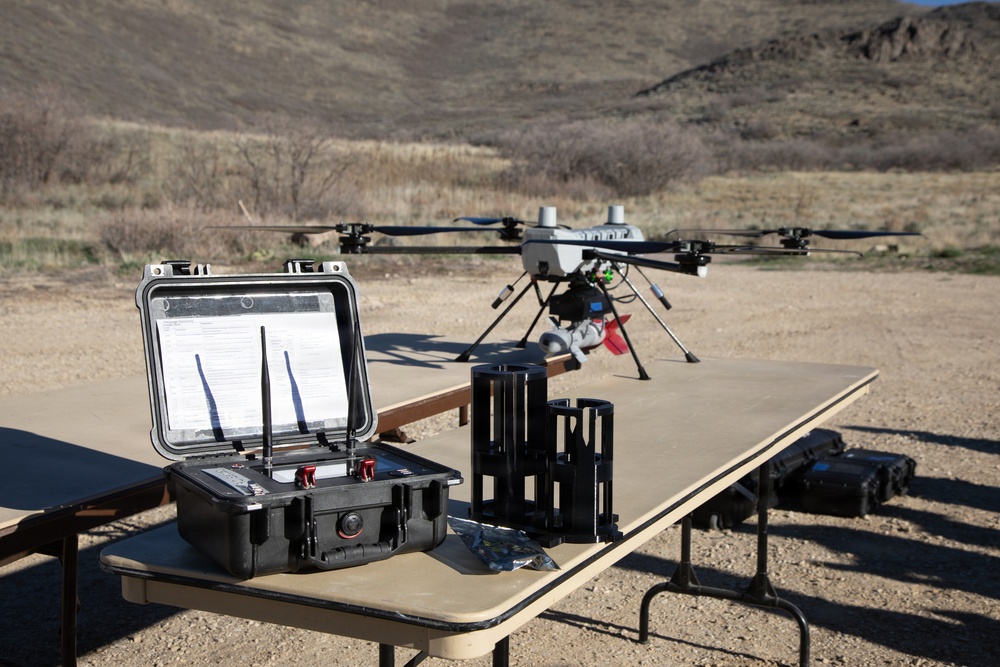
Tell a drone swarm what you want, not how to do it. That is the pitch behind AgenticSwarm, a new framework from researchers at the Skolkovo Institute of Science and Technology's Intelligent Space Robotics Laboratory (ISR Lab) that lets a single operator issue mission instructions in plain language and have a fleet of heterogeneous drones figure out the rest — who flies where, what gets inspected, and what happens when something breaks mid-flight.
The work, described in a paper submitted to arXiv on Sept. 18, 2026 (arXiv:2609.21716) and titled "AgenticSwarm: Semantic Perception and Adaptive Task Allocation for Heterogeneous Multi-UAV Missions," was authored by Muhammad Ahsan Mustafa, Yasheerah Yaqoot, Faryal Batool, Roohan Ahmed Khan, Valerii Serpiva, and Dzmitry Tsetserukou. Tsetserukou, an associate professor at Skoltech, heads the ISR Lab, whose published focus areas include heterogeneous robot swarms and UAV navigation and control — the same territory AgenticSwarm sits squarely in, alongside the lab's other recent projects, GuideTouch and HoverAI.
From Natural Language to a Mission Graph
The core engineering problem AgenticSwarm tries to solve is one that has dogged multi-robot systems for years: translating a loosely specified human intent — "search the warehouse and flag anything that looks like a leak" — into a set of discrete, assignable tasks that a fleet of dissimilar aircraft can actually execute and adapt on the fly. AgenticSwarm's answer is what the authors call a "grounded mission graph," a data structure that ties objects the drones actually perceive in the environment to the task constraints the mission requires. Rather than a human pre-scripting waypoints and task lists, the system builds and updates this graph as perception data comes in, then uses it to allocate tasks across the swarm.
The design leans on two components working in tandem: a perception pipeline that identifies and semantically labels objects in the environment, and an adaptive task-allocation layer that assigns and reassigns jobs based on what that perception pipeline reports — including when it reports that a drone is no longer available or a battery is running low.
A Meaningful Jump in Perception Accuracy
Perception quality is the leverage point in any system like this, since bad object detection propagates into bad task assignments. The Skoltech team built AgenticSwarm's perception stack around SAM3, and benchmarked it against a baseline combining Grounding DINO with SAM2.1 — a pairing that has become a common reference point in open-vocabulary detection and segmentation research. Across the paper's test conditions, the SAM3-based pipeline improved class-aware recall by 25.2 percentage points and semantic label accuracy by 29.5 percentage points over that baseline. In plain terms: the system was substantially better both at finding the right objects and at correctly naming what it found, which matters directly for a "grounded" mission graph whose usefulness depends on accurate labels.
The researchers didn't test this purely in simulation, either. AgenticSwarm was evaluated across five different Gazebo simulation environments and validated on a real indoor testbed — a combination that lets the authors argue the results aren't just an artifact of a single tuned scenario, while still stopping short of outdoor, GPS-degraded, or contested-airspace conditions.
What Happens When a Drone Fails
The more operationally interesting number in the paper concerns what happens when the adaptive-replanning module is switched off. In an ablation study, removing that component caused mean "repeated work" — tasks the swarm redundantly re-executes because it failed to properly reassign them after a disruption — to jump from 0% up to 61.7%. Post-event recovery time, the time it takes the swarm to get back on mission after a drone drops out or degrades, also worsened by 58.6% without the module.
Those figures are a useful illustration of why adaptive replanning is treated as a load-bearing feature rather than a nice-to-have in this class of system. A swarm that can't gracefully redistribute work after losing a unit either wastes enormous effort re-covering ground it already covered, or simply fails to complete the mission on time — both failure modes that matter a great deal if the swarm is doing something time-sensitive, like search and rescue or battlefield reconnaissance, rather than a leisurely warehouse audit.
Why It Matters
AgenticSwarm lands in a field that is visibly accelerating but has not yet resolved the tension between capability and trust. Reporting by IEEE Spectrum in March 2026 on the state of autonomous drone warfare in Ukraine captured that tension directly: one expert quoted in the piece said collaborative-drone software "is there" in the lab, but field operators remain wary of actually fielding it because the cost of a mistake is high. That same reporting projected fully autonomous aerial drones arriving within two to three years, with a longer horizon — 10 to 15 years — before humans are fully out of the loop on lethal or high-stakes decisions. It also noted a parallel, cheaper trend: the Ukrainian firm The Fourth Law has dispatched "more than thousands" of roughly $50 retrofit autonomy modules to troops, with the company's founder saying they raise drone-strike success rates by up to four times over purely operator-controlled drones — part of a broader push that includes sister company Odd Systems building thermal cameras for those same drones — suggesting that autonomy is proliferating from the bottom as much as it is from well-funded lab programs.
AgenticSwarm is a lab-grade academic contribution, not a fielded military system, and its testing so far is confined to simulation and an indoor testbed. But it's a useful data point on where the underlying software is heading: toward systems that let one person direct many heterogeneous drones through natural language rather than manual task assignment, and that can absorb the loss of individual aircraft without needing a human to manually replan. Given the wariness IEEE Spectrum's sources expressed about fielding "it's there in the lab" capability, work like AgenticSwarm — with its quantified perception gains and its explicit measurement of what breaks when adaptive replanning is removed — is part of the evidence base that will eventually inform whether, and how fast, that gap between lab and field closes.
