
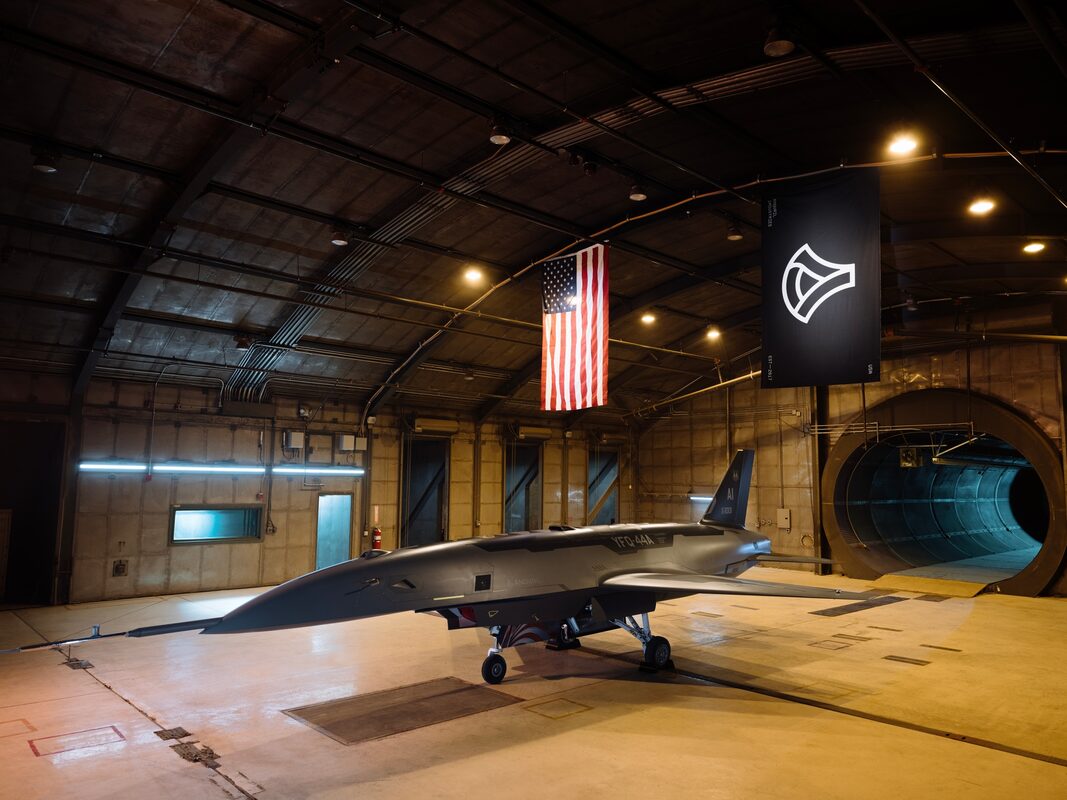
Northrop Grumman's YFQ-48A Talon Blue flew for the first time on Oct. 3, 2026, from Mojave, California. The company says the aircraft handled the whole sortie on its own, including taxi, takeoff, in-flight maneuvers and landing. Northrop paid for the aircraft itself, and the Air Force has not yet selected it for production. That is the main point of the flight. The company is betting it can win a place in the service's Collaborative Combat Aircraft (CCA) program by showing a flying article before the next competition is fully defined.
According to Air & Space Forces Magazine, Northrop subsidiary Scaled Composites built the aircraft in about 15 months from concept to "weight on wheels." The Air Force wants to field at least 500 CCAs by 2032. So far, though, it has awarded production contracts to only two companies: General Atomics for the FQ-42 Vengeance and Anduril for the FQ-44 Fury.
From Project Talon to YFQ-48A
Talon Blue started as Project Talon, an internally funded Northrop effort. The Air Force formally recognized it on Dec. 22, 2025, when it gave the prototype the Mission Design Series designation YFQ-48A. The service's announcement, published by Air Force public affairs, called Project Talon a semi-autonomous prototype. Brig. Gen. Jason Voorheis, Program Executive Officer for Fighters and Advanced Aircraft, said Northrop's approach "aligns with our strategy to foster competition."
The designation did not come with a contract. The same Air Force release said CCA acquisition is built on continuous competition with multiple on-ramps. In practice, a company that missed the first award can still bring a design forward later. A designation tells industry the service is watching the aircraft. It does not commit the service to buying it.
What Northrop Says It Built
As reported by The War Zone, Northrop's Oct. 3 release presents Talon Blue as a design focused on cost and producibility, with fewer parts and lower weight. Visible features include a high air intake, a wide wheelbase and an integrated weapons bay. The release says these support a wide variety of missions for U.S. and allied partners, and the internal bay suggests Northrop sees Talon Blue carrying weapons internally instead of only working as a sensor or decoy platform.
On software, Northrop cites more than 500,000 hours of autonomous flight experience across its portfolio. Air & Space Forces Magazine reports that the company's Talon IQ testbed, part of the broader Project Talon, runs Prism mission autonomy software. The first flight was described as fully autonomous from taxi to landing, but the published accounts give no flight duration, altitude, speed or envelope. One sortie is the start of a flight-test program, not a demonstration of its results.
The roughly 15-month schedule also needs context. Scaled Composites is known for innovative aircraft, and a prototype built quickly is not a production line built quickly. Northrop's claims about parts count and weight are the company's own and have not been independently checked.
The Competition Northrop Is Entering
Increment 1 is settled for now: General Atomics and Anduril hold the production work. Talon Blue is aimed at Increment 2, which The War Zone describes as a buy of hundreds of aircraft whose requirements remain undefined. That cuts both ways for Northrop. A flying prototype can shape what the service decides it wants. But because the Air Force has not published Increment 2 requirements, Northrop is designing without knowing exactly what will be evaluated.
Talon Blue will not be the only contender. The War Zone lists Boeing's MQ-28 Ghost Bat, Lockheed Martin's Vectis and Kratos's Valkyrie as other serious CCA offerings, and says many more types are on the horizon. Air & Space Forces Magazine says the market is crowded. Northrop's earlier CCA offering lost out on the Increment 1 contracts because of its cost, according to the head of its aeronautics division, which led to Talon Blue.
Why It Matters
The CCA effort is quickly turning into one of the largest new aircraft markets in the U.S. military. A goal of at least 500 aircraft by 2032 is a production run that a prime contractor cannot afford to sit out. Northrop has extra reason to push. Both outlets note that the company lost the Navy's F/A-XX sixth-generation fighter competition to Boeing. The War Zone says that winning a CCA contract would get Northrop back into the Pentagon's tactical air combat portfolio, so an uncrewed combat aircraft program is worth more to it.
The flight also tests whether the Air Force's acquisition approach works as described. If the service really intends to keep the CCA field open through "multiple on-ramps," as its December release said, then a company-funded prototype that got a designation and then flew is the kind of entry the policy is supposed to allow. If Increment 2 ends up going to the current incumbents anyway, companies may conclude that self-funded prototypes buy attention but not contracts.
For the broader drone industry, Talon Blue adds to a trend: a big prime is spending its own money to build and fly an uncrewed combat aircraft before a formal requirement exists. The Air Force can see more flying hardware before it commits. The open question is how long the service can put off defining Increment 2 before companies start reconsidering how much of their own money to spend.
Sources
- Northrop's Talon Blue Collaborative Combat Aircraft Makes First Flight (Air & Space Forces Magazine)
- Northrop Grumman's Talon Blue Collaborative Combat Aircraft Has Flown (The War Zone)
- Air Force designates Northrop Grumman's Talon prototype as YFQ-48A (U.S. Air Force via AFRC, via Wayback Machine snapshot)
