
The drones keep crossing the line, and Europe's eastern frontier is running out of patience. In a June 16 statement bluntly titled "Stop the Russian drones, fix the gaps!", the Renew Europe group in the European Parliament announced that NATO has agreed to accelerate concrete counter-drone initiatives for its frontline member states — work that is meant to feed directly into an upcoming alliance summit in Ankara, where drone defence is expected to sit at the center of the agenda.
The political language is sharper than the usual Brussels boilerplate, and the reason is geographic. From the Arctic down to the Black Sea, the member states that border Russia and its theater of war in Ukraine have spent the past several years absorbing incursion after incursion. The Renew statement frames the problem as one of "gaps" — not a lack of will, but a lack of fielded, working capability to detect, intercept, and neutralize hostile drones along the entire length of the flank.
What Renew Europe is actually asking for
The June 16 statement is a policy demand, not a procurement announcement, and it stacks several initiatives on top of one another. Renew Europe is pressing for the build-out of a European Drone Defence Initiative and an Eastern Flank Watch — the umbrella efforts intended to give frontline states a continuous, layered counter-drone posture rather than a patchwork of national systems. The group wants those efforts to deliver real capabilities across the full spectrum: detection, interception, and neutralization.
Two more specific asks round out the package. The first is a Black Sea Maritime Security Hub, a nod to the increasingly contested waters where drone warfare has reshaped naval operations. The second is a European Centre of Excellence for Drone Warfare — and notably, Renew Europe wants it staffed with Ukrainian instructors. That detail matters: it treats Ukraine not as a recipient of European protection but as the continent's most battle-tested source of counter-drone and drone-warfare doctrine.
The money question is front and center too. MEP Dan Barna of Romania put it directly: "We must secure increased funding in the upcoming Multiannual Financial Framework for anti-drone systems." The Multiannual Financial Framework is the EU's long-term budget, and tying anti-drone systems to it is an attempt to move counter-drone spending from emergency improvisation to a durable line item.
The framing throughout is one of hybrid pressure. MEP Petras Auštrevičius of Lithuania pointed to intensifying Russian hybrid warfare as the backdrop, and the group paired its capability demands with a call for the swift adoption of the EU's 21st sanctions package — an explicit linkage of the kinetic problem on the border to the economic levers in Brussels.
The capability gap is real, and it shows up on the range
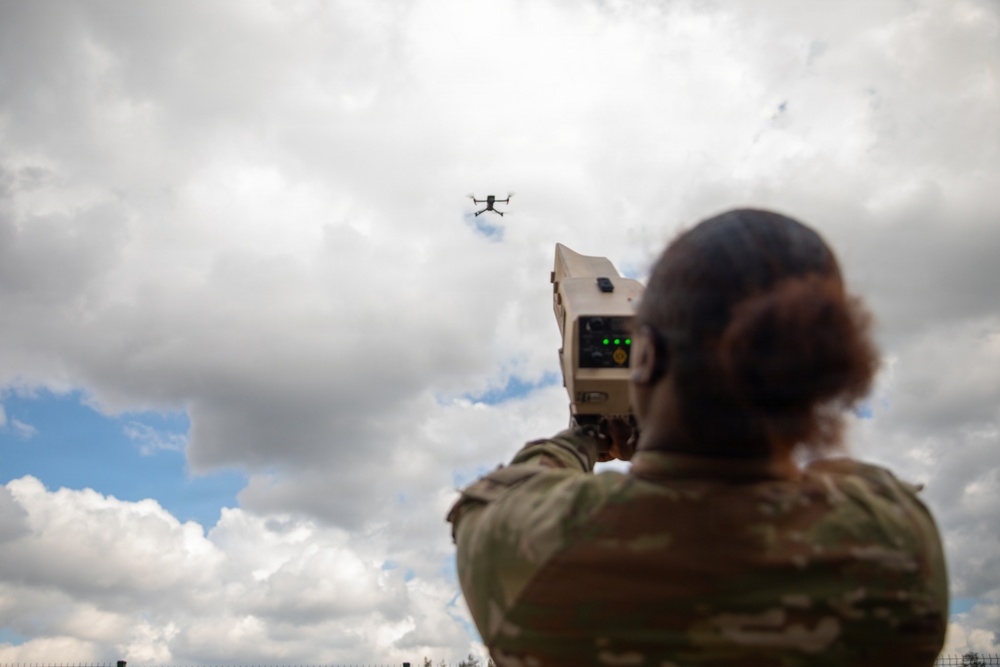
The harder truth underneath the policy rhetoric is that Europe's counter-drone tools are still maturing. Reporting in early June 2026 from a NATO range in Latvia documented exactly that: a mix of successful intercepts and outright misses during counter-drone testing at the Sēlija range. The "hits and misses" are not a sign of failure so much as a snapshot of where the technology sits — promising, improving, but not yet a reliable, fielded shield across an entire flank.
That testing context is why the Renew Europe demands emphasize real capabilities rather than announcements. Detection alone does not stop a drone; interception that works on a range but fails in the field does not protect a city. The gap between a demonstrated intercept and a dependable, always-on defensive layer is precisely the space these initiatives are trying to close.
How the pieces fit together
It helps to read this as three layers stacked on one timeline. At the political layer, NATO's agreement to accelerate frontline counter-drone work sets up the Ankara summit as the venue where commitments are expected to harden. At the institutional layer, the EU instruments — the European Drone Defence Initiative, Eastern Flank Watch, the Black Sea hub, and the proposed Centre of Excellence — provide the structures meant to turn commitments into standing capability and shared doctrine. At the operational layer, the Latvia range testing shows where the actual hardware stands today.
The throughline connecting all three is the recognition that the threat is outpacing the defence. The range results are the reality check, and the Ankara summit is the deadline that forces the question of whether NATO and the EU can field something that works before the next surge.
Why It Matters
This is fresh policy movement, and it signals a shift from describing the eastern-flank drone problem to committing institutional structures and budget lines to solving it. By routing NATO's accelerated work into the Ankara summit and tying EU funding to the Multiannual Financial Framework, Renew Europe is trying to convert a recurring emergency into permanent capability. The Latvia range results are the sobering counterweight: the policy ambition is racing ahead of a counter-drone technology base that still misses as often as it hits. The inclusion of Ukrainian instructors in a proposed European Centre of Excellence for Drone Warfare is the most telling detail — it concedes that the continent's deepest counter-drone expertise currently lives on the battlefield in Ukraine, not in NATO's existing institutions. Whether the Arctic-to-Black Sea flank gets a working shield or another round of declarations will turn on whether the funding, the doctrine, and the hardware converge before the threat escalates any further.
