
The federal government has spent the better part of a decade figuring out how to keep drones away from things that do not move: air bases, munitions depots, presidential motorcade staging areas, stadiums. On July 21, 2026, it put roughly $156 million behind a much harder version of the problem — keeping drones away from a nuclear weapons convoy doing highway speed on an American interstate.
The National Nuclear Security Administration's Office of Secure Transportation awarded Kratos Defense & Security Solutions a sole-source, single-award Indefinite Delivery/Indefinite Quantity contract for mobile counter-unmanned aircraft systems. The program has a name: Project Solar Shield. Work is expected to begin immediately and will be performed at secure Kratos facilities.
Kratos describes the award as the first large-scale government production contract of its kind built around its integrated C-UAS approach. Investors read it the same way — per StockTitan, KTOS gained 4.94% on the day of the announcement, against a market capitalization of roughly $9.04 billion.
What OST Actually Does
To understand why this contract is different from the dozens of C-UAS awards that have come before it, you have to understand the customer.
The Office of Secure Transportation is the organization that physically moves the United States' nuclear weapons and the material that goes into them. Per NNSA's own description, OST handles the "safe and secure transport of government-owned special nuclear materials in the contiguous United States." A given shipment may contain nuclear weapons, weapons components, enriched uranium, or plutonium.
The materials travel in what NNSA calls "highly modified secure tractor-trailers," accompanied by armed federal agents riding in escort vehicles who provide both security and emergency response. The whole enterprise is watched from a Transportation and Emergency Control Center in Albuquerque that monitors the status and location of every convoy and maintains real-time communications with it 24 hours a day, 365 days a year.
OST operates out of three command locations: Albuquerque, New Mexico; Amarillo, Texas; and Oak Ridge, Tennessee. Its headquarters is in Albuquerque, and its training operations are based at Fort Chaffee, Arkansas.
Its safety record is the number that gets quoted, and it deserves to be. Since the office was established in 1975, OST has accumulated more than 140 million miles of over-the-road experience transporting special cargo with no accident causing a fatality or a release of radioactive material. Half a century, 140 million miles, zero.
That record is the context for Project Solar Shield. This is not a customer that experiments in production.
Why a Moving Convoy Breaks the Fixed-Site Playbook
Nearly every counter-drone architecture fielded domestically over the last ten years assumes a defended point. You survey the site, you characterize the RF environment once, you site your radars and RF sensors and effectors to cover known approach corridors, you build a map of what "normal" air traffic looks like overhead, and you negotiate — slowly, painfully — the legal authorities that apply to that specific piece of geography.
Almost none of that survives contact with a convoy.
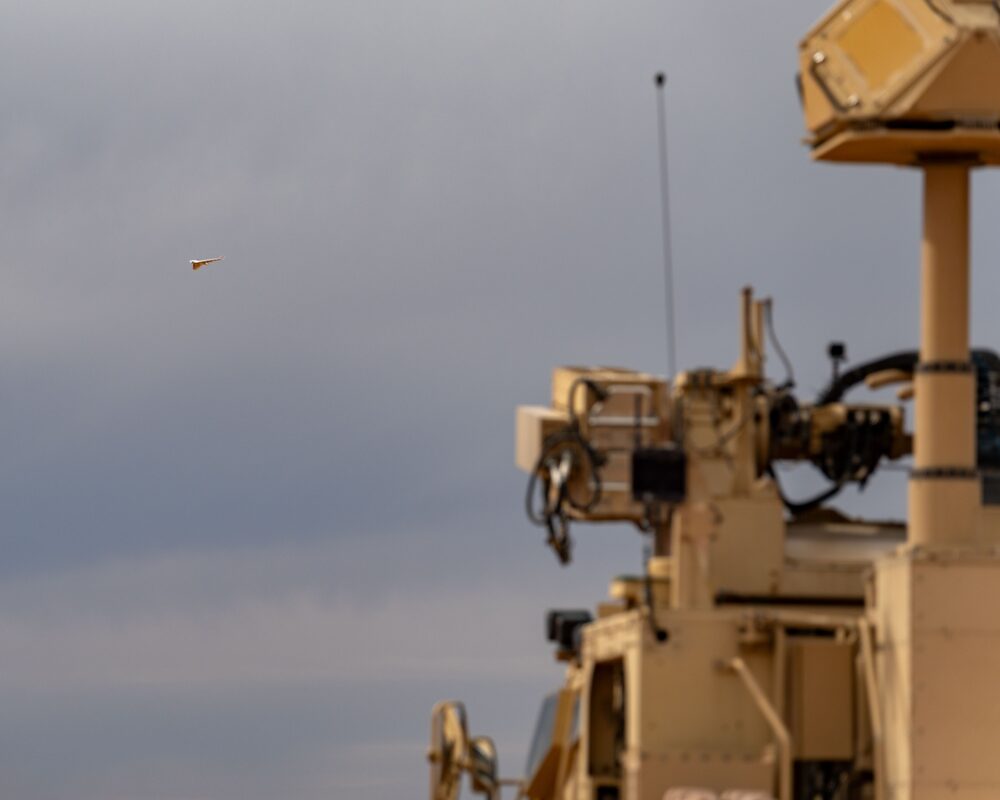
The Kratos scope, per the company's announcement, is the delivery of mobile C-UAS platforms capable of detecting, tracking, identifying, and responding to potentially hostile unmanned aircraft systems in real time, in support of OST's nuclear weapons and materials transportation missions. The company describes the solution as integrating its C-UAS system, mobile platform design, command-and-control, and advanced power management technologies into a single fully integrated package that is "highly modular and scalable," supporting the safe and secure ground and air transportation of nuclear weapons, weapon components, and special nuclear materials.
Unpack the engineering implications of putting that kill chain on wheels:
The sensor picture is never static. Radar clutter on a moving platform is a fundamentally different problem than radar clutter from a fixed mast. Ground returns sweep, terrain masks and unmasks, and every overpass, cut, and treeline reshapes the horizon. Detection thresholds tuned for a flat desert perimeter will drown a system moving through Appalachian terrain.
The RF environment changes by the minute. Passive RF detection — reading drone control and video links out of the spectrum — is one of the cheapest and most reliable detection layers available. It is also the layer most sensitive to background noise. A convoy transits urban RF density, rural quiet, and everything between, sometimes within the same hour. What reads as an anomalous emitter in open country is background in a metro area.
Discrimination gets harder, not easier. A fixed site can build an empirical baseline of the drones that routinely appear near it — the neighbor's hobby quadcopter, the utility inspection flight, the local news aircraft. A convoy has no baseline. Every track is a first encounter. The "identify" step in the kill chain is doing an enormous amount of work here, because the alternative to good identification is either ignoring a real threat or reacting to a teenager filming trucks on a highway.
Everything has to fit and survive. Vehicle-mounted apertures live inside a size, weight, and power envelope, take road vibration continuously, and cannot compromise the vehicle's other jobs. The "highly modular and scalable" language in the announcement is doing real work — and so is the emphasis on advanced power management, which is not a phrase a company includes by accident when the payload has to run off a vehicle.
The Response Problem
Detection is the tractable half. Response is where the mission gets genuinely constrained, and it is worth being precise about why.
Electronic attack — jamming a drone's control link or its GNSS reception — is the default effector in most military C-UAS. On a convoy moving through the national airspace and across public road networks, that tool comes with obvious hazards: the emissions do not stop at the shoulder of the road, and the convoy is surrounded by civilian aircraft, civilian vehicles, and civilian infrastructure that all depend on the same spectrum. Any employment doctrine has to account for that.
Kinetic response has its own arithmetic. Shooting down an aircraft over a public highway means something has to come down somewhere, and the somewhere is not a controlled range. The escort agents are armed, but a firearm pointed upward from a moving convoy on an interstate is not a general-purpose counter-drone answer.
Neither problem is unsolvable. Both are the reason a mobile C-UAS program of this scale takes a rigorous evaluation rather than a catalog buy — and per StockTitan's account of the award, Kratos was selected after exactly that, identified following a rigorous technical evaluation as the provider capable of meeting OST's technical, cost, schedule, operational, safety, redundancy, integration, and long-term sustainment requirements. Note the presence of safety and long-term sustainment in that list. For a customer with a 140-million-mile record free of fatal accidents, safety is not a box to check; it is the product.
Why Sole Source
The contract is sole-source and single-award. In the ordinary run of federal contracting, that structure invites scrutiny, and in the ordinary run it should. Here, the combination of an IDIQ vehicle with a single awarded source suggests a customer that wants ordering flexibility over an extended period without re-competing the integration each time — which is a reasonable posture when the mission is this sensitive, the work is performed at secure facilities, and the number of vendors cleared to do it is small by construction.
It also means there is no second vendor in the wings. Kratos owns the integration for this mission, and the government has tied Project Solar Shield's schedule to one company's execution.
What Kratos Says
The company framed the award as a category shift rather than a one-off. "Project Solar Shield represents a significant milestone for Kratos and the broader government C-UAS market," said Dave Carter, President of Kratos' Defense & Rocket Support Services division, adding that the program "demonstrates the value of combining C-UAS, mobile platform design, command-and-control capabilities, and resilient power management into a single mission-ready solution." President and CEO Eric DeMarco added, "We believe that Kratos' technology, system and integration capabilities in the C-UAS mission area are industry leading, and also our ability to mass produce large quantities of relevant systems at an affordable cost."
Read past the vendor register and the specific claim worth tracking is the one about production. Kratos characterizes this as the first large-scale government production contract of its kind built around this integrated approach — a distinction from prototypes, demonstrations, and technology-development awards. Counter-drone has been an unusually prototype-heavy corner of the defense market, with a long tail of systems that performed well in evaluation and were never fielded at scale. A production contract is a different commitment.
The award also arrives on top of a run of other Kratos wins in the same reporting period: approximately $400 million in new funding for hypersonic system and other programs, and an approximately $100 million sole-source prime award for a space domain awareness system program.
Why It Matters
Domestic counter-drone spending has, until now, mostly gone toward defending places. Project Solar Shield is the government paying to defend a thing in motion, and the thing in motion is the most sensitive cargo the United States moves on public roads.
That shift matters for three reasons.
First, it is an implicit threat assessment. The NNSA does not spend $156 million and attach a program name to a hypothetical. Standing up a mobile C-UAS capability for OST convoys is an official judgment that small unmanned aircraft now constitute a credible surveillance-or-worse risk to nuclear material in transit inside the contiguous United States. The requirement itself is the statement.
Second, it moves the technical goalposts for the entire domestic C-UAS industry. Vendors who have built their businesses around fixed-site installations — survey, install, calibrate, monitor — are now competing in a market where the reference mission is a system that works while moving through unknown RF and terrain, with no site survey and no baseline. That is a harder engineering problem and it will separate the field.
Third, it forces the legal and doctrinal questions that the fixed-site model has been able to defer. Counter-drone authorities in the United States are geographically scoped and narrowly held. A convoy crosses jurisdictions continuously. Whatever concept of operations Project Solar Shield produces — when the system may act, what it may do, and how those decisions are made at highway speed with a control center in Albuquerque tracking the convoy in real time — will become a reference model for every other mobile high-value mission that follows. Presidential movements, other special nuclear material shipments, high-value logistics: the same problem, different cargo.
The details of the system will stay behind the classification line. What is public is the shape of the requirement, and the shape is the news. The counter-drone fence has been jumped. The convoy is the new perimeter.
