
The math of the drone threat is simple and brutal. A commercially derived quadcopter costs a few hundred dollars. A Stinger missile to kill it runs around $120,000. A navy SM-6 is north of $4 million. The US military has spent upwards of $2 million per unit defeating drones that cost hundreds to thousands of dollars — a cost ratio that, at scale, is strategically untenable.
Directed energy changes that math. Both high-power microwave (HPM) and high-energy laser (HEL) systems offer cost-per-shot figures measured in dollars rather than six figures. But the two technologies work on fundamentally different physical principles, excel in different tactical situations, and fail in different ways. Understanding the divide matters because the Pentagon is spending real money on both: the Congressional Research Service tracked a DoD request of $789.7 million for unclassified directed-energy programs in FY2025 alone, down from $1.1 billion the year prior.
Electromagnetic Disruption: How HPM Attacks at the Speed of Light, in Every Direction at Once
HPM weapons don't burn their targets — they scramble them. A high-power microwave pulse couples into a drone's electronics, inducing currents that upset, damage, or destroy processors, flight controllers, and navigation hardware. The critical difference from a laser is spatial: an HPM system can radiate energy across a wide arc simultaneously, engaging multiple targets in a single emission.
USAF Chief Scientist Richard Joseph's description of THOR's broad-area effect has since become the shorthand comparison for both technologies: HPM works like "a shotgun full of birdshot" while a laser is "like a sniper rifle." One blankets an area; the other threads a needle.
Traditional HPM systems fired nanosecond bursts. Epirus's Leonidas takes a different approach: long-pulse HPM, with pulses measured in milliseconds rather than nanoseconds. The extended dwell time — combined with solid-state gallium nitride (GaN) semiconductor technology and a software-defined, digitally beamformed phased-array antenna — produces what Epirus calls an electromagnetic interference field (EIF). Rather than requiring precise alignment to damage specific components, the EIF saturates the target's electronics environment. Leonidas can also operate in a narrow beam against a single drone, tune to a subset of a swarm, or switch to broad-beam mode to sweep a full sector.
The results in testing have been striking. Leonidas defeated all 49 drones in a 49-drone swarm with 100% effectiveness. More significantly, a January 2026 demonstration took down a fiber-optic controlled UAS — a drone immune to RF jamming because it has no radio control link. HPM doesn't care: it attacks the drone's own electronics, not the signal tethering it to an operator.
"Electromagnetic interference can be smart...you can even penetrate what you might think to be a hardened, non-susceptible drone." — Andy Lowery, CEO, Epirus Inc.
The Air Force Research Laboratory's THOR (Tactical High-Power Operational Responder) reached operational testing through a different development path. THOR is containerized, fits in a C-130, and can be assembled from stowed to firing-ready on standard ground power. In a swarm test at Kirtland AFB on April 5, 2023 — described by AFRL as "the first test of this scale in AFRL history" — THOR engaged multiple drone types it had never previously encountered and dropped them all. Program Manager Adrian Lucero called it "exceptionally effective," citing "wide beam, high peak powers, and fast-moving gimbal." AFRL subsequently awarded Leidos a contract to develop Mjolnir, a follow-on HPM system designed for improved capability and manufacturing readiness.
Concentrated Photons: How High-Energy Lasers Kill Drones One at a Time
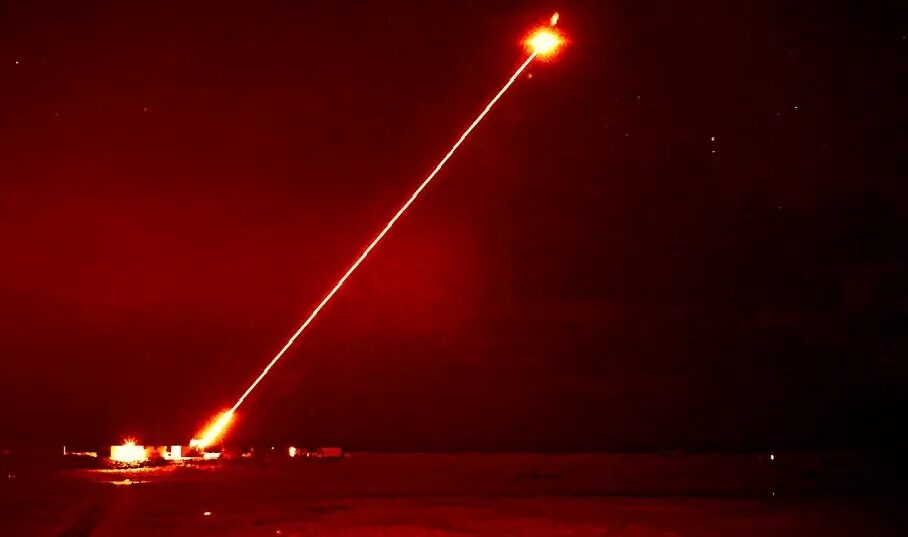
A high-energy laser concentrates photonic energy onto a small spot on a target until the material fails — skin buckles, electronics overheat, or fuel ignites. The physics demands sustained dwell time: several seconds of beam contact per target for a reliable hard kill. That dwell requirement is the central tactical constraint of every HEL system currently fielded or in development.
Three programs illustrate where lasers fit — and where they struggle.
Raytheon's HELWS, a 10 kilowatt-class palletized system, has accumulated more than 25,000 hours of operation since its 2019 Air Force deployment and carries combat certification. It has been tested on Apache attack helicopters. HELWS occupies the low end of the power range — effective against small UAS but constrained against faster or more robust targets.
The Navy's HELIOS, built by Lockheed Martin, operates at 60kW and is aboard USS Preble (DDG-88). With an effective range of approximately five miles and engagements across at least four separate test events, HELIOS represents the most operationally mature shipboard directed-energy weapon in the US inventory. A containerized HELIOS variant is under development for carriers, amphibious ships, expeditionary sea bases, and shore installations; Congress proposed $5 million for that concept in FY2027.
The Army's DE M-SHORAD tells a harder story. A 50kW Raytheon/KBR laser mounted on a Stryker A1, it posted strong results at White Sands Missile Range — acquiring, tracking, and defeating multiple 60mm mortar rounds and small, medium, and large drones across four weeks of continuous live-fire. Then the Army deployed four prototypes to the Middle East in 2024 for soldier testing, and the feedback was candidly negative. Army acquisition chief Doug Bush cited heat dissipation failures, excessive electronics complexity, wear in tactical environments, and performance degradation from weather, dust storms, and airborne particles. "Results from the lab environment and test ranges is very different from the tactical environment," Bush said. "They will tell you everything and they're not worried about your feelings." The Army cut DE M-SHORAD funding from $110 million in FY2024 to $88 million in FY2025, with further reductions projected through FY2028.
The One-to-Many Problem — and What It Means at Scale
The tactical divide between HPM and HEL comes into focus when drone numbers grow. A laser must serially dwell on each target for several seconds. Against a 10-drone threat that might mean 30-60 seconds of continuous engagement — manageable. Against a 49-drone swarm, the math collapses: by the time a laser has worked down the queue, the first wave may have already arrived.
HPM's area-effect design sidesteps this problem. Leonidas can engage an entire swarm in a single broadbeam burst. The US Army's choice to pursue Leonidas as the IFPC-HPM candidate — signing a $43,551,060 contract in July 2025 for two Generation II systems through RCCTO — reflects this calculus. Gen II delivers 30% more power, more than double the maximum effective range according to The War Zone in the same package, 800 lbs of lithium-polymer batteries enabling 30 continuous minutes of firing, and high-duty burst mode for faster multi-target engagement. Two cooperating Leonidas units can also network as a single system, achieving 2x linear power and range gains.
The cost-per-shot figures reinforce the strategic logic. Laser engagements cost an estimated $1-10 in electricity. Israel's Iron Beam laser — a comparable system — runs approximately $3.50 per engagement. Epirus describes Leonidas HPM engagements as costing "pennies per kill." Set against the $120,000 Stinger or $4-million-plus SM-6, either directed-energy approach represents an order-of-magnitude improvement. At Epirus's described pennies-per-kill cost, defeating a 1,000-drone swarm could cost a few dollars in electricity rather than $120 million in Stingers — assuming the engagement geometry allowed it.
Neither technology is without constraints. Laser systems lose half or more of their effective range in heavy rain or dense fog. Spinning or reflective coatings on drone bodies can distribute or deflect the thermal load. HPM carries its own signature problem: Epirus CEO Andy Lowery has acknowledged that Leonidas's output is detectable at extreme distance — "If you transmitted with our system in Kyiv, they would be able to detect it in St. Petersburg." And if software-defined safe zones are not correctly configured, HPM can affect friendly electronics inside the beam. Leonidas also requires a 15-20 minute startup time — a constraint that matters in an ambush scenario.
The CRS assessment of DoD directed-energy strategy targets 500kW laser systems in the 2025-2030 timeframe — with 300kW representing the threshold at which cruise missiles in certain flight profiles become vulnerable — and megawatt-class capability thereafter. At those power levels, dwell times shrink and the laser's serial-engagement limitation becomes less severe. But until that roadmap matures, the operational picture is one of complementary tools: HPM for swarm area defense and fixed-site point defense (IFPC-HPM positioned alongside Patriot batteries), HEL for precision maritime and longer-range precision engagements where weather and thermal management can be controlled. Doug Bush's blunt assessment of the field environment is a reminder that the gap between range performance and operational performance remains real — and that directed energy, like every other technology, has to survive contact with soldiers in the field before the math on paper becomes the math that matters.
Sources
- Epirus Inc. — Electronic Warfare / Leonidas platform overview
- Epirus Inc. — $43.5M IFPC-HPM Generation II Army contract (July 2025)
- The War Zone — Army's $50M bet on next-gen Leonidas HPM (2025)
- Air and Space Forces Magazine — THOR drone swarm demo at Kirtland AFB (April 2023)
- Breaking Defense — THOR prototype deployed to Africa for base defense testing (December 2020)
- Raytheon/RTX — HELWS and laser weapon systems
- Next Gen Defense — US Navy HELIOS laser system (2024)
- Sandboxx — US military laser experiments for counter-drone (2024)
- Breaking Defense — Army soldiers' negative DE M-SHORAD field feedback (May 2024)
- Congressional Research Service (CRS IF11882) — Directed Energy Weapons (January 2026)
- Military Machine — Military laser weapons and directed energy overview
