
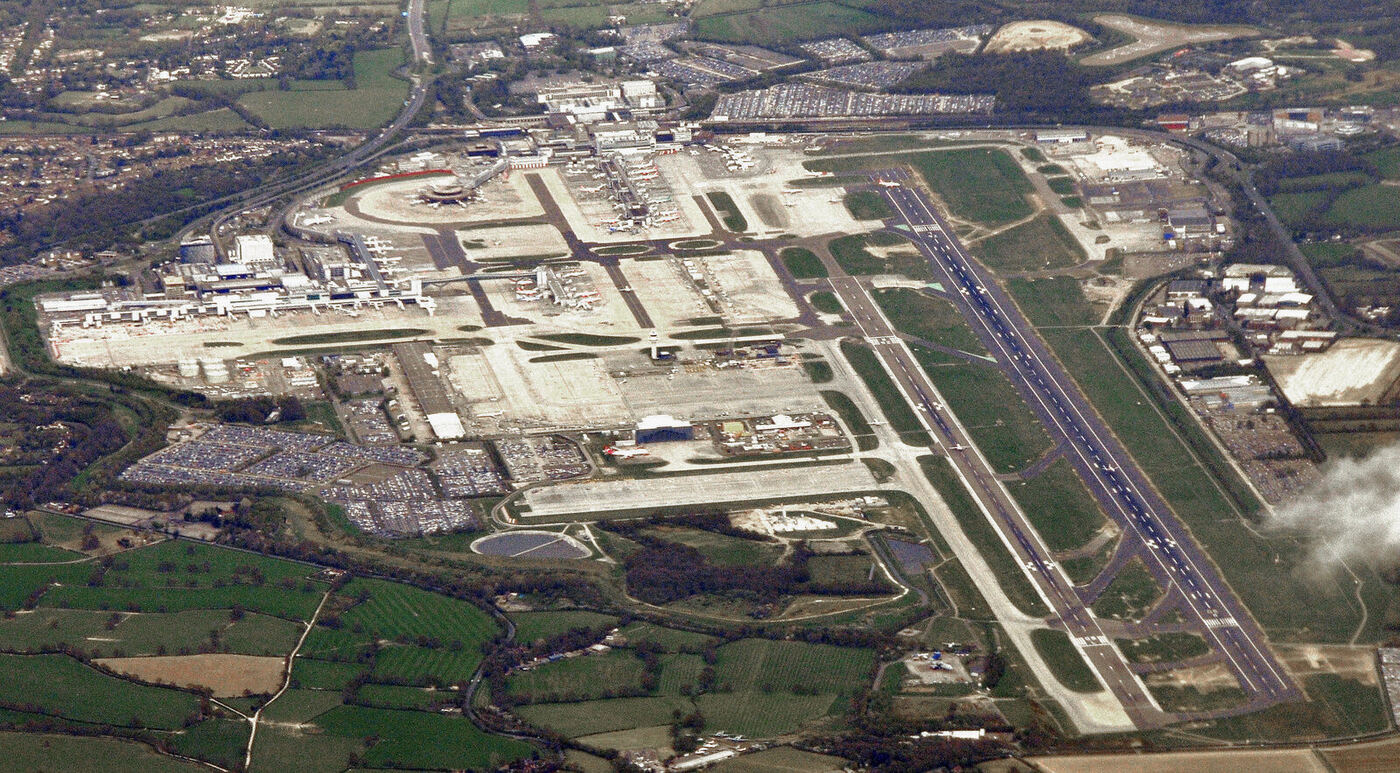
On the evening of December 19, 2018, at approximately 9 p.m., a reported drone sighting near Gatwick Airport's runway triggered the immediate suspension of all flights. What followed was 33 hours of closure, approximately 800 cancelled or diverted flights, and somewhere between 120,000 and 140,000 stranded passengers during one of the year's heaviest travel periods. The financial toll exceeded £50 million in total; Gatwick's direct losses were estimated at approximately £15 million.
Nearly eight years on, the incident remains unresolved in a precise and consequential way: no verified photograph or video of the drone was ever produced. The RAF confirmed the absence of any hostile or malicious drone activity after their sensors were deployed. No pilot filed an airprox report. No one was ever charged. And the senior detective who briefly said what the data implied was removed from press duties within days of saying it.
The Evidence the Sensors Didn't Find
Sussex Police launched Operation Trebor in response, receiving approximately 129 separate reports of drone activity. The force designated 109 as coming from "credible witnesses" — including a pilot and airport police officers — a figure that gave the initial public account its apparent empirical weight.
The response escalated quickly. Gatwick approached the Ministry of Defence within 24 hours to source detection and tracking equipment. Ten RAF personnel were deployed by the second day. Counter-drone systems on scene included Leonardo's Falcon Shield, Metis Skyperion with AUDS integration, and DJI AeroScope. Gatwick subsequently procured AUDS as part of its permanent counter-UAS posture — a layered system combining Blighter A400 radar, Chess Dynamics Hawkeye electro-optical/infrared tracker, and an Enterprise Control Systems RF inhibitor.
What those systems returned was the problem. Leonardo's Falcon Shield detected zero malicious drones during the incident, though it successfully tracked deliberate test drones that Gatwick and Sussex Police flew on December 21–23 to validate the equipment. The RAF formally confirmed "absence of any 'hostile or malicious' drone activity" after their sensors were operating. National Police Air Service helicopters flew continuous sorties from three bases between December 19 and 23; their crews reported no visual on a drone or a drone operator. Not a single pilot filed an airprox report near Gatwick from December 19 onward — including the NPAS helicopter crews who had the strongest professional incentive to do so.
The eyewitness sightings occurred exclusively after dark. Weather on the evening of December 19 was rainy and windy — conditions broadly incompatible with most consumer and commercial drone operations of that era. Professional press photographers were present at the airport. The general public carried smartphones. Security cameras covered the perimeter. No image ever materialized.
The CAA and DfT both later confirmed to FOI requesters that no written description exists anywhere in official records specifying the drone's size, color, speed, or rotor configuration. That is not an administrative oversight. That is the official record documenting an absence.
"We cannot discount the possibility that there may have been no drone at all." — Detective Chief Superintendent Jason Tingley, Sussex Police, December 23, 2018
Tingley was removed from press duties immediately after making that statement. He left Sussex Police within a year.
The Crawley Raid and the £200,000 Settlement
On December 22, approximately a dozen armed officers stormed the Crawley home of Paul Gait and Elaine Kirk. The couple was held for 36 hours before being released without charge. Gait had an alibi — he had been at work when the first sightings were reported, and colleagues vouched for him immediately.
In June 2020, Sussex Police settled out of court: £55,000 in compensation to Gait and Kirk and £145,000 in legal costs, totaling £200,000. Assistant Chief Constable David Miller offered the following: "We recognise that things could have been done differently." The couple described the settlement as confirmation of their innocence and their wrongful treatment by police.
Ninety-six individuals in total were designated persons of interest over the course of the investigation and ruled out. Nobody was ever charged. Operation Trebor closed in September 2019 with no convictions and, in the force's own framing, no "realistic lines of inquiry." The investigation cost Sussex Police £790,208; nine assisting forces spent a further £206,708. The RAF's entire deployment was recorded at £1,161.
Five Years of Obstruction — and Counting
The closure of Operation Trebor marked the beginning of a separate and arguably more troubling episode: systematic obstruction of public disclosure about what the government did and did not know during the shutdown.
Official DfT situation reports circulated during the crisis stated the incident was "being regarded by industry as a malicious attempt to disrupt operations," a claim that directly contradicted actual drone industry skepticism at the time. The DfT invoked national security exemptions; a number of emails from the period could not be located.
Ian Hudson of UAV Hive pursued Sussex Police's Operation Trebor Structured Debrief and related documents through FOI proceedings. In March 2024, the First-Tier Tribunal issued decisions [2024] UKFTT 166 and [2024] UKFTT 168, ruling that Sussex Police must disclose the requested information, finding public interest in transparency outweighed available exemptions. Hudson was unambiguous about the stakes: "What is not acceptable is painting a picture of a drone being present throughout the event or even at all, when the evidence the authorities hold says otherwise."
The DfT's internal "Lessons Report" — a structured post-incident review — became a separate FOI battleground. In May 2024, Hudson initiated proceedings seeking that document. In July 2024, the DfT allegedly attempted to conceal the document's existence. In October 2025, a heavily redacted version was released. On February 2, 2026, Information Commissioner John Edwards ruled that the DfT's national security exemption was unjustified and ordered near-complete unredaction; only the names of three national security bodies remain redacted. Edwards noted that drone and airport detection technology "will have significantly moved on since 2018," making the historical redactions unnecessary on national security grounds. As of March 2026, the DfT was appealing to the General Regulatory Chamber First-Tier Tribunal.
Why It Matters
The Gatwick incident reshaped UK civil aviation regulation with unusual speed. Airport drone no-fly zones were extended from approximately 1 km to approximately 5 km around runways by March 2019, with an additional 1 km buffer along approach and departure routes. New police powers for drone incident response were enacted. The CAA introduced mandatory consumer drone registration. AUDS was procured by Gatwick and later cited in wider military counter-UAS evaluations. Parliament's Defence Committee catalogued the incident as a central case study in its Domestic Threat of Drones inquiry, noting it "effected 140,000 passengers, and the (potential) operator(s) continues to evade prosecution." One industry survey found 65% of respondents reported more negative views of drones following the disruption.
That entire policy architecture was triggered by an event whose physical reality has never been confirmed.
This is not an argument that airport drone defenses are unnecessary — they are not. UK drone-endangerment incidents had risen more than a third in 2018 alone; the Airprox Board logged 125 incidents that year against 93 in 2017 and 71 in 2016. The detection and response gaps the shutdown exposed were genuine, regardless of what actually caused the closure. The counter-UAS systems that followed have produced real capability.
What the episode has also exposed is a government willing to use an unverified incident as the primary justification for a major counter-UAS procurement and regulatory program, while obstructing access to documents that might clarify what actually happened. Gary Mortimer, editor of sUAS News, has described Gatwick as having launched a wave of counter-drone systems without a single piece of confirmed evidence.
The Lessons Report, once fully unredacted, may establish what the government understood in real time versus what it chose to communicate publicly. Until then, the record stands as follows: no drone was ever described in any official document. No image was ever produced. No operator was ever identified. No conviction was ever secured. And the policy apparatus built on those 33 hours continues to treat those facts as peripheral rather than foundational.
Sources
- Airprox Reality Check — Gatwick 2018: In-Depth Investigative Analysis (FOIA-based)
- UK Parliament — Written Evidence to Defence Committee, Domestic Threat of Drones Inquiry (DTD0013), 2019
- The Register — Gatwick Drone Tribunal (March 2026)
- The Register — Gatwick Drone Couple Payout (June 2020)
- sUAS News — Tribunal Rules Sussex Police Must Release Gatwick Drone Information (March 2024)
- Unmanned Airspace — How UK Government and Airports Responded to the Gatwick Drone Chaos
- Airport Technology — Gatwick Drone Impact (2019)
- Robin Radar Systems — Lessons from the Gatwick Airport Drone Incident
- UK Government — Counter-Unmanned Aircraft Strategy (2019, the official response to the Gatwick disruption)
