
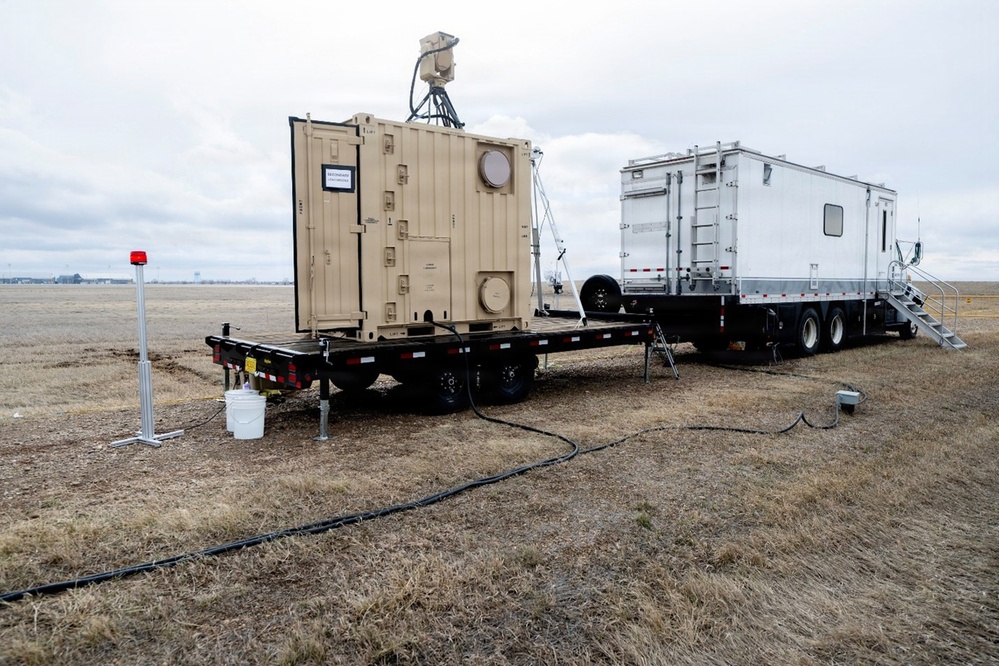
The cheap drone problem has a new shape on the show floor. At Eurosatory 2026 in Paris, the late-June trade coverage points to a counter-unmanned-aircraft-systems (C-UAS) market that has stopped pretending a single jammer can solve everything. Instead, exhibitors are stacking effectors — directed energy, passive sensing, optical tracking — into layered architectures designed to detect, track, and physically defeat the first-person-view (FPV) and one-way-attack drones that have come to define the modern battlefield's bottom tier.
Three threads from the show, each independently reported, tell the same story. A high-energy pulsed laser that physically destroys drones on roughly four kilowatts of draw. A microwave directed-energy weapon now reaching for bigger targets at longer ranges. And a vehicle-protection system that fuses a radio-frequency drone-detection sensor with passive optical and infrared sensing. Behind all of it sits a procurement engine: the U.S. Army and its allies signing paperwork at the show to widen the marketplaces through which exactly these kinds of systems get bought.
The hard-kill laser: Esh-Tech's DroneLight
On June 27, trade outlet Zona Militar reported that Esh-Tech used Eurosatory 2026 to unveil DroneLight, a hard-kill C-UAS solution built around a high-energy pulsed laser. "Hard-kill" is the operative phrase: rather than disrupting a drone's control link or navigation and hoping it tumbles, DroneLight is designed to physically destroy the aircraft with directed laser energy. Per the report, it does this with short, high-power pulses that drill into a drone's structure and remove material, rather than the slow heating of a continuous-wave (CW) emitter.
The headline specification is power. According to the report, DroneLight requires only around four kilowatts to operate — against the more than 20 kW a conventional CW laser emitter typically draws. That number matters more than it might first appear. High-energy laser weapons have historically been constrained less by their optics than by the generators, cooling, and prime power they demand — logistics that tether a system to a fixed site or a large dedicated platform. A roughly 4 kW draw, as Zona Militar frames it, cuts that logistical tail; Esh-Tech estimates the approach could lower the acquisition cost of laser effectors by up to 75 percent versus traditional CW technology. A laser you can actually move with the force it protects is a different proposition than one that needs its own power station.
The microwave and the passive 'cocktail'
If a laser is a scalpel — precise, line-of-sight, one target at a time — high-power microwave is closer to a shotgun for the electromagnetic spectrum. At Eurosatory, as reported by Unmanned Airspace, Cyprus-based Ecliptic Defence and Space exhibited ANTIGONI, a high-power microwave directed-energy C-UAS weapon. At its current stage of development the system is designed to neutralise drones up to 25 km away across Class I, II and III UAVs, and Ecliptic says its next development phases will target larger drone platforms and longer engagement distances — suggesting the system is pushing beyond the small-quadcopter envelope where directed-energy demonstrations often plateau.
The same outlet detailed a distinctly French answer to the vehicle-protection problem. Lacroix, Bertin, and MC2 Technologies have partnered on S-KAPS, a counter-drone system built to shield armoured vehicles from drone attack. Rather than relying on a single sensor type, S-KAPS integrates several detection layers: MC2's HADDES portable RF drone-detection sensor, a PeriSight Top Attack 360° passive infrared optronic system, plus acoustic and laser-warning detection. Its emphasis on pairing RF detection with passive infrared optronics is the most interesting part.
That emphasis is a direct response to how drone war has evolved. An active radar or an RF jammer announces itself; in a contested environment, anything that radiates can be located and targeted. An RF detection sensor, by contrast, listens for the drone's own emissions rather than transmitting, and pairing it with passive infrared optronics provides a second, independent detection path that doesn't depend on the threat radiating at all. It is, in effect, a sensor "cocktail" tuned for survivability as much as detection.
Why three different kill mechanisms?
It is worth pausing on a question the show floor answers implicitly: if all of these systems exist to stop drones, why are they so different from one another?
Because the threat is not one threat. A consumer FPV quadcopter, a fixed-wing one-way-attack drone, and a larger reconnaissance platform present different sizes, speeds, materials, and control schemes. A pulsed laser that can burn through an FPV's airframe behaves differently against a target at extended range. A microwave weapon that fries electronics scales by range and aperture in ways a laser does not. And neither effector is any use without a sensor chain that can find the target first — which is where RF detection and optics come in.
Because cost asymmetry is the core problem. The reason this market is converging on directed energy at all is economic. FPV and one-way-attack drones are cheap and disposable; spending an expensive interceptor missile on each one is a losing trade over a long campaign. A laser firing on a few kilowatts of power, or a microwave weapon that can engage in a cone rather than against a single point, changes the math in the defender's favor — assuming detection keeps pace.
Because no single layer is sufficient. The unifying lesson across DroneLight, ANTIGONI, and S-KAPS is that detection and defeat are being designed as integrated systems, not standalone gadgets. A passive sensor that can't shoot, a laser that can't see, and a microwave weapon without a tracking feed are each incomplete. The architecture on display at Eurosatory pairs RF and optical detection with tiered kill options — and that tiering is the point.
The procurement backdrop: the C-UAS Marketplace
None of this hardware reaches a unit without a way to buy it, and Eurosatory 2026 was also where the buying machinery got reinforced. According to the U.S. Army, Secretary of the Army Dan Driscoll, together with allied and partner representatives, signed a joint statement of intent at the exhibition on June 16 — the second day of the show — to expand the Army's UAS and Counter-UAS Marketplaces. The stated goal: reach 25 allied and partner nations by the end of summer 2026, building on agreements concluded over the past year with partners including the United Kingdom, Romania, Australia, Poland, and the Republic of Korea.
That marketplace model is the connective tissue under the effector wave. The push the U.S. Army has been driving — faster acquisition, stronger interoperability, and broader allied access to counter-drone capabilities proven on today's battlefields — lines up with what the European exhibitors are bringing to market. The statement of intent signals a procurement environment built to pull these systems in quickly and at scale across a widening coalition, rather than one-off national buys. For vendors like Esh-Tech, Ecliptic, and the Lacroix-Bertin-MC2 trio, that backdrop is as important as any spec sheet.
Why It Matters
The counter-drone market has spent years stuck in a single-sensor, single-effector mindset: a jammer here, a radar there, each sold as a point solution. The Eurosatory 2026 coverage marks the visible tipping point of a different model. Esh-Tech's roughly 4 kW DroneLight shows hard-kill lasers shedding the prohibitive power and logistics that kept them off mobile platforms. Ecliptic's ANTIGONI shows microwave directed energy reaching toward larger drones at longer ranges. And the Lacroix-Bertin-MC2 S-KAPS shows the sensor side leaning on RF detection and passive infrared optronics rather than emitters that can give a vehicle's position away.
Layered over all of it, the U.S. Army's marketplace expansion — with a 25-nation target by the end of summer 2026 — turns these exhibits into a procurement pipeline rather than a tech demo. The throughline is unmistakable: cheap FPV and one-way-attack drones have forced defenders to trade single jammers for integrated detection plus tiered laser, microwave, and interceptor kill options. Eurosatory 2026 is where that layered architecture stopped being a concept and started being a catalog.
Sources
- U.S. Army, Allies and Partners to Expand Drone and Counter-Drone Marketplaces at Eurosatory Defense Exhibition (army.mil)
- DroneLight, the pulsed laser C-UAS solution unveiled by Esh-Tech at Eurosatory 2026 (Zona Militar)
- Eurosatory 2026 — Ecliptic Defence and Space exhibits microwave directed energy C-UAS weapon (Unmanned Airspace)
- Eurosatory 2026 — Lacroix, Bertin, MC2 partner to protect armoured vehicles from drone attacks (Unmanned Airspace)
