
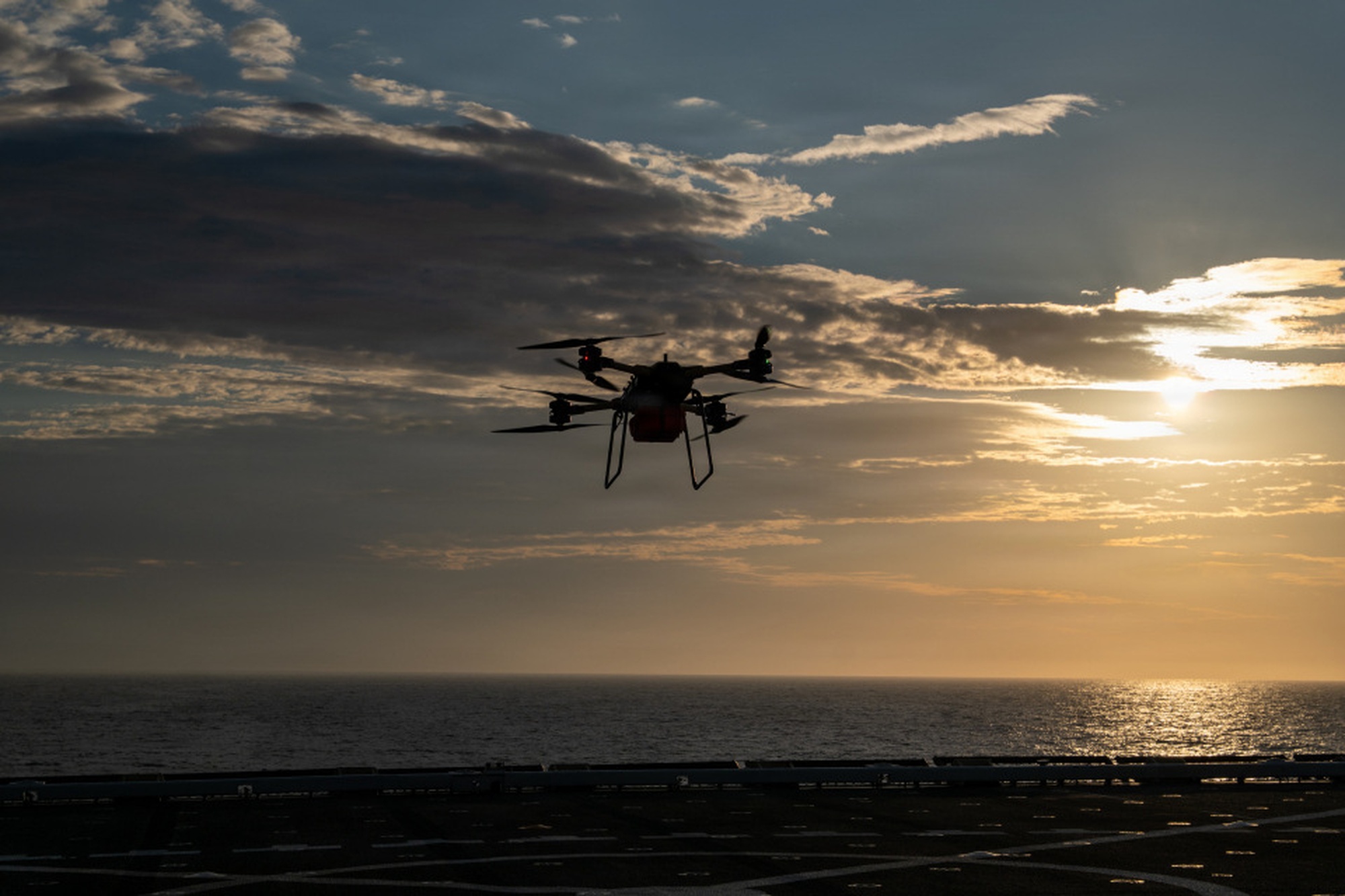
Israeli defense contractor Elbit Systems is pitching a concept that would turn ordinary commercial cargo ships into floating drone bases, according to a July 15 report from C4ISRNET. The idea: take a merchant vessel off a normal shipping route, bolt on deck infrastructure and control systems, and load it with 9 to 12 Hermes 650 Spark unmanned aircraft capable of independently patrolling wide stretches of ocean.
It's a pitch aimed squarely at a gap in naval airpower. Aircraft carriers are enormously expensive to build, crew and maintain, and only a handful of countries operate them. Elbit's proposal offers something in between a carrier and a single ship's onboard sensor suite — a mobile, modestly priced way to put persistent unmanned eyes over large maritime areas without the price tag or diplomatic weight of a flattop.
What's Actually Being Proposed
The concept, as described by C4ISRNET, involves converting existing commercial vessels rather than building purpose-designed drone ships from scratch. Each converted ship would carry between 9 and 12 Hermes 650 Spark aircraft, along with the deck infrastructure needed to launch and recover them, plus onboard control systems and mission support capability.
The Hermes 650 Spark itself is built for exactly this kind of improvised basing. It has a front-mounted engine and short takeoff and landing (STOL) capability, which matters when you're trying to operate fixed-wing unmanned aircraft off a deck that wasn't designed as a runway. The aircraft carries dual payload bays for sensors or other mission equipment, satellite communications for beyond-line-of-sight control, and is compatible with the same ground control infrastructure used for the larger Hermes 900. That last point is notable — it means an operator already running Hermes 900 systems could plug the smaller Spark variant, and by extension a converted drone ship, into an existing control architecture rather than standing up a parallel one.
Independent reporting from Naval Today, published a day earlier on July 14, corroborates the broad shape of the concept, describing the modified merchant vessel as a mobile unmanned-aviation hub meant to extend intelligence, surveillance and reconnaissance (ISR) reach well beyond what a single ship's onboard sensors could cover on their own.
Who Elbit Says Needs This
According to C4ISRNET, Elbit is framing the pitch around countries with large maritime surveillance requirements but no interest in — or budget for — a traditional carrier fleet. The cited use cases include Japan, which faces persistent surveillance demands across a sprawling island chain and surrounding waters; Denmark, whose responsibilities extend to the vast and thinly monitored waters around Greenland; Germany, given its posture in the increasingly contested Baltic Sea; and Israel itself, where offshore natural gas platforms represent high-value infrastructure that benefits from persistent aerial monitoring.
None of these are framed as confirmed customers. C4ISRNET's reporting is explicit that Elbit has not named any buyers and has not attached a timeline to the concept. This is a marketing pitch at this stage, not a program of record — the kind of concept vendors float at trade shows and in briefings to gauge interest before committing engineering resources to a specific customer's requirements.
A Crowded Field
Elbit isn't alone in eyeing this niche. C4ISRNET's report positions the company against Turkey's Baykar and South Korea's Hanwha, both of which are also active in maritime drone-basing concepts. That the reporting names two competitors by nationality — a NATO member and a treaty ally — underscores how quickly "put drones on a ship" has gone from a novel idea to a competitive segment with multiple industrial players chasing the same customers. Calcalist, an Israeli business-press outlet, frames Elbit's push as part of a broader company strategy to extend naval air power without the cost and operational complexity of a traditional carrier — language that reads as much as an investor pitch as a defense one.
Why It Matters
Aircraft carriers are the ultimate expression of naval airpower, but they are also a capability that has remained the province of a small club of nations — the acquisition cost, crew requirements and logistical tail put them out of reach for most navies, including several with genuinely large maritime domains to watch. A converted commercial vessel carrying a dozen unmanned aircraft is a fundamentally different proposition: cheaper to acquire, cheaper to operate, and built on a hull type that's already mass-produced and widely available on the secondhand market.
That math is exactly why the countries Elbit is naming make sense as targets. Denmark's obligations around Greenland cover an enormous, sparsely populated expanse of water and ice. Germany's Baltic Sea posture reflects the region's increasingly contested security environment. Japan's surveillance needs span its sprawling island chain and surrounding waters. None of these missions requires the strike capability of a carrier air wing — they require persistent, wide-area watching, which is precisely what a distributed fleet of STOL unmanned aircraft is suited for.
The catch is that this remains, for now, a slide-deck capability. Converting a real merchant hull into a functioning drone base involves solving problems that go well beyond bolting on a flight deck — structural modifications, sea-state limits on launch and recovery, crew training, integration with a ship's existing systems, and the regulatory and insurance questions that come with operating military aircraft off a civilian-flagged hull. Elbit has not disclosed a customer, a contract, or even a firm timeline. Whether "aircraft carrier on a budget" survives contact with those engineering and operational realities — and whether it beats out Baykar's or Hanwha's competing pitches — is the story to watch from here.