
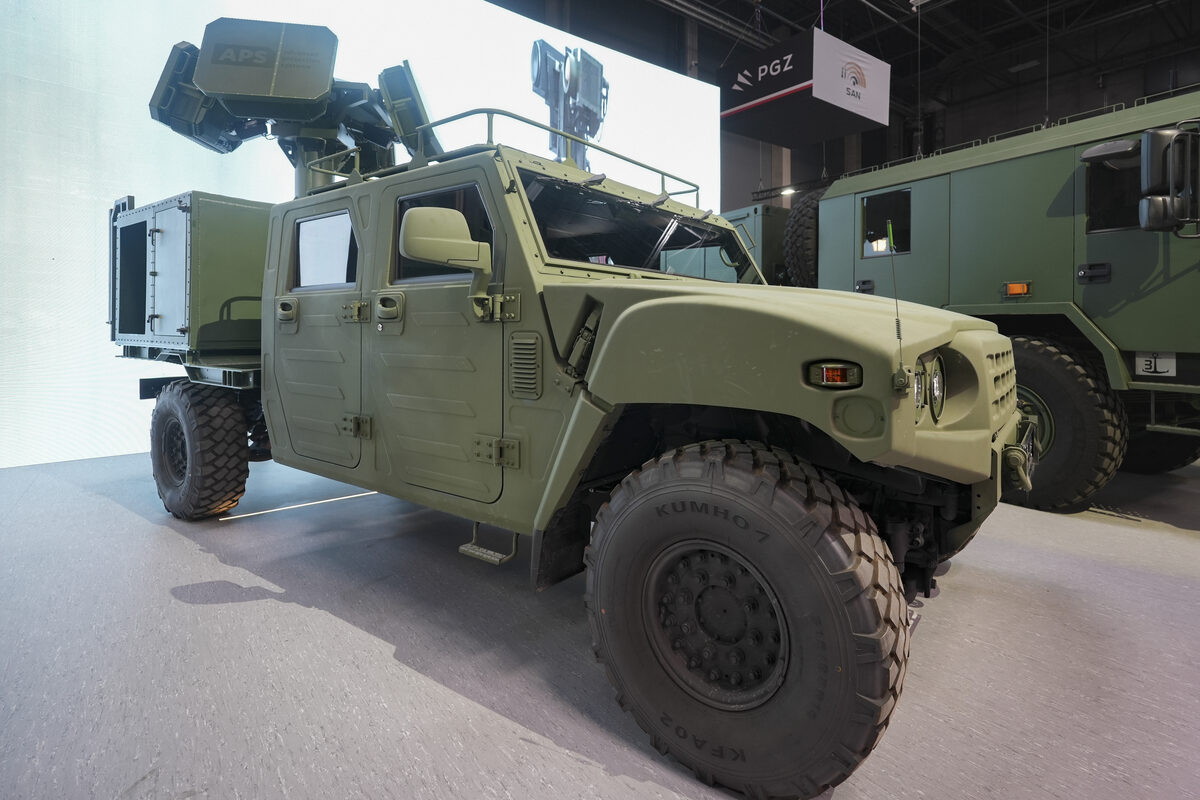
Echodyne said on Nov. 10 that its EchoShield radar has been "selected and integrated into" the BAE Systems Anti Threat System, or BATS, a counter-drone platform that Echodyne's release describes as modular and software-defined. In that system, Echodyne's job is to supply the precise airspace data needed to detect, classify and track uncrewed threats, which BATS then uses to respond. The announcement came shortly after BATS completed live trials in Scotland. Those trials tied multiple sensors and effectors into a single command-and-control (C2) architecture.
Read closely, this is a sensor-supply story. EchoShield is one of several sensors in BATS, not the system's centerpiece. The release does not name a customer. It gives no detection range, no delivery schedule, no contract value and no figures on how often the system defeated targets in Scotland. What it does show is how a large European prime is putting together its counter-UAS offering. BAE owns the architecture and the decision layer, and brings in sensors from specialist vendors.
What BAE Is Building
According to Echodyne's release, distributed via Business Wire, BATS connects current and future sensors and effectors through a "secure, resilient data core" that fuses sensing, intelligence, C2, decision support and countermeasures. In DroneDJ's description, the architecture is designed to scale from protecting individual sites to wider-area coverage. That makes it relevant to military installations, government facilities and critical infrastructure.
Both BAE and the coverage stress that people stay in charge. DroneDJ notes that BATS maintains human control over the process. Louise Heywood, head of strategy for BAE Systems' Digital Intelligence and Land business, said in the release that "EchoShield contributes a precise, data-rich airspace picture," and that BATS uses that feed to apply rapid decision logic and connect operators with the most appropriate effector "while preserving human control." In practice, the radar feeds the picture and BATS handles the fusion and decision support.
The release, as reprinted by ASDNews, describes BAE as Europe's largest defense company, with equipment fielded by more than 25 European nations. That reach matters for a sensor vendor. If a radar is designed into a prime's reference architecture, it can show up in programs the vendor would struggle to win alone.
What the Radar Is Supposed to Do
EchoShield uses Echodyne's metamaterials electronically scanned array (MESA) radar technology in a compact, low size, weight and power (SWaP) package. The release says that low SWaP enables operation across fixed installations, rapidly deployable configurations and on-the-move platforms. DroneDJ also pointed to the radar's relatively compact size, weight and power requirements as a selling point.
The release sets out the requirement in functional terms. A counter-drone radar has to detect targets at actionable range and hold stable tracks through complex maneuvers. It also has to supply position and classification data to the command system, optical sensors and effectors. That is the core problem for radar against drones: a track that drops when the target maneuvers leaves cameras and effectors with nothing to aim at.
Echodyne CEO Eben Frankenberg said in the release: "Every decision and every effect is only as good as the sensor data beneath it." That is a fair point about how layered C-UAS works. It is also a vendor's argument for why its own part of the stack matters most.
What the Announcement Doesn't Say
The release is light on detail in ways that matter for anyone judging BATS or EchoShield:
- No customer. Nothing says which armed force, government agency or infrastructure operator, if any, has ordered BATS with EchoShield.
- No range or performance figures. "Actionable range" is the requirement, but no number is given for this configuration. There are also no track-continuity statistics from the Scottish trials.
- No trial results. The release says BATS "recently completed live trials in Scotland," but gives no dates, target types, number of engagements or defeat rates. It doesn't say which effectors were used.
- No schedule or contract terms. There is no delivery date, quantity or dollar value.
- Several sensors, unnamed. The trials combined multiple sensors and effectors. EchoShield is one of them, and the others aren't identified in the material reviewed.
None of this makes the integration less real. It does mean "selected and integrated" describes engineering work done, not a fielded capability or a production order.
Echodyne's Scale Claims
Echodyne uses the announcement to stress its reach. According to the release and Defence Industry Europe, the company says its radars are integrated into hundreds of counter-UAS systems, many of them available through the Joint Interagency Task Force 401 (JIATF-401) C-UAS Marketplace. It also says a newly opened manufacturing facility in Washington State will eventually scale capacity to more than 30,000 radars a year. These figures come from Echodyne. The release gives no timeline for reaching that rate, and none of the sources independently confirms it.
The ownership picture matters too. DroneDJ's coverage links to a report that Shield raised $2.5 billion to finance a major Echodyne acquisition, and ASDNews lists a headline putting that deal at $5.3 billion. This announcement is about where Echodyne's radar ends up, not about the deal itself. Still, a deepening tie to a European prime's C-UAS architecture is the kind of design-in that could make a sensor supplier more valuable to a new owner.
Why It Matters
The announcement shows how European counter-drone integration is shaping up. BAE's pitch for BATS is the data core: software that fuses inputs, supports decisions and keeps humans in control. In that model, the radar is a vital part but also potentially a replaceable one. If the architecture is truly modular and software-defined, a customer could in principle swap one radar for another without rebuilding the system.
That pushes sensor vendors to compete on SWaP, track quality, price and, above all, volume. Echodyne's claims of hundreds of systems and a planned 30,000-a-year factory are pitched at that market. The company is presenting itself as the radar you can buy in quantity and drop into anyone's C2 system, whether that's a U.S. marketplace offering or a BAE architecture.
For buyers, the takeaway is to wait for the numbers. A trial in Scotland and an integration announcement indicate that the pieces work together. They don't show how far out the radar holds a small drone, how the fused system performs against a determined attacker, or when any customer will receive it. Those are the figures that should decide procurements, and so far neither company has published them.
Sources
- Echodyne EchoShield Selected for BAE Systems Anti Threat System (Echodyne press release via Business Wire, Nov. 10, 2026)
- Echodyne EchoShield Selected for BAE Anti Threat System (ASDNews, Nov. 10, 2026)
- Echodyne says BAE Systems has integrated EchoShield radar into its BATS counter-drone system (Defence Industry Europe, Nov. 11, 2026)
- Echodyne radar strengthens BAE Systems' drone detection capabilities (DroneDJ, Nov. 13, 2026)
