
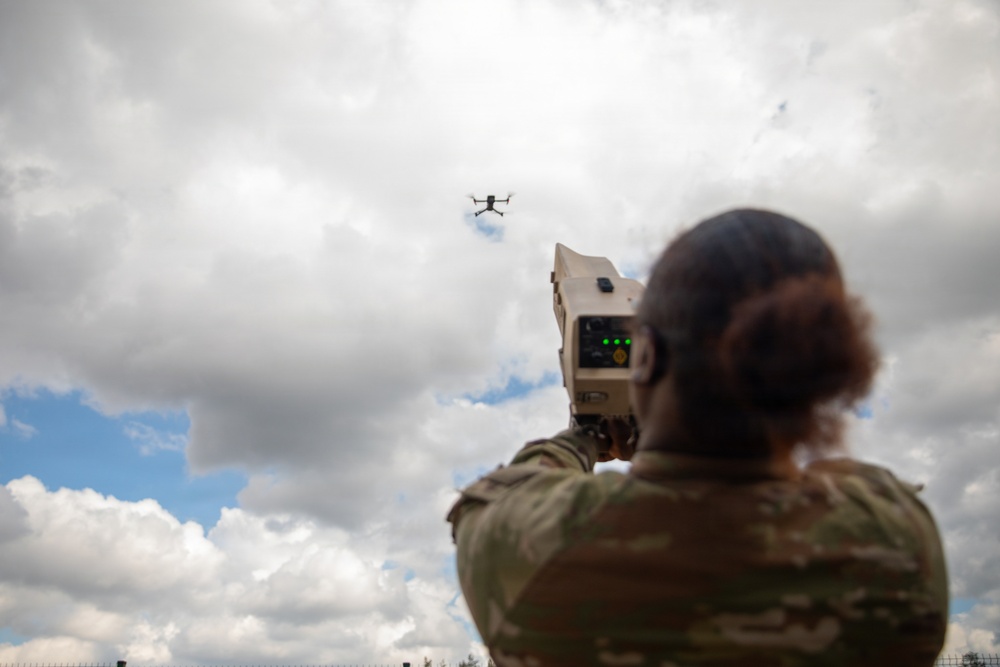
The recurring nightmare for airport and critical-infrastructure operators is no longer hypothetical. A drone appears over a runway approach or a power substation, and the people charged with protecting that airspace discover, in real time, that they can neither reliably see the threat nor lawfully do anything about it. A new global survey from counter-drone company DroneShield puts numbers to both halves of that failure — and the numbers are not reassuring.
The report, titled Airspace Under Pressure and released on Monday, June 29, 2026, draws on responses from 23 airport and critical-infrastructure operators spread across five regions: North America, Europe, Africa, Asia-Pacific, and the Middle East. Its two headline findings are the ones that explain why a single small quadcopter can still ground flights or trigger a security scramble at a major facility. Seventy percent of the operators surveyed cited gaps in their ability to detect drones. Sixty percent said they lack the legal authority to take direct mitigation action against an unauthorized drone — even one operating near runways and approach corridors.
Those two figures describe a system that is, in effect, blind in one eye and handcuffed in both arms. Detection is the precondition for everything else; you cannot respond to what you cannot see. But the survey suggests that even when an operator does spot an intruding aircraft, a majority would still have no lawful means to bring it down or force it away.
Two gaps, not one
It is tempting to treat counter-UAS readiness as a single technology problem — buy a better sensor, install a jammer, close the case. The DroneShield data argues against that framing by separating the challenge into distinct layers, each with its own failure rate.
Detection capability led the list of cited gaps at 70 percent. Below that, 48 percent of operators pointed to integration complexity — the difficulty of getting radar, radio-frequency sensors, cameras, and command systems to work together as a coherent whole rather than a pile of disconnected boxes. Thirty-five percent flagged training and preparedness shortfalls, the human side of the equation that determines whether an alert actually produces a competent response.
And then there is the legal layer, sitting apart from the technical ones. The 60 percent of operators without authority to act are not necessarily under-equipped; in many jurisdictions, the act of jamming, spoofing, or physically interdicting a drone is itself restricted or outright illegal for civilian and even some governmental operators. That is a policy gap, not a procurement gap, and no amount of new hardware closes it.
Most operators are still stuck at 'awareness'
The survey's planning data is arguably more damning than its capability data, because it speaks to intent and maturity rather than budget. According to the findings, 17 percent of operators have no formal counter-UAS plan at all. Another 13 percent describe their objectives as awareness-only, and a further 13 percent frame their goals around detection alone. Taken together, a striking 57 percent of operators describe their counter-drone objectives in terms of awareness, detection, tracking, and response — language that, on its face, stops well short of decisive mitigation.
That distribution maps neatly onto the central argument made by the report's authors. DroneShield's director of public safety, Tom Adams, framed the core challenge not as a lack of sensors but as the difficulty of converting awareness into effective action — and he explicitly called for regulatory reform to close the gap between what operators can detect and what they are permitted to do. In other words, the industry has spent years getting better at the first half of the problem while the second half remains legally frozen in place.
What the survey doesn't fix, the battlefield illustrates
The readiness gaps the DroneShield report quantifies in spreadsheet form are being stress-tested in the open elsewhere in Europe. At NATO's new uncrewed-systems test range in Latvia, hands-on reporting by C4ISRNET captured European startups demonstrating autonomous and jet-powered interceptors against drone targets — including JetDrones, which is developing systems aimed at intercepting Shahed-type drones at altitudes of four to eight kilometers. The Latvia range is, in effect, a live laboratory for the mitigation half of the equation: the hits and misses there are concrete evidence of just how immature reliable detection-and-defeat remains, even as the threat accelerates.
The contrast is instructive. The military and quasi-military world is racing to field kinetic and electronic answers to drones, complete with test ranges and competitive fly-offs. The civilian operators DroneShield surveyed are, by the report's own numbers, largely still trying to reliably detect the threat in the first place — and most of them couldn't legally fire back even if they had the means.
The airport problem, specifically
For the aviation sector, the survey's two top-line figures land with particular force. Coverage of the report emphasized airport exposure directly: 70 percent of operators face detection limitations, and 60 percent have no legal authority to act against unauthorized drones operating near runways and approaches. Those are precisely the conditions that have produced high-profile airport disruptions — the scenario in which a drone sighting forces a precautionary shutdown not because the threat has been neutralized, but because no one is confident it can be.
An airport is an unforgiving environment for this particular pair of gaps. The approach and departure corridors are exactly where a drone is most dangerous to crewed aircraft, and exactly where an operator most needs both certainty of detection and a lawful, proportionate response. The DroneShield data suggests that at most surveyed facilities, at least one of those two requirements is missing.
Why It Matters
The value of Airspace Under Pressure is that it converts a vague, widely shared anxiety into measured failure rates. For years, the counter-UAS conversation has cycled through the same explainer-level abstractions: drones are a growing threat, detection is hard, the law hasn't caught up. This survey replaces those generalities with figures — 70 percent, 60 percent, 17 percent with no plan at all — drawn from operators on five continents.
Those numbers matter because they point to a mismatch in where effort is going. The detection gap is a technology-and-integration problem that money and engineering can, in principle, solve; the 48 percent integration-complexity figure and the 35 percent training figure show that even the technical side is unfinished work. But the 60 percent legal-authority gap is different in kind. It cannot be procured away. As DroneShield's Tom Adams argues, the binding constraint for a majority of operators is not awareness but the authority to act on it — which makes regulatory reform, not just better sensors, the load-bearing variable. Until that changes, operators will keep finding themselves in the worst version of the Gatwick scenario: able to see a drone, perhaps, but powerless to stop it, and left with no option but to shut the airspace and wait.
Sources
- DroneShield survey reveals gaps in critical infrastructure C-UAS security — Unmanned Airspace
- New DroneShield report finds gaps in counter-drone readiness at airports, critical infrastructure — UAS Magazine
- Report Details Counter-UAS Readiness Gaps — AVweb
- At a NATO range in Latvia, hits and misses mark Europe's counter-drone journey — C4ISRNET
