
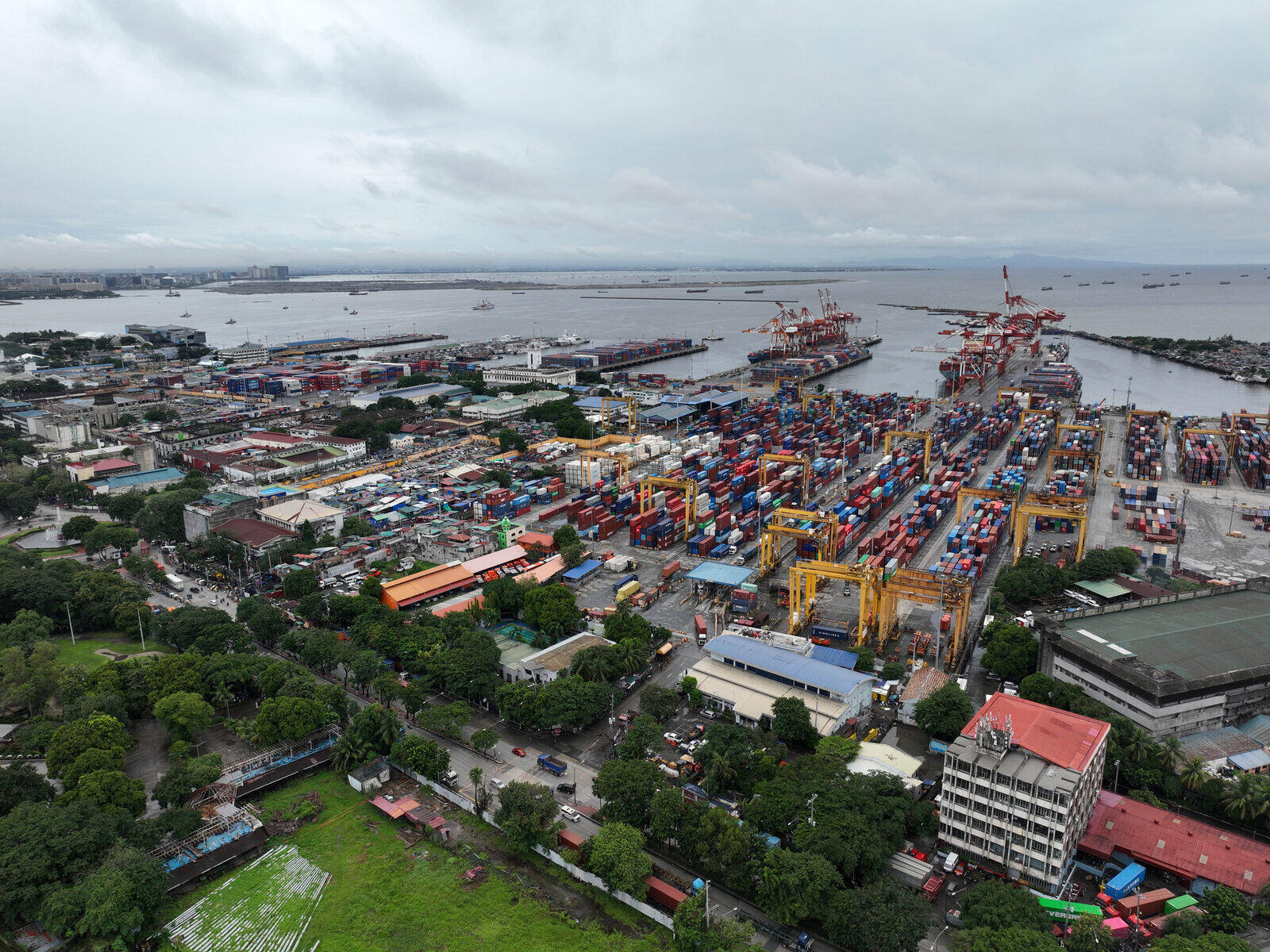
Merchant shipping moves more than 80 percent of world trade, yet the physical infrastructure of that fleet — hull plating, ballast tanks, exhaust stacks — has historically been inspected through methods unchanged since the steam age: rope access teams suspended over open water, scaffolding erected inside confined tanks, and diesel launches dispatched just to sample fuel. The scale of the blind spots matches the scale of the industry. Drones are closing them, and the operational record now spans several regulatory cycles.
Traffic Radar for Sulphur
The European Maritime Safety Agency’s Remotely Piloted Aircraft System program is the most operationally mature example. Since 2018, EMSA has run sniffer drone campaigns in Danish waters, the English Channel, the Strait of Gibraltar, and the Mediterranean, building a multi-year dataset of vessel emissions across some of the world’s busiest shipping lanes.
The aircraft — principally the Schiebel Camcopter S-100 VTOL unmanned helicopter, rated for six-plus hours of endurance and a 100-plus kilometer range, alongside the ATLAS 4 quadcopter manufactured by ALTUS LSA — carry dual sniffer sensor systems that derive sulphur content from a ship’s exhaust plume in real time. The operational model resembles traffic enforcement: the drone transects the plume, the sensor makes a measurement, and the result encodes automatically into the THETIS-EU port state control database. A possible violation doesn’t generate a fine at sea — it flags the vessel for targeted laboratory fuel sampling at its next port of call.
MARPOL Annex VI imposes a 0.50 percent by mass global sulphur cap. EMSA’s 2021 Gibraltar campaign — two daily flights from Tarifa base, averaging ten vessel inspections per day — measured 294 ships over roughly four months and flagged 27 as possible violators, a 9.2 percent non-compliance rate. The 2022 English Channel deployment, operating from MRCC Cap Gris-Nez in Pas-de-Calais, accumulated 430-plus flight hours and formally measured 375 merchant ships from over 600 observed. EMSA deployed the ATLAS 4 at Marseille and Fos the same year to cover Mediterranean traffic simultaneously under EU Directive 2016/802 and MARPOL Annex VI.
From Rope Access to Digital Twins
Hull and tank inspection poses a different problem: access to dark, confined, structurally complex spaces where scaffolding erection alone can consume days and expose workers to fall and oxygen-depletion risk. DNV has run drone survey programs since June 2016, conducting 25-plus production surveys covering tankers, bulk carriers, semi-submersibles, jack-up vessels, and tender support vessels, using four aircraft types including the Flyability Elios for confined-space work.
DNV’s first offshore drone survey, in July 2017 aboard the Prosafe semi-sub Safe Scandinavia, inspected fairleads and structural connections 25 meters below the main deck in 15-knot wind. The time savings against conventional scaffolding were immediate.
“The drone survey took only a few hours and was just as effective” compared to operations that would normally cause “disruption of several days.” — Ian Young, Prosafe Chief Operating Officer
DNV’s REDHUS project pairs LiDAR-enabled drones with AI for autonomous inspection of cargo tanks, ballast tanks, and confined spaces, with partners including Altera Infrastructure, Klaveness, Scout Drone Inspection, and NTNU, part-funded by the Research Council of Norway. ScoutDI’s Scout 137 — a tethered drone with unlimited flight time, hand-launched through a single access opening, BVLOS-capable, and designed to generate 3D digital twin models of inspected spaces — completed the world’s first robotic FPSO cargo tank inspection with ABS class sign-off on Shell’s Turritella FPSO in 2024, then performed an autonomous inspection aboard a Klaveness Combination Carrier transiting between New York and the Bahamas. Dry-dock is no longer a prerequisite for classification-accepted inspection. ScoutDI had raised NOK 31.8 million by November 2024 and operates in more than 20 countries.
Port Gates and Floating Warehouses
Ship-to-shore logistics has long required a launch vessel — a fuel-intensive, weather-dependent operation. Wilhelmsen Ships Services estimated drone delivery at approximately $150 per run versus approximately $1,500 for a traditional launch, a cost ratio that scales sharply across thousands of annual port calls.
Skyports’ BlueWater 2 program, backed by Innovate UK’s CMDC fund and the UK SHORE programme, is running three parallel demonstrations at Portsmouth and Cornwall. From November 2025, a DJI M350 RTK with an Aeromon BH-12 sensor began measuring SOx, NOx, and CO2 from ship exhaust plumes in real time at Portsmouth. From December 2025, a DJI M3DT launched from a Dock 2 drone-in-a-box began automated BVLOS port surveillance from Skyports’ remote operations center in Buckinghamshire, replacing fossil-fuel patrol vehicles. January 2026 brought ship-to-vessel delivery tests at Predannack Airfield in Cornwall and a Quantum Systems Vector with satcom-enabled BVLOS over the Straits of Dover from Lydd Airfield with the Maritime and Coastguard Agency. “The shipping sector needs to decarbonise and embrace smarter solutions like drones and artificial intelligence,” said Alex Brown, CEO of Skyports Drone Services. Dronamics became Europe’s first fully licensed cargo drone airline in 2023; its Black Swan carries 350 kg over 2,500 km.
Offshore: Blades, Bearings, and the End of the Crew Boat
Vattenfall’s DanTysk and Sandbank offshore wind farms in the German North Sea represent one of the more detailed public deployments of integrated UAV operations. AI-equipped aerial drones conduct turbine blade inspections; cargo UAVs deliver spare parts directly to platforms. “AI-equipped drones have the potential to free up valuable offshore working time,” said Tomas Jansen of Vattenfall. “The innovation we showcased included using UAVs for rapid deliveries and pre-loading spare parts and tools to the turbine’s nacelle,” said Roddy Douglas. The aircraft operate in winds up to 38 km/h and waves up to 1.5 meters.
Vattenfall’s 12-meter uncrewed vessel Blue Essence, equipped with an eROV, performs seabed mapping and cable and foundation inspection at Hollandse Kust Zuid in the Dutch North Sea; uncrewed survey vessels of this type emit approximately 95 percent less CO2 than crewed equivalents. Cyberhawk’s drones extend the inspection model to industrial assets, delivering ultrasonic thickness measurement at sub-millimeter precision on tanks, pipelines, and pressure vessels, with AI-enhanced defect analysis via the iHawk cloud platform. For search and rescue, the VIDAR autonomous detection system has located objects as small as jet skis at five nautical miles; in one documented Australian case, a drone dropped a flotation device to two boys in heavy surf within two minutes of detection.
The ABS class sign-off on Shell’s Turritella FPSO in 2024 is as consequential as any operational milestone above. Classification society acceptance closes the regulatory loop that operators have been waiting on. When surveyors treat drone-generated data as a valid basis for class renewal, the economics shift for the entire fleet — not just early adopters.
Sources
- EMSA — Sniffer drone monitoring sulphur and nitrogen emissions from ships in the English Channel (2022)
- EMSA — RPAS drones continue monitoring ship emissions in Danish waters (2020)
- EMSA — RPAS assisting Spanish authorities monitoring sulphur emissions at the Strait of Gibraltar (2021)
- EMSA — Sniffer drone supports French authorities monitoring Mediterranean ship emissions (2022)
- DNV — Supporting ScoutDI’s journey towards safer autonomous inspections (2024)
- DNV Maritime Impact — The drone squad for ship surveys
- DNV Research Review 2023 — Remote drone-based ship hull survey (REDHUS)
- DroneLife — Skyports launches BlueWater 2 maritime drone demonstrator (November 2025)
- Commercial UAV News — 4 ways drones serve maritime and offshore operations
- Cyberhawk — Oil, gas, and marine drone inspection services
- ASME — Drones deliver in the maritime environment
- U.S. Coast Guard — Unmanned Systems Help Coast Guard Members Navigate the Future
