
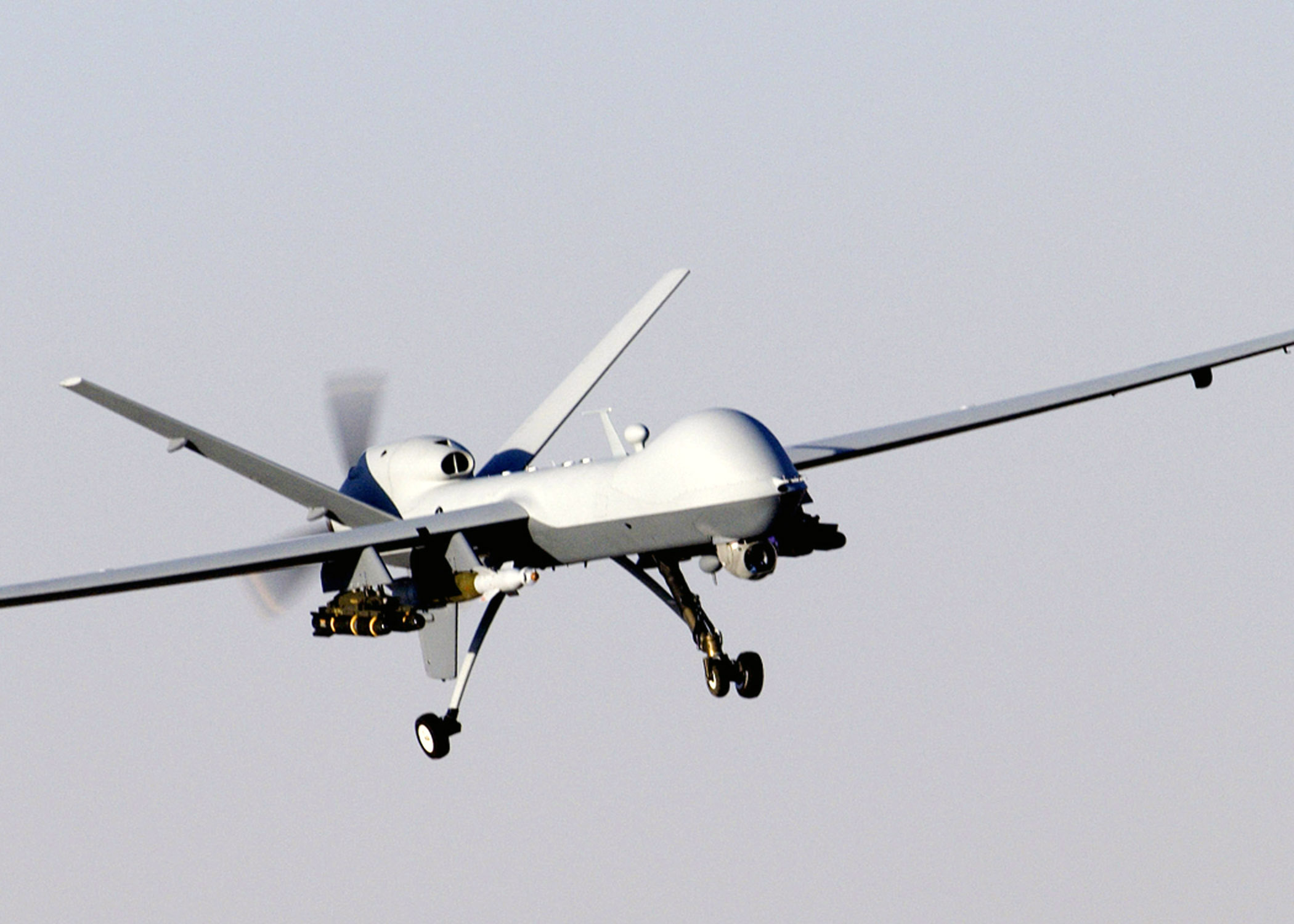
Every drone export from American hands passes through one of two overlapping federal frameworks. The International Traffic in Arms Regulations (ITAR), administered by the State Department’s Directorate of Defense Trade Controls, govern items on the United States Munitions List (USML): drones specifically designed for military or intelligence purposes — armed reconnaissance platforms, signals-collection aircraft built to military specification. Licenses are required for virtually every foreign transfer, and “deemed export” rules extend controls to sharing technical data with foreign nationals on US soil.
The Export Administration Regulations (EAR), run by Commerce’s Bureau of Industry and Security (BIS), cover dual-use items with legitimate civilian applications but proliferation risk. Commercially available quadcopters, mid-tier fixed-wing surveillance UAS, agricultural mapping platforms — these sit here. EAR licensing is more flexible: a case-by-case review weighing destination, end-use, and end-user rather than presuming denial.
The dividing line is design intent. Purpose-built military platforms land on the USML; civilian-market systems with dual-use potential fall under EAR. In practice the line blurs, and for large long-endurance platforms its precise location was a decade-long policy controversy with market-reshaping consequences.
The Missile Regime That Captured UAS
Layered on top of both frameworks is the Missile Technology Control Regime (MTCR), a 1987 political arrangement among 35 nations designed to limit the spread of nuclear-capable ballistic and cruise missiles. Its definitions proved broad enough to capture unmanned aircraft the moment they became militarily significant.
The MTCR divides controlled items into two tiers. Category I covers systems capable of delivering a payload of at least 500 kilograms to a range of at least 300 kilometers. Exports face a “strong presumption of denial” amounting in practice to near-automatic refusal except for the closest treaty allies under government-to-government arrangements. Category II captures everything below those thresholds: case-by-case review, evaluated on the merits.
Under ITAR’s USML (Category VIII) and the US application of MTCR rules, “range” has a precise legal meaning: maximum distance in one direction in stable flight, at full fuel, zero wind, optimal flight profile — not round-trip operational radius. A drone with a 400-km one-way range clears the 300-km threshold regardless of practical combat radius. The definition was engineered for WMD delivery, not ISR platforms with human operators and return missions.
Applied to 2010s-era armed reconnaissance drones — systems designed with sophisticated data links, human operators, and precision munitions for counterterrorism — the WMD-proxy framework created a category mismatch. The presumption-of-denial wall was imposed only on the United States, not on China, Turkey, or Israel.
How China and Turkey Filled the Gap
From the mid-2000s through 2020, the MQ-9 Reaper and RQ-4 Global Hawk — exceeding both 500 kg payload and 300 km range — and the MQ-1 Predator, controlled under ITAR for its range regardless of payload — were effectively off-limits for most buyers. Before 2020, only Australia, France, and the United Kingdom had been authorized to purchase large US drones. Jordan faced repeated rejections. Saudi Arabia, the UAE, Egypt, and Iraq — partners in counterterrorism operations the US depended on — were turned away.
The demand migrated.
China, not an MTCR member, faced none of the presumption-of-denial calculus. The Wing Loong series and the Caihong CH-4 and CH-5 platforms reached Saudi Arabia, the UAE, Egypt, Pakistan, Iraq, Algeria, and multiple African nations; both types saw combat deployment in Yemen and Libya. Saudi Arabia went further: unable to buy US drones, it established a joint venture with Chinese firms to manufacture military drones domestically, embedding Chinese technology and supply chains inside a key Gulf partner.
Turkey, an MTCR member, found a different path. Baykar’s Bayraktar TB2 never triggered the 500 kg/300 km wall. Israel managed its own export growth through MTCR compliance and close bilateral relationships, keeping flagship export platforms below Category I thresholds.
“China, Turkey and others have had no such scruples, which has let them fill the gap and expand their defense sales and influence across the Middle East, Africa and beyond.” — Elizabeth Dent and Grant Rumley, Washington Institute for Near East Policy
Defense industry advocates put it in commercial terms: “without changes to the existing U.S. policy for drone exports, the United States will fall behind in the fast-growing, multibillion-dollar global drone market.”
Reform in Two Acts: 2020 and 2025
On July 24, 2020, the Trump administration announced a unilateral reinterpretation of US MTCR implementation. The mechanism: UAS with a maximum true airspeed below 800 km/hr — even if they otherwise crossed the 500 kg/300 km Category I thresholds — would receive Category II case-by-case review. The targets were explicit: the Predator (~400 kph), Reaper (~400 kph), and Global Hawk (~575 kph) all flew well under the speed ceiling and were newly eligible for export consideration.
R. Clarke Cooper, Assistant Secretary of State for Political-Military Affairs, stated: “We think this kind of reform is necessary in order to respond to a rapidly changing technological environment.” Critics disagreed sharply. Rachel Stohl of the Stimson Center argued the decision “undermines a global regime, allows others to ignore international restraints, and focuses on economic benefits over U.S. national security, foreign policy and human rights concerns.” Senator Bob Menendez called it “This reckless decision once again makes it more likely that we will export some of our most deadly weaponry to human rights abusers across the world.”
The formal implementing rule — BIS amending EAR § 742.5(b)(1) — arrived January 12, 2021. It explicitly stated it “does not change UAS export licensing requirements under the EAR or the International Traffic in Arms Regulations”; the ITAR/EAR jurisdictional split remained intact, only the review standard within EAR changed. Case-by-case still imposed real scrutiny on national security, human rights, and diversion risk. The Biden administration retained the policy rather than reversing it.
The speed carve-out addressed the Predator generation but left the broader category mismatch in place. On September 15, 2025, the second Trump administration went further: the State Department announced that advanced UAS would be reviewed “similarly to how it reviews requests to export crewed fighter aircraft” rather than as missile systems. Officials cited intent to make America “the premier drone provider instead of ceding that space to Turkey and China.” One immediate consequence was the potential unlocking of over 100 MQ-9 sales to Saudi Arabia as part of a $142 billion arms package announced that May.
The MTCR was not amended — consensus among all 35 members was never sought — but the US exercised the national implementation discretion the regime permits. Whether American manufacturers can recapture market share lost during the lockout years, against competitors with entrenched relationships and domestic supply chains in key buyer nations, is the question that export-policy reform alone cannot answer.
Sources
- Arms Control Association — “U.S. Reinterprets MTCR Rules” (September 2020)
- Arms Control Association — “U.S. Aims to Expand Drone Sales” (July/August 2020)
- Federal Register / BIS — “Change to the License Review Policy for Unmanned Aerial Systems” (January 12, 2021)
- Baker McKenzie — Commerce Department Amends EAR to Implement Revised UAS Licensing Review Policy (2021)
- Breaking Defense — “US Loosens Export Rules For Military Drones” (July 2020)
- Wiggin and Dana LLP — “UAVs and ITAR: Why Range Matters”
- Washington Institute for Near East Policy — “How Washington’s Drone Policy Is Catching Up to Reality”
- Government Contracts Navigator — “U.S. Department of State Eases Military Drone Export Review Policy” (September 24, 2025)
- Arms Control Association — “U.S. Reinterprets MTCR Rules to Fast-Track Drone Sales” (October 2025)
- Army Recognition — “Analysis: US Drone Policy Reform Confronts Chinese UAV Influence and Reinforces Allied Defense” (2025)
