
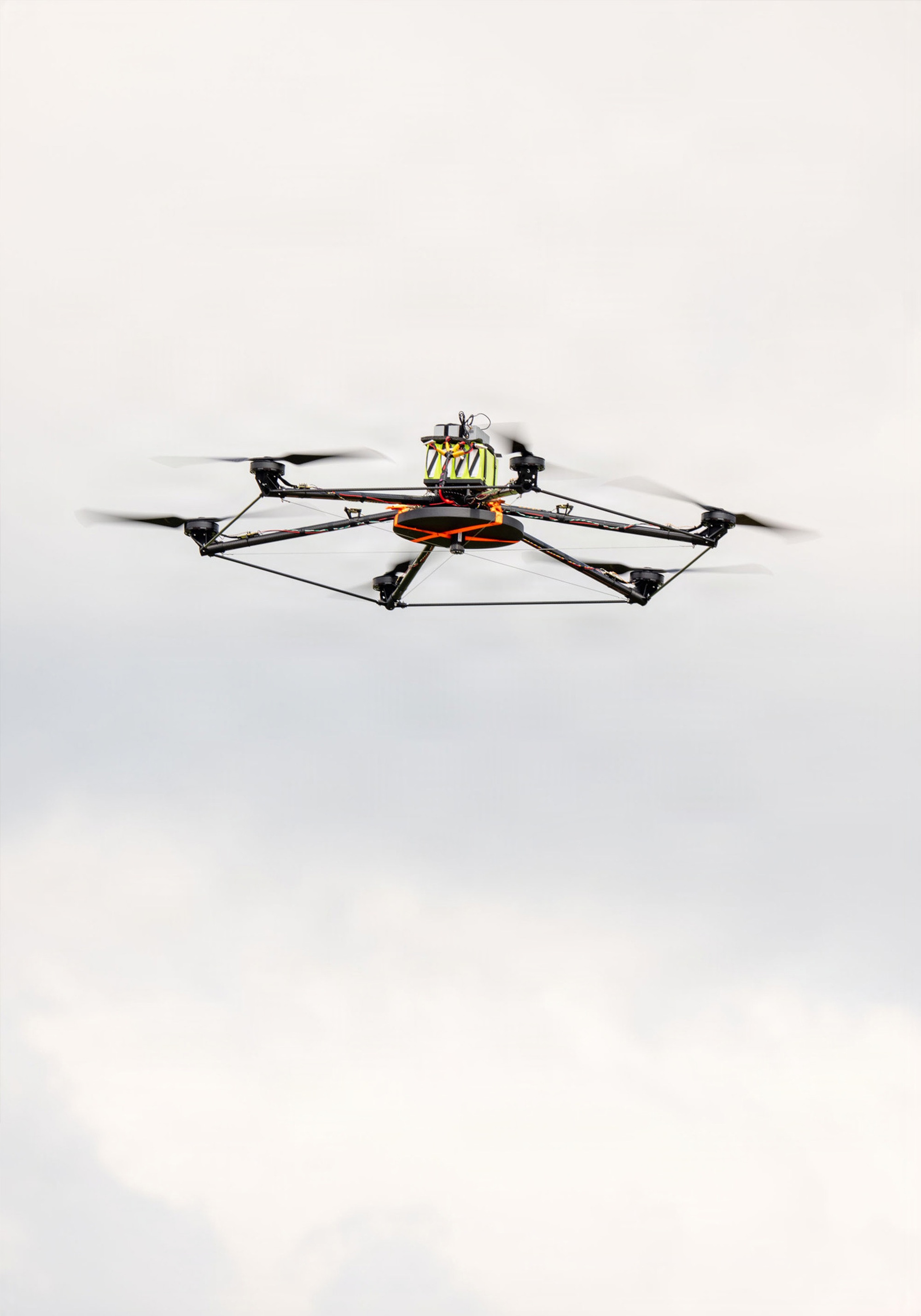
Six weeks after a small electric helicopter from a Maryland startup hauled nearly four times its own weight across a stage at the National Museum of the US Air Force, DARPA has told the heavy-lift drone community: do it again, but farther, heavier, and with two more years to figure it out.
The Defense Advanced Research Projects Agency has confirmed a second running of its Lift Challenge, designated DLC-2, for summer 2028. The program page for the competition now carries a line that wasn't there before the first event wrapped: "Second Competition Coming Summer 2028." Underneath it sits a new set of numbers that roughly double the physical demands of the original contest while leaving its most distinctive constraint untouched.
What Changes, What Doesn't
The core trade-off of the Lift Challenge — squeeze maximum payload out of a tightly weight-capped aircraft — carries over intact. Aircraft in DLC-2 must still weigh 55 lbs or less, the same ceiling that governed the first competition. That's the number that made DLC-1 hard: teams weren't just building heavy-lift drones, they were building heavy-lift drones that had to stay light enough to qualify as small unmanned aircraft.
Everything layered on top of that constraint gets tougher. The minimum payload requirement doubles, from 110 lbs in DLC-1 to 220 lbs in DLC-2. The course doubles too, growing from the 5-nautical-mile circuit DLC-1 required to 10 nautical miles total in DLC-2, split into eight loaded legs and two unloaded legs. And DARPA is giving teams more room to solve the problem: prep time stretches from whatever runway DLC-1 competitors had to a full two years before the 2028 event.
One more detail matters for who shows up at the starting line: DARPA has made clear that participation in DLC-1 is not required to enter DLC-2. The rematch is open to newcomers, not just a victory lap for the first cohort.
How DLC-1 Set the Bar
The first Lift Challenge ended August 9, 2026, at the National Museum of the US Air Force, with a $6.5 million prize pool on the table and a stated target ratio of 4:1 payload-to-weight — meaning DARPA wanted to see an aircraft lift four pounds of cargo for every pound the airframe itself weighed. According to DARPA's own results announcement, dated August 11, 2026, the winning performance came from AVIDrone Inc., a company based in Columbia, Maryland, whose electric helicopter achieved a 3.84:1 payload-to-weight ratio at the finale — just short of the 4:1 stretch goal, but close enough to prove the target was within reach of real hardware rather than purely theoretical.
DARPA Lift Challenge program manager Phillip "Donna" Smith spoke to the rationale behind the 4:1 target in the agency's results writeup, framing it as the kind of efficiency benchmark that separates a demonstration drone from something that could plausibly carry meaningful payload for military or commercial use in the field.
Reading the New Numbers
Doubling the payload floor while holding the airframe weight cap flat is the part of DLC-2 worth sitting with. In DLC-1, a 55-lb aircraft carrying 110 lbs was already operating at roughly a 2:1 ratio just to clear the entry bar, with the 4:1 stretch goal sitting well above that floor. AVIDrone's 3.84:1 finish implies an aircraft in the neighborhood of 55 lbs carrying somewhere around 210 lbs of payload — which is, not coincidentally, extremely close to the new 220-lb minimum DARPA has now set as the baseline requirement for DLC-2, not the stretch target.
In other words, DARPA appears to be taking the best result from DLC-1 and making it the new floor. What counted as a near-record performance in 2026 becomes the minimum qualifying threshold in 2028. That's a substantial ask: teams aren't being asked to improve on 4:1, they're being asked to treat something close to the best-ever DLC-1 result as table stakes, then build a program around clearing it reliably enough to fly a real course.
The course change compounds the difficulty. Extending the route to 10 nautical miles, with eight loaded legs against only two unloaded ones, shifts the challenge away from a single peak-performance run and toward sustained efficiency across a mission profile that more closely resembles actual cargo logistics — load, fly, unload, repeat, most of it while carrying weight. An aircraft optimized to hit a high payload ratio once, for a short hop, is a different engineering problem than one that has to do it eight times over without a mid-course teardown.
That's likely why DARPA doubled the prep timeline as well. Two years gives teams room to iterate past a single-flight demonstrator and toward something closer to a repeatable platform — swappable battery packs, faster turnaround between loaded legs, structural fatigue margins that a one-shot record attempt doesn't have to worry about.
Independent reporting backs up the specifics DARPA posted to its own program page. Electronic Design's Andy Turudic covered the DLC-2 announcement on September 1, 2026, confirming the same core numbers — the summer 2028 date, the 220-lb payload requirement, and the 10-nautical-mile course — through reporting separate from DARPA's own materials, corroborating rather than merely repeating the agency's language.
Why It Matters
Payload-to-weight ratio is a proxy for something the drone industry has struggled to crack outside of purpose-built cargo aircraft: how much useful work a small, portable, relatively cheap airframe can actually do. A 55-lb weight cap keeps DLC aircraft in a category that's realistic to transport, deploy, and operate without the infrastructure a full-size cargo helicopter needs — closer to something a small team could carry in a truck bed than to a program-of-record aircraft. Getting that category of drone to reliably carry 220 lbs over a multi-leg, 10-nautical-mile course would represent a genuine jump in what small electric aircraft can contribute to logistics, resupply, and disaster response, both for the military sponsor funding the prize money and for the commercial heavy-lift drone sector watching from the sidelines.
It also signals how DARPA is running this particular competition. Rather than declaring victory after one dramatic finale and a stretch goal narrowly missed, the agency is converting last year's best result into next cycle's floor, and explicitly opening the field to teams who sat out the first round. That structure — result becomes requirement, timeline expands, door stays open — is as much a statement about where DARPA thinks heavy-lift electric aircraft are headed as the payload numbers themselves. AVIDrone proved 3.84:1 was achievable once, at one museum, on one August afternoon. DLC-2 is DARPA's bet that within two years, a field of competitors can make numbers in that range routine.
