
On the night of December 19, 2018, a drone or drones appeared over Gatwick Airport in southern England and stayed there. Over the following 36 hours, roughly 1,000 flights were canceled or diverted, stranding 140,000 passengers. No one fired a shot. No jammers silenced the intruder. Authorities simply could not find a tool appropriate to the environment — and the gap between detection capability and safe neutralization capability was exposed for the world to see.
That gap has since driven a surge in counter-UAS investment. As of 2019, the U.S. alone had 160 companies developing approximately 300 counterdrone products. But the product proliferation masks a harder problem: most neutralization methods acceptable in a combat zone are flatly incompatible with civilian airspace, crowded stadiums, or urban corridors.
Why the Standard Toolkit Fails in Civil Environments
The FAA classifies drones of all sizes as "aircraft," which means that for most actors, shooting one down, jamming it, or physically intercepting it constitutes a federal crime regardless of the drone's intent. Only four U.S. federal agencies — the Departments of Defense, Homeland Security, Justice, and Energy — are authorized to deploy kinetic counter-drone measures, including nets, projectiles, and lasers. State and local law enforcement, private security firms, and airport operators are excluded from the mitigation tier entirely, even when they have robust detection capability.
That legal constraint coincides with a technical one. Each of the major neutralization categories carries collateral problems that limit its urban utility. RF jamming is comparatively cheap and can force a drone to return to its launch point, but it creates broadband interference that disrupts authorized aviation communications, emergency frequencies, and nearby commercial drones. As autonomous drones increasingly navigate on pre-loaded mapping software without any active RF link, jamming becomes progressively less effective against the most sophisticated threats — and may send a compromised drone toward its target rather than away from it.
Directed-energy systems — lasers and high-power microwave emitters — offer rapid re-engagement and effectiveness against a wide array of airframes, but they destroy the drone and its potential intelligence value completely. Falling fragments from a laser kill in a populated area create their own hazard. High-power microwave systems operate indiscriminately, potentially rendering nearby civilian electronics inoperative. GPS spoofing, which redirects a drone by falsifying its navigation inputs, simultaneously disrupts every other navigation device in the affected area.
Net capture and RF cyber-takeover are the two methods consistently rated most suitable for urban and civil aviation environments — precisely because they remove the drone from the sky without generating uncontrolled debris or interference fields.
How Physical Capture Systems Work
Physical capture divides into two broad platform families: ground-launched net projectors and interceptor drones that carry net guns aloft.
OpenWorks Engineering, based in Prudhoe, Northumberland, UK, produces the SkyWall line of compressed-air launchers. The SkyWall Patrol is a shoulder-fired unit with an onboard SmartScope targeting system; the operator tracks the target, the scope confirms a fire solution, and the launcher projects a canister that splits near the drone and deploys a net to entangle the rotors. The SP40 projectile variant includes a parachute that controls the captured drone's descent, keeping the airframe intact for forensic analysis. If the initial capture misses, the projectile still deploys its tethered components in a controlled manner to prevent debris hazards — a design constraint that reflects how seriously the system takes the populated-environment use case.
SkyWall Patrol protected President Biden at a NATO summit, deployed alongside the Dronegun Tactical from DroneShield as part of a "layered defence" approach. The larger SkyWall 300 is a turret-mounted, automatically tracking variant that requires only a remote operator authorization to fire.
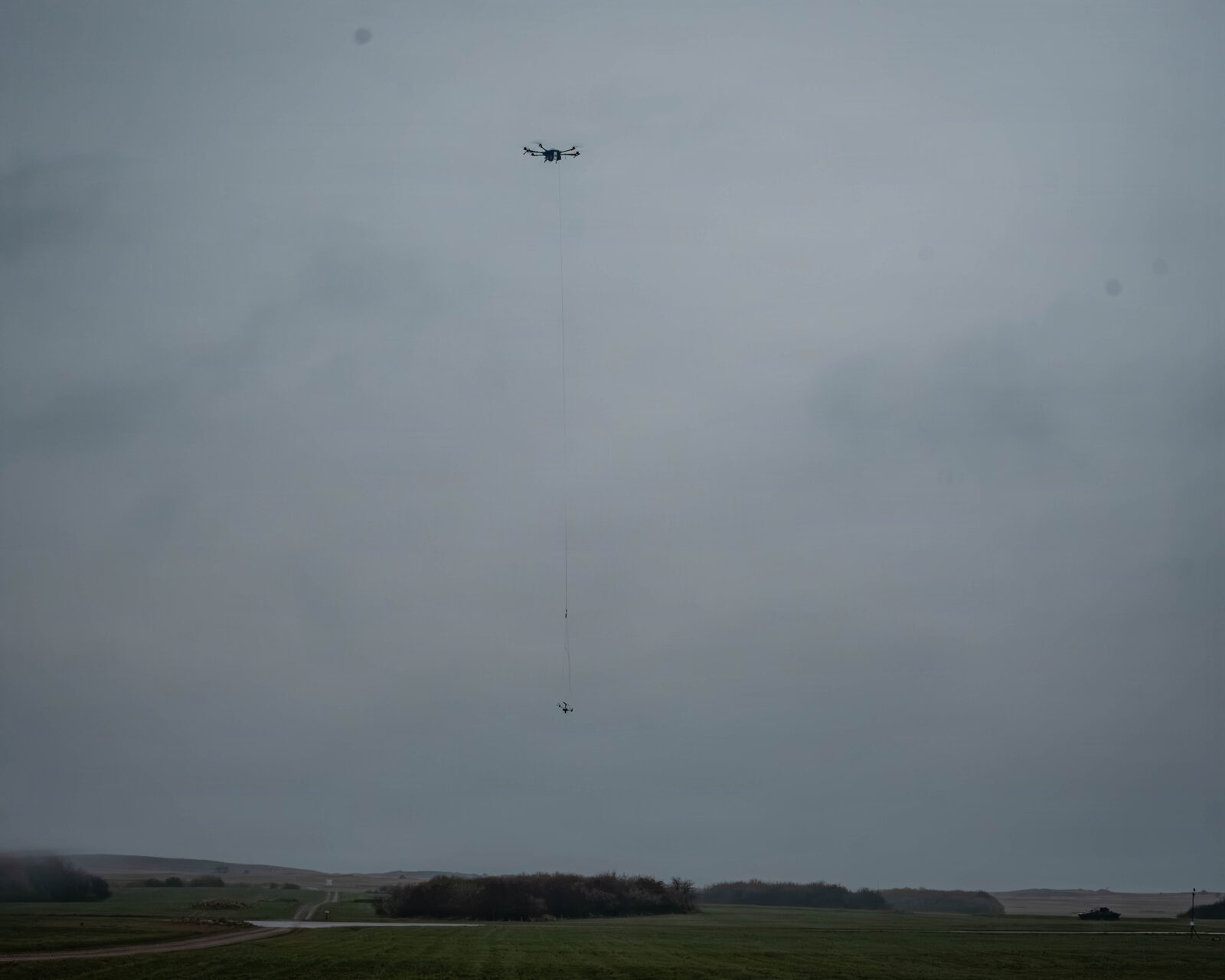
The interceptor drone approach sends a purpose-built UAS to intercept the threat in the air. Delft Dynamics' DroneCatcher, initiated in 2014 at the request of Dutch police and military authorities, exemplifies the concept. The platform measures 750 mm diagonal, weighs under 6 kg, reaches speeds up to 20 m/s, and carries a pneumatic net gun with a firing range of up to 10 meters. After a successful capture, DroneCatcher either carries the intercepted drone via tow cable to a safe landing zone or, if the captured platform is too heavy to carry, acts as a controlled parachute for a slow, predictable descent. Government backers include the Royal Netherlands Marechaussee, the Dutch National Police, and the Ministry of Safety and Justice.
The newest DroneCatcher version introduces a releasable tether design that lets the interceptor remain airborne on standby before instantly deploying when a threat is detected.
"As far as we know, we are the first in the world to show this releasable tethered drone concept and especially for countering drones, fast deployment is of utmost importance." — Arnout de Jong, CEO, Delft Dynamics
Other interceptor platforms in the market include the AeroGuard octocopter from SCI Technology of Alabama and the Skysec Sentinel family from Switzerland, which uses a four-winged seeker-equipped airframe that can either deploy a parachute on the captured drone or carry it to a landing zone.
Fortem DroneHunter: From Ukraine to the FIFA World Cup
The most operationally deployed interceptor drone system is Fortem Technologies' DroneHunter, a Utah-built VTOL hexacopter roughly four times the size of a DJI Phantom. The platform carries a TrueView R20 AESA radar — approximately pencil-box sized — and operates in conjunction with a ground-based R30 radar, laptop-sized; an upgraded detection panel achieves ranges beyond 4 kilometers against Phantom-class drones. Both radars use active electronically scanned array phased-array technology optimized for low size, weight, and power, with radiation levels the company compares to sitting in front of a campfire.
DroneHunter operates in two net-engagement modes: an attack mode deploying a smaller net against Group 1 and low-end Group 2 drones, and a defense mode deploying a larger net against faster Group 2 and low-end Group 3 fixed-wing threats. The system has demonstrated capture of Russian Orlan-10 ISR platforms and Iranian Shahed-136 drones, which weigh approximately 200 kg. Between sorties, operators swap four net heads and a battery — the only consumables in an otherwise fully reusable system.
"...you put four new net heads on, throw a new battery in, and it's back up into a fight." — Jon Gruen, CEO, Fortem Technologies
Fortem deployed DroneHunter in Ukraine approximately 1.5 years before October 2023, initially for prototype testing and subsequently adapting it to operate in heavy electronic warfare environments — a real-world forcing function that no test range can replicate. The system reached Technology Readiness Level 9, full operational maturity, built over six years of iterative AI refinement.
The fifth-generation DroneHunter 5.0, with first deliveries beginning in January 2026, offers an optional four-gun configuration, doubling the net-gun count from the standard two-gun layout, enabling a 1:4 engagement ratio against swarm attacks with a development roadmap toward 1:10. Fortem's SkyDome C2 software can coordinate up to five DroneHunter interceptors simultaneously against five simultaneous threats. The system was selected by the Pentagon's counter-UAS task force for operational purchase under the Replicator-2 initiative.
The Department of Homeland Security has also selected Fortem as the sole kinetic counter-drone provider for the 2026 FIFA World Cup, a multi-million-dollar contract that positions TrueView R30 radars, SkyDome C2, and DroneHunter hexacopters across host cities as the tournament moves. Fortem previously provided the same coverage at the Qatar FIFA World Cup.
"...a net that mitigates collateral damage because there's no debris falling from the sky." — Jon Gruen, CEO, Fortem Technologies
The Authorization Gap and What It Means in Practice
For all the technical progress, deployment authority in the United States remains tightly constrained. DHS holds explicit statutory authority to "disrupt control of the drone," "seize or exercise control," and "use reasonable force to disable, damage or destroy" a UAS. But that authority does not extend to state or local agencies, airports operating outside a federal nexus, or private entities protecting critical infrastructure.
This bottleneck explains why most civilian drone threats — the incursions over refineries, stadiums, correctional facilities, and border regions that fall below the federal protective umbrella — go unmitigated in real time. Detection has outpaced authorization.
There are also genuine technical limits to address. As Arthur Holland Michel of Bard College noted in AIAA Aerospace America, "Radar can struggle to see small, low-flying drones. Electro-optical and infrared systems must have direct line of sight." Net-gun range on drone-based interceptors remains short — DroneCatcher fires at up to 10 meters — which means successful intercept requires flying a platform close enough for precision engagement in conditions where the threat may be maneuvering or GPS-denied. Interceptor drone endurance is bounded; DroneCatcher runs approximately 30 minutes.
The swarm problem is the hardest open question. A single interceptor drone with a two-gun configuration and a reload requirement cannot pace a coordinated multi-vehicle attack. DroneHunter 5.0's four-gun layout and SkyDome's five-versus-five coordination are explicit responses to this, but they represent the leading edge of what is currently fielded. As drone swarm doctrine matures — and evidence from Ukraine and commercial pilots alike suggests it is maturing quickly — the one-to-one intercept concept that underlies current capture systems will face increasing pressure.
The trajectory nevertheless favors capture systems for civilian contexts: increased interceptor autonomy reducing operator burden, longer-range projectile development, and expanding authority frameworks that several legislative proposals seek to extend to airports and local law enforcement. Until those authorizations arrive, physical capture remains the one mitigation technique that can operate without creating new hazards — which is precisely why the only C-UAS method present at a NATO summit, a FIFA World Cup, and active combat operations in Ukraine is a drone hunting another drone with a net.
Sources
- Breaking Defense — A Better C-UAS Option: Capture Enemy Drones in a Net
- Fortem Technologies — DroneHunter 5.0 Deliveries Begin, January 2026
- The Defense Post — Fortem Counter-Drone Shield, February 2026
- OpenWorks Engineering — SkyWall Patrol Product Page
- AIAA Aerospace America — Counterdrone Challenges
- Delft Dynamics / DroneCatcher — Product Page
- Electronic Specifier — Unleashing the DroneCatcher for Controlled Interception
- Royal Aeronautical Society — Defeating Drones
- D-Fend Solutions — C-UAS Mitigation Overview
- Heliguy — Best Counter-UAV Methods
- DroneLife — Federal Laws Restrict Counter-Drone Measures for Critical Infrastructure