
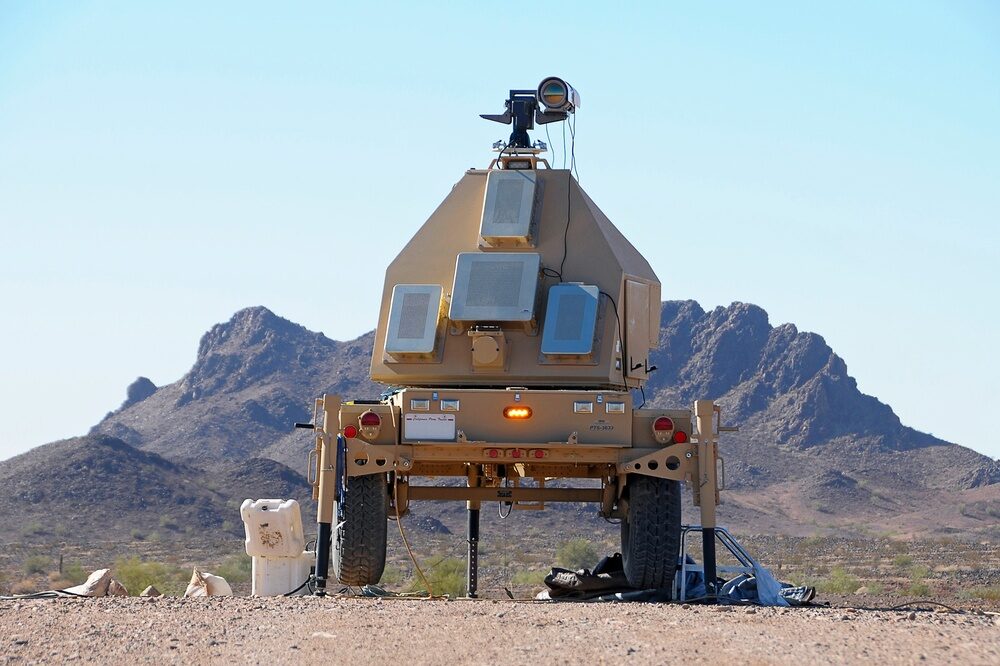
A validation stamp from JIATF-401 is not a product endorsement. It is a procurement key. When the Pentagon's consolidated counter-UAS task force declares a system validated for joint-force-wide use, it removes the single largest bureaucratic barrier between a C-UAS vendor and every U.S. military installation on the planet. CACI International received that key when JIATF-401 formally validated its SkyValor system at MCAS Yuma, Arizona, following a two-day live evaluation conducted alongside Joint Task Force-Southern Border and U.S. Customs and Border Protection. The practical consequence is direct: SkyValor's eligibility is no longer bounded by the 1,954 miles of southern border where it earned its operational record. It is now cleared for layered C-UAS deployment anywhere in the joint force.
What SkyValor Actually Brings to the Stack
SkyValor — — is a mobile, trailer-mounted system designed for 24/7 autonomous operation across the full UAS threat spectrum, Groups 1 through 5. Its sensor stack layers long-range RF detection, radar, and EO/IR, with the RF library holding more than 1,000 unique UAV radio and flight-computer signatures. The architecture is software-defined, enabling rapid signature database updates as adversaries introduce new platforms or modify existing ones — a practical necessity given how fast commercial-off-the-shelf drone proliferation has outpaced static threat libraries.
The claimed detection and tracking range exceeds 75 kilometers, a figure CACI's engineering team has framed specifically around closing the threat window before an engagement becomes unavoidable. As Michael Solberg, CACI's managing engineer on the program, put it: "Expanding that range is crucial because it closes the threat window and delivers heightened awareness for operators who now can neutralize an attack even before it's launched." That framing matters tactically — against a Group 1 FPV, 75 km is academic; against a Group 5 intelligence-collection platform orbiting at altitude, it is the difference between an early interdiction decision and a reactive scramble.
Defeat is entirely non-kinetic. SkyValor uses electronic warfare jamming driven by automated sense-and-shoot algorithms, plus capture nets effective to approximately four miles. CACI describes the combination as providing "low/no-collateral" defeat options — language that matters both for urban or near-civilian operating environments and for ROE constraints that increasingly govern how the military can respond to drone incursions over installations. The system also operates across multiple classification levels, which simplifies integration into both unclassified joint-base environments and more sensitive facilities.
"SkyValor is now validated for use as one component of a layered C-UAS defense across the entire Joint Force." — Lt. Col. Adam Scher, JIATF-401
Advertisement
The Border as Operational Proving Ground
The Yuma evaluation was not a sterile range test. Targets ranged from small first-person-view quadcopters to Group 5 platforms, flown at varying ranges, elevations, and flight paths — a profile that reflects the actual heterogeneous threat mix JIATF-401 and CBP face along the border, where cartel surveillance drones, commercial FPVs used for smuggling, and occasionally more sophisticated platforms all demand detection and response. That operational fidelity is precisely why the southern border has become the DoD's de facto live C-UAS test bed.
CBP liaison Jose Gonzalez made the integration logic explicit: "Having an effective non-kinetic defeat option is a crucial component of strong, layered, counter-drone capabilities at the southern border." The border mission has specific constraints that align well with what a validated joint-force system must also satisfy — persistent coverage over long, linear terrain; interoperability with law enforcement and civilian agencies; and defeat options that can be employed without triggering collateral damage concerns. A system that performs under those conditions carries meaningful credibility into the military installation mission set.
JIATF-401's southern border team lead, Lt. Col. Alejandro Elizalde, pointed to the interagency dimension that makes the border useful as a validation environment beyond its geographic scope: "A whole-of-government approach is crucial to maintain a strong counter-drone defense across all 1,954 miles of the southern border." The task force's ability to validate SkyValor in a context where DoD, DHS, and CBP are operating together provides a richer operational data set than a purely military range trial would generate — and positions validated systems for interagency use cases that extend well beyond the military installation baseline.
Layered Architecture and the JIATF-401 Pipeline
Scher's language — "one component of a layered C-UAS defense" — is not boilerplate. It reflects how JIATF-401, the Pentagon's consolidated C-UAS authority, actually structures its validation and acquisition pipeline. No single system defeats the full threat envelope; the task force is building a portfolio of validated, interoperable layers, each cleared for specific roles within a broader architecture. SkyValor's long-range RF detection and non-kinetic defeat slot into that architecture as an outer-layer sensor-to-shooter chain, complementing shorter-range directed-energy and hard-kill systems validated through separate evaluations.
The validation's timing is not incidental. With FY2027 C-UAS budget deliberations underway, a JIATF-401 validation puts CACI in the pool of eligible providers for installation-wide task orders and programmatic buys. Contract terms between CACI and the Pentagon have not been disclosed, but the commercial mechanics are straightforward: validation is a prerequisite for serious procurement consideration, and the joint-force-wide designation maximizes the addressable market across Army, Navy, Air Force, Marine Corps, and combatant command installations. The southern border mission — managed under a separate JTF-SB construct — provided the operational exposure; the JIATF-401 stamp converts that exposure into acquisition eligibility at global scale.
For the C-UAS architecture picture broadly, SkyValor's validation adds a mobile, trailer-deployable option to the validated stack — relevant for expeditionary bases and forward-deployed installations where fixed infrastructure for tower-mounted sensors is either absent or tactically inadvisable. The system's ability to operate autonomously without persistent operator attention also fits the manning reality at smaller installations, where dedicated C-UAS watch-standers are rarely available around the clock. Whether SkyValor's 75-kilometer detection claim holds across the full adversarial envelope that JIATF-401 will eventually test it against is a question that operational deployment data will answer. For now, the validation means those deployments can begin.
Sources
- DVIDS (official DoD) — JIATF-401 Validates Next-Generation Counter-Drone Technology at Yuma
- CACI (manufacturer) — New C-UAS Technology Extends Range, Closes Critical Gap in Homeland Defense
- DefenseScoop — Pentagon Approves Autonomous Counter-Drone System After Border Testing
- Defense Daily — CACI's SkyValor Counter-Drone System Validated for Operational Use by JIATF-401
- ExecutiveGov — SkyValor UAS/JIATF-401 Counter-Drone Demo
- InsideDefense — JIATF-401 Validates SkyValor Counter-Drone System for Operational Use
