
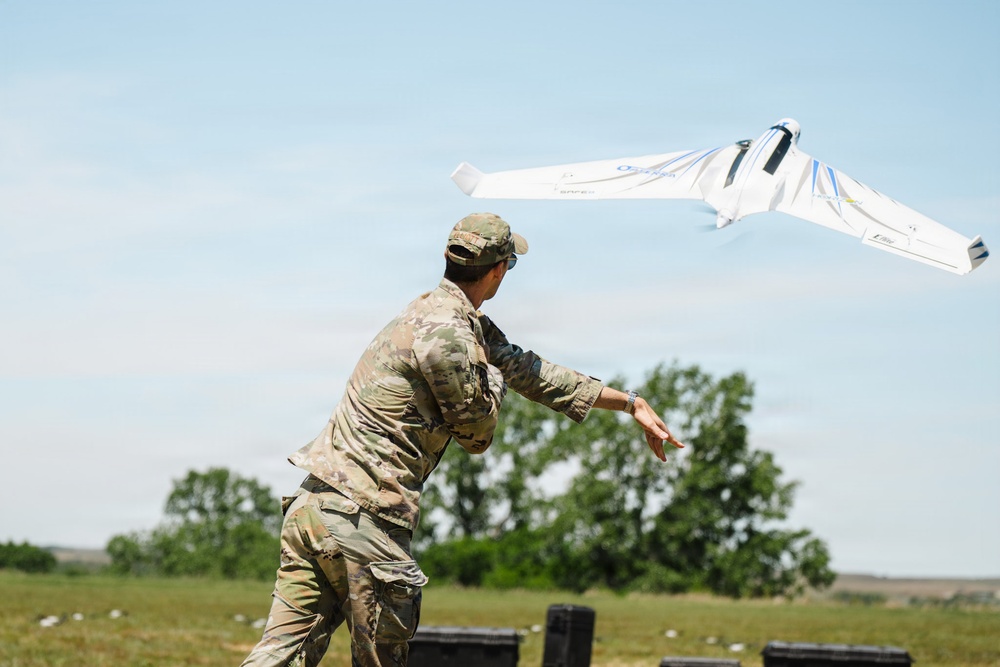
The British Army has spent eight weeks flying a swarm of eight drones under collective control, and the organisation that delivered the work says the technology behind it is not limited to aircraft. On 16 September 2026 the Defence Science and Technology Laboratory (Dstl) announced that Phase 1 of its Software Defined Swarms Concept Demonstrator had delivered what it describes as the UK's first high technology readiness, collective control swarming drone demonstrations, according to the Dstl release on gov.uk.
The interesting part is less the headline than the structure. Dstl describes testing two industry-led options, and the output the release names is a test bed the Army can keep using. The release announces no supplier selection.
What was actually tested
Phase 1 was delivered by Dstl with Army HQ and industry, and it builds on joint AUKUS Pillar 2 activity, per the release. Two industry-led options were put through their paces in what the announcement calls realistic operational environments:
- BlueBear, a Saab company.
- The Disruptor Group, a consortium of UK companies led by Applied Intuition.
The output of the work is the Swarm Capability Test Bed (CTB), which consists of eight uncrewed aerial vehicles. Dstl says the CTB is now in the hands of British Army operators and is a focus for live flying by the Army's Experimentation and Trials Group (ETG). The Army has already completed eight weeks of experimentation with it. Janes, which covered the release the next day, phrases the duration as at least eight weeks and notes that a Dstl video shows at least seven UAVs being controlled during the trials.
Further experiments, trials and field tests are planned for 2026-2027.
What we do not know
Dstl published no comparison of the two options. Janes says explicitly that no further details on the outcome of the demonstrations were provided in the release, and the Dstl text as reviewed contains no performance figures, range, endurance, payload, or failure data for either system. The release does not say which option, if either, the test bed leans on more heavily, and nothing in the sources we reviewed indicates a decision on which to carry forward.
The one number that does exist on the vendor side comes second-hand. Janes identifies BlueBear as Saab's Autonomy Accelerator and reports that, according to Saab, its SwarmCommand platform enables 21 systems to be flown simultaneously. That is a vendor claim about the product, not a result from the British Army trials, where the test bed comprises eight aircraft. The gap between 21 and eight is worth keeping in view: the eight-aircraft test bed should not be read as showing the product's ceiling.
Nothing comparable was reported for the Applied Intuition-led consortium.
The army's stated goal
Brig. Kieran Sheldon, Head Military Capability Plans at Army HQ, is quoted in the Dstl release saying the Army has conducted extensive in-field trials "since May". The Army's aim, he says, is to increase fighting power through "lower cost attritable and consumable systems that provide coordinated effect".
That framing matters. Coordinated effect from cheap, expendable aircraft depends on software that lets one operator or a small crew direct many vehicles without flying each by hand. In our reading, that software layer, rather than any single airframe, is what the Software Defined Swarms name points at. The Drone Front, reporting on 18 September, restates the Dstl account, including Dstl's line that flexibility and speed of adaptation are crucial as lessons from Ukraine have shown. The Drone Front adds no new figures.
Beyond drones
Dstl says the technology could also apply to uncrewed ground vehicles (UGVs) and uncrewed surface vessels (USVs), and that open architectures are being used to keep it flexible. The Drone Front likewise reports that the same collective-control technology could direct ground vehicles and surface vessels.
Dstl also places the work on a long research line: it says the project combined more than a decade of its own AI, autonomy and swarming research. Dstl is part of the National Armaments Directorate of the Ministry of Defence.
Why It Matters
Read plainly, the announcement describes a procurement-adjacent learning exercise, not a fielded swarm capability; the release itself says the experiments will help shape future military capability and procurement decisions. The UK is assembling an open-architecture test bed, putting it in the hands of soldiers, and flying it repeatedly, with no supplier decision announced. That reading is an analysis on our part, not a statement from Dstl, but it fits the facts: eight aircraft, eight weeks of Army experimentation, and more trials scheduled for 2026-27.
The open-architecture point is the durable one. If the control software is meant to run across air, land and surface vehicles, and is meant to stay flexible, the value lies in being able to change what sits underneath it. Testing two competing suppliers on one programme also gives the Army something a single-vendor pilot cannot: a basis for comparison, even though that comparison has not been made public.
The caveats are real. Dstl's claim of "high technology readiness" is its own characterisation. No independent performance data has been released, the trial environments are described only as realistic, and the release does not disclose what the operators found. Until the 2026-27 trials produce published findings, the question of which approach performs better, and at what scale, stays open.
Sources
- Dstl drone swarm accelerates Army autonomy ambition (Defence Science and Technology Laboratory, gov.uk, 16 Sept 2026)
- British Army experiments with UAV swarming, deploys base C-UAV system (Janes, 17 Sept 2026)
- British Army Puts Rival Drone Swarm Systems to the Test (The Drone Front, 18 Sept 2026)
