
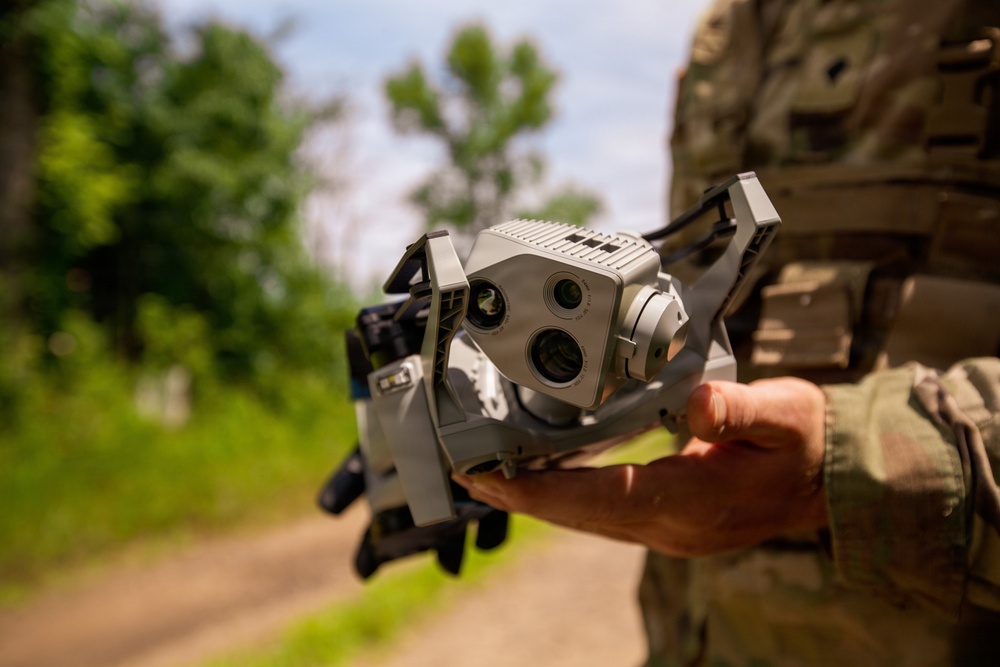
When the Army cancelled its Future Attack Reconnaissance Aircraft program in early 2024, it walked away from a clean-sheet scout helicopter—but not from everything the effort produced. According to a late-June release from the Army's armaments enterprise, one of FARA's surviving artifacts is a fire-control system called "Gunslinger," and engineers have now repurposed it for a job its designers never had in mind: killing small drones from a moving ground vehicle.
The work comes out of the DEVCOM Armaments Center at Picatinny Arsenal, New Jersey, where the Science & Technology Integration Office ran a software effort to take Gunslinger's aviation-grade targeting logic and point it at the ground force's most stubborn new problem—the cheap, fast, hard-to-hit small unmanned aircraft system. The reworked system was tested in April 2026 at Aberdeen Proving Ground, Maryland, where it was integrated onto a common Remote Operated Weapon Station and demonstrated engaging and defeating small UAS while the platform was shooting on the move.
What Gunslinger actually is
Strip away the branding and Gunslinger is fire control—the software and sensor-fusion brain that tells a weapon where to point, when to shoot, and how to lead a target so rounds and target arrive at the same place at the same time. It was originally developed under the FARA program, meaning it was conceived to solve an air-vehicle's targeting math: a moving aircraft engaging targets, with all the stabilization and lead-angle computation that implies.
That heritage is exactly why the reuse makes sense. The hard part of shooting down a small drone with a gun is not the gun. It is computing a firing solution against a small, maneuvering, low-radar-cross-section object—and doing it while your own weapon platform is itself moving. A helicopter fire-control system already lives in that world of moving-shooter, moving-target geometry. Pointing it down instead of out is, conceptually, less of a leap than building a counter-UAS fire-control stack from scratch.
Why "on the move" is the whole point
Plenty of counter-drone systems can defeat a small UAS from a fixed position. The harder and more operationally relevant trick is doing it while the vehicle is rolling. A convoy, a maneuvering unit, or a vehicle trying not to be a stationary target cannot stop and set up a static air-defense engagement every time a quadcopter or fixed-wing drone shows up overhead. The threat that has dominated recent conflicts is precisely the small, inexpensive drone that arrives without warning while everyone is moving.
By integrating Gunslinger onto a common Remote Operated Weapon Station—the kind of turreted, gun-equipped mount already fielded across a wide range of Army vehicles—the Armaments Center is targeting that gap directly. According to the release, the system pulls in real-time data from various vehicle sensor feeds so the weapon stays accurately aimed at the target drone while the vehicle is in motion. The April demonstration's headline claim is the combination: engage and defeat a small drone, from a ROWS, while shooting on the move. That is the capability the Army has been trying to push from the lab to the motor pool.
The cost angle: reuse over reinvention
The quietly significant part of this story is not the demo footage but the bill of materials. Counter-UAS programs have a habit of becoming expensive, bespoke systems with their own sensors, their own software, and their own logistics tail. The Gunslinger approach inverts that. The fire-control intellectual property already existed, paid for under a different program. The Remote Operated Weapon Station already exists and is common across the fleet. The effort at Picatinny was, by the release's own framing, a software effort—adapting existing fire control for ground-to-air use rather than designing a new weapon. The release describes it as a modular open system approach, so the software and any future enhancements can be shared across the Army.
That is a cheaper, faster path to a fielded capability than starting clean, and it is a recurring theme in how the Army is trying to address the drone threat at scale: bolt a smarter brain onto guns the force already drives around, rather than buy an entirely new air-defense system for every vehicle.
How it came together
The project officer named in the release is Nick Cascia, and the effort is described as mission-driven—begun as a response to the emerging small-UAS threat at the direction of leadership, rather than as a long-running formal program of record. That framing matters. It signals an organization reaching into its own shelf of existing technology to answer an urgent operational need quickly, using the Science & Technology Integration Office as the vehicle to stitch a FARA-era capability onto a current weapon station.
The choice of Aberdeen Proving Ground for the April 2026 test is consistent with that. Aberdeen is where the Army puts weapons and vehicles through instrumented, controlled evaluation—the venue for demonstrating that a software-integrated fire-control solution can actually put effective fire on a small aerial target under realistic conditions.
What the release does not tell us
The available material is a government announcement and its mirrors, and it is light on the specifics that engineers and program watchers will want. It does not detail what caliber or weapon the ROWS was armed with, which specific vehicle sensors feed Gunslinger's targeting solution beyond the general "vehicle sensor feeds" it cites, the size or speed envelope of the drones it defeated, the engagement ranges, or how many trials were run. Nor does it lay out a fielding timeline, a transition path to a program of record, or which vehicles might receive the capability first—though the team has signaled that follow-on testing will increase the speed of both the vehicle and the drone. Those are the questions that separate a successful demonstration from a deployed system, and they remain open.
What is documented and consistent across the primary release and its independent mirrors is the core claim set: a Picatinny software effort adapted FARA's Gunslinger fire control for ground-to-air use, integrated it onto a common Remote Operated Weapon Station, and demonstrated engaging and defeating small UAS while shooting on the move, in an April 2026 test at Aberdeen.
Why It Matters
Counter-UAS has become the defining force-protection problem of the current era, and the most valuable solutions are the ones that scale across thousands of vehicles without a thousand-vehicle price tag. Repurposing fire-control software from a cancelled helicopter program and grafting it onto weapon stations the Army already fields is a template for exactly that kind of cheap, fast scaling—turning sunk-cost aviation IP into a ground capability and giving maneuvering units a way to swat small drones without stopping to do it. If the April demonstration translates into a fielded system, it would partly close the on-the-move sUAS gap using hardware that is already in the motor pool. The caveat is that a controlled demonstration at Aberdeen is the beginning of that story, not the end: the move from a working test to a robust, deployed capability across the fleet is where these efforts usually face their hardest engineering and budget questions, and the release does not yet answer them.
