
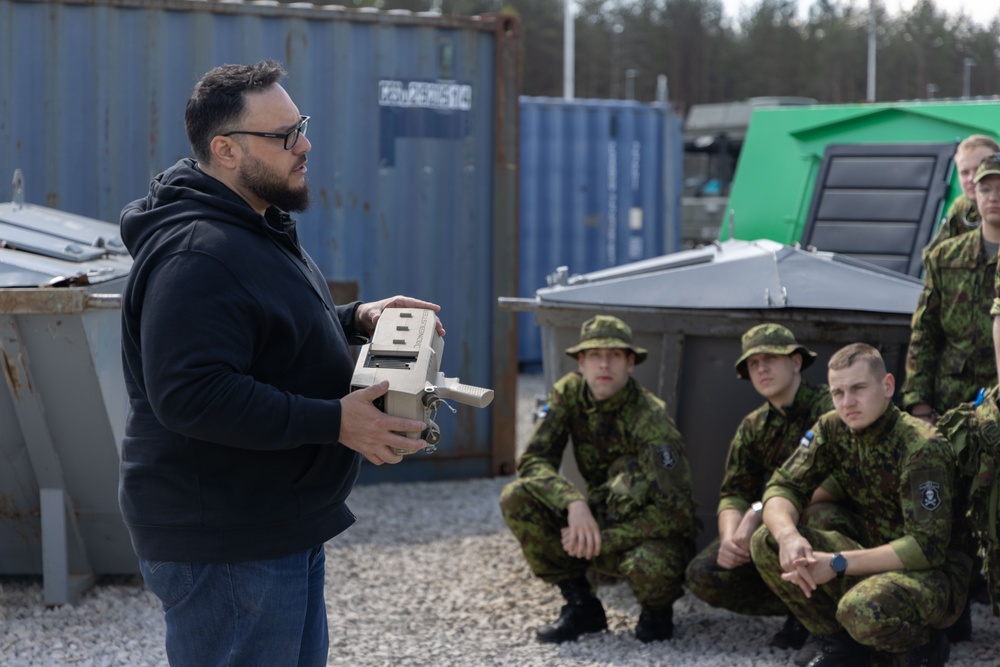
The Army has put nearly $100 million behind a shoebox-sized piece of electronic-warfare hardware designed to sniff out hostile drones before they get close enough to matter. On August 28, 2026, Army Contracting Command at Aberdeen Proving Ground, Maryland, awarded Research Innovations Inc. (RII) of Alexandria, Virginia, a firm-fixed-price indefinite-delivery/indefinite-quantity (IDIQ) contract worth $99,529,577 to procure, deliver and sustain the company's Dragonfly payload system. The award was reported the same day by trade outlet Aerotech News in its contract-briefs roundup, which detailed the contract's terms and value.
The scale of the competition is notable on its own: Aerotech News' summary of the award notes the contract was solicited via the internet and drew 95 bids. That is an unusually deep field for a specialized counter-UAS electronic-warfare payload, suggesting either a broad pool of vendors chasing the counter-drone budget line or a low bar to entry that RII's proposal cleared decisively. The contract runs on an estimated performance window stretching to August 31, 2031 — a five-year horizon that points toward sustained production and support rather than a one-off buy.
What Dragonfly Actually Is
According to RII's own product description, Dragonfly is built around a compact but serious compute stack: an Intel Xeon W processor paired with an Nvidia RTX-A4500 GPU and roughly 7 terabytes of onboard storage, all packed into a unit that weighs 3.5 pounds. RII calls it a "Spectrum Cognition node" — a term that signals the system's core function is not jamming or kinetic defeat, but sensing and understanding the radio-frequency environment around it.
In practice, that means Dragonfly listens for the RF emissions that small unmanned aircraft give off — whether that's a command-and-control uplink, a video downlink, or a GPS-adjacent signal — and runs that signal through onboard classification and direction-finding processing. RII states the system can geolocate an RF-emitting target in under five seconds, and it does all of that processing locally, on the GPU, without needing a connection back to a cloud server or a rear-echelon data center. For a system meant to operate at the edge of contested electromagnetic environments — where connectivity to any backhaul network is exactly the thing an adversary will try to deny — that no-cloud-reachback design is arguably the more important spec than the five-second detection number.
Built to Ride on Almost Anything
The "man-portable" framing undersells how flexible the mounting options are. RII lists Dragonfly as deployable in a genuinely dismounted, carried configuration, but also as a payload for ground and maritime vehicles, tethered or free-flying unmanned aircraft, and unattended autonomous platforms. That modularity is a deliberate hedge: a sensor package this size can ride along on whatever platform a unit already has in its formation — a small UAS doing overwatch, an unmanned ground vehicle on a patrol route, a vehicle-mounted mast — rather than requiring a dedicated carrier. For force-protection missions, where counter-drone coverage needs to extend across a perimeter or a convoy route rather than sit at a single fixed point, that platform-agnostic design is the practical selling point.
Reading the Contract Structure
The IDIQ vehicle and firm-fixed-price terms are both telling in their own right. An IDIQ contract doesn't commit the Army to buying a fixed quantity up front; it establishes a ceiling and a mechanism for issuing task or delivery orders against it as units identify a need, which is standard practice for equipment the service expects to field incrementally across multiple commands rather than in a single mass buy. Firm-fixed-price terms shift cost risk onto RII rather than the government, indicating the Army considers Dragonfly's per-unit cost and production process mature enough to price with confidence rather than something still being engineered on the fly.
The five-year performance window to 2031, combined with "sustainment" explicitly named in the contract description, indicates this isn't just a hardware buy — it includes ongoing support, and likely software or signal-library updates, for a system the Army expects to remain relevant against an evolving threat set for years rather than months.
Why It Matters
Small, cheap, off-the-shelf drones have become one of the most persistent threats facing deployed forces, and the tactical problem they pose is fundamentally a detection problem before it is anything else: you cannot defeat what you cannot find, and by the time a small quadcopter is visible or audible it may already be in position to do damage. RF-based detection like Dragonfly's is attractive precisely because a drone's control and video links are often detectable well before the aircraft itself is seen or heard, and doing that detection locally — without cloud reachback — matters enormously in an electromagnetic environment where an adversary is actively trying to jam or deny network connectivity.
The 95-bid field also says something about the state of the counter-UAS industrial base: this is no longer a niche corner of defense electronics but a crowded, competitive market that the Army is actively shopping in, with real dollars now flowing to a proven platform rather than remaining in a demonstration phase. A $99.5 million IDIQ with a five-year sustainment tail suggests the Army sees this class of dismounted, platform-agnostic RF-hunting payload as a standing requirement across formations — not a one-time pilot buy — and that other vendors chasing the same budget line should expect the bar for winning future rounds to be set by what Dragonfly delivers in the field.